


Controversial playwright Martin McDonagh is used to creating headlines in Britain and Ireland with his dark tales laced with black humor and flowing with stage blood.
So his attempt to crack the American market with his first play set in the US has caused an understandable stir on Broadway, where Christopher Walken has been persuaded to play the lead role. But trying out an American setting as opposed to an Irish one is proving a challenging exercise.
The play, A Behanding in Spokane, has a typically bleak and violent McDonagh premise: An aging killer, played by Walken, is looking for a severed hand that he lost many years ago, then he meets a couple of con artists in a dingy hotel room who tell him they have the precious appendage.
Some reviewers have judged that McDonagh — whose other plays include The Lieutenant of Inishmore and The Pillowman and who also directed and wrote the hit film In Bruges, starring Colin Farrell — fails to understand the American psyche as well as he does that of his fellow Irishmen. “He seems to have lost his hitherto unerring sense of direction in the busy, open country of the United States,” wrote Ben Brantley in the New York Times. USA Today called it: “... hardly McDonagh’s most fully realized effort.”
Then there was the New Yorker. In an extraordinary and withering review, the magazine’s theater critic, Hilton Als, laid into the play for being overtly racist. “I don’t know a single self-respecting black actor who wouldn’t feel shame and fury while sitting through Martin McDonagh’s new play,” began Als’ review, which is probably one of the most negative pieces of theater criticism produced by the magazine in recent years.
Als, who is black, took umbrage at the play’s use of racist insults by Walken’s character, who is openly and proudly prejudiced. “A Behanding ... isn’t in the least palatable; it’s vile, particularly in its repeated use of the word ‘nigger,’” Als wrote. He then went on to compare the play’s lone black role, Toby — played by Anthony Mackie, the star of The Hurt Locker, to the racist caricatures of black Americans that populated American cinema in the 1920s and 1930s. “The caricature he [McDonagh] presents in Toby, the young black male, as a shucking, jiving thief can’t be excused,” he wrote, before lamenting that he believed that Mackie and other black actors have to take such roles in order to get higher-profile work. “The sad fact is that, in order to cross over, most black actors of Mackie’s generation must act black before they’re allowed to act human,” Als wrote.
Als appears to be the only major critic who reacted to the play’s racial themes so viscerally. Few other reviews paid its use of racist language much attention, instead focusing on Walken’s performance, which has been widely praised amid early whispers of Tony awards. But Als’ remarks certainly hit home with the play’s British producer, Robert Fox. “It was absolutely vindictive. Although Hilton Als’ comments are meaningless in the scheme of things, because the show is doing very well, I think his remarks were entirely inappropriate and irresponsible,” Fox told the Observer.
Fox said he thought Als’ criticism was in itself an injection of racism where none was merited. “It was racist in that it was racially intolerant to write those things. He doesn’t identify himself [in the review] as a black writer. I think it is extraordinary. I know people who have written to the New Yorker about it already. It is completely out of order,” Fox said.
Als did not reply to e-mails or an interview request from the Observer. Nor did the theater or Mackie have an official reaction. “We have no comment, nor does Anthony Mackie,” said a spokeswoman for the production.
Some Broadway experts, however, agreed that, while the work does contain racially provocative material, it is unlikely to cause widespread offense, especially with audiences there to see Walken. “I can understand why an African American may approach the play with a little reticence, but I don’t think that is McDonagh’s intent,” said Dan Bacalzo, managing editor of Theatermania, a top New York theater Web site.
Bacalzo defended McDonagh’s right to put racist language in the mouths of one of his characters as he tries to take on American themes. “For Americans race is more important than class, so the material is appropriate for him to tackle when dealing with America,” he added.



And so, in the wake of US President Donald Trump’s trip to the People’s Republic of China (PRC), all the experts on the Strait of Hormuz suddenly became experts on US-China-Taiwan relations. The Internet has certainly expanded human knowledge. Lots of these sudden experts made noise this week about Trump’s words after the meeting with PRC dictator Xi Jin-ping (習近平). Trump is going to sell out Taiwan! Longtime Taiwan commentator J. Michael Cole summed the situation up neatly in the Guardian: “We need to keep in mind that he has a tendency to say many things — sometimes contradicting himself within

Last week US President Donald Trump was asked by a reporter whether he would speak on the phone to the President of Taiwan. “l’ll speak to him. I speak to everybody. We have that situation very well in hand,” Trump said. This marked the second time in a couple of weeks he had said he would talk to the President of Taiwan. In 2016 he famously took a call from then-president Tsai Ing-wen (蔡英文), when he was president-elect. Despite warnings that the apocalypse was nigh because of a phone call, the world quickly forgot about the conversation between two democratically-elected presidents.
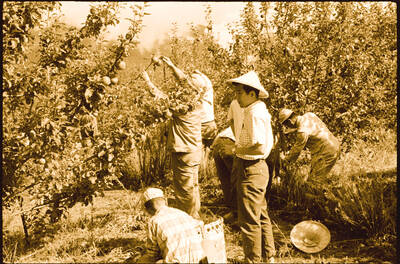
May 25 to May 31 Few believed that apples could be cultivated on a commercial scale in Taiwan’s high mountains. When horticulturalist Cheng Chao-hsiung (程兆熊) first proposed the idea in 1955, both American and Taiwanese colleagues dismissed it as implausible, arguing that temperate fruit could not be reliably grown on a subtropical island, especially on rugged terrain. However, it was this terrain in the Central Mountain Range where many Chinese Civil War veterans were resettled in the late 1950s. With limited job prospects and no family in Taiwan, they were placed on cooperative farms aimed toward self-sufficiency. Some say the conditions

There is considerable frustration and confusion among many, both in Taiwan and abroad — including in Washington — as to why the Chinese Nationalist Party (KMT) seems so dead set on using their legislative leverage to slash defense spending and disrupt the ability of the ruling Democratic Progressive Party (DPP) administration to function. Are they pawns of the Chinese Communist Party (CCP)? Are they traitors? In reality, there are multiple reasons. In the first column in this series on this subject, “Donovan’s Deep Dives: How and why the TPP and KMT help Beijing” (Sat May 16, page 12), we examined three


 RSS
RSS