


For a band that dresses in black leather, wears ghoulish white face paint and sings about the multiple depths of hell, Chthonic (閃靈) wields an impressive amount of star power, both on and off stage.
The five-person ensemble, whose members call their music “extreme metal,” is the country’s best-known rock export and an indie success story.
In 2000, Chthonic (pronounced “thonic”) was the first Taiwanese band ever to be invited to perform at Japan’s Fuji Rock Festival. The band soon gained a cult following after signing with a US label and playing at metal festivals in Japan, North America and Europe. In 2007, the group landed an opening slot on British metal legend Ozzy Osbourne’s Ozzfest tour, taking in 24 major American cities.
Today Chthonic is signed with Spinefarm, part of Universal Records, and has just completed a 30-date tour of North America and Europe in support of its latest album, Mirror of Retribution, released in mid-2009 and produced by Anthrax guitarist Rob Caggiano.
And the hype is only getting bigger, at least in metal circles. Last year, Chthonic beat venerated heroes such as Megadeth and Slayer in British magazine Terrorizer’s readers’ poll for best band, taking second place.
So, what next?
“Now we are in the fashion business,” joked front man and singer Freddy Lim (林昶佐) in an interview last week with the Taipei Times.
It certainly looks that way for bassist and band spokeswoman Doris Yeh (葉湘怡), who has been enjoying the spotlight as a rock starlet. She was featured as one of the “hottest chicks in metal” in the US bi-monthly Revolver and is in the magazine’s 2010 calendar. Homegrown publications have also caught Doris-fever. Yeh graced the cover of men’s magazine FHM in 2008 and she features in a five-page spread in this month’s edition of GQ Taiwan.
While Yeh may be stoking metalhead yearnings, darker fantasies are to be found on Chthonic’s latest CD, which contains a barrage of machine-gun drumbeats, distorted guitar riffs, and vocals that range from guttural to screeching.
Mirror is Chthonic’s most refined work to date, released in two versions, one in Hoklo (commonly known as Taiwanese) and the other in English.
“We wanted to write an album that tried to include the whole philosophy of hell, of Oriental hell,” said Lim, who drew on Taoist mythology to write the lyrics, which include images like “a mountain of knives” and phantoms with their tongues ripped out.
Modern Taiwanese history plays a major role in Lim’s story. The liner notes to Mirror of Retribution tell an elaborate backstory that takes place at the time of the 228 Incident, when Chinese Nationalist Party (KMT) troops massacred hundreds of civilians.
The album’s hero, Tsing-guan, is a mystic who sets out to help his friends in the 27th Brigade, a volunteer youth militia that fought against KMT troops who marched into Taichung in the weeks after the 228 Incident.
To help the militia, Tsing-guan uses his supernatural powers to enter the spirit world to steal the “Book of Life and Death,” which holds the key to controlling life in the mortal world and has the power to reverse the course of history.
The songs depict Tsing-guan’s journey through the multiple levels of hell (there are 18 main levels and 10 courts of hell, according to Lim), where he engages in epic battles and gory encounters with ghosts, beasts and other wicked creatures.
But Tsing-guan fails to retrieve the book and save his friends. In the final song, he is banished to the edge of hell, where he is shackled to the Mirror of Retribution and forced to serve a “timeless sentence” of watching his comrades butchered by “the tyrannical regime”; he watches as his “motherland,” and eventually the universe, disappear.
“We like tragedies,” said Lim, who used the 228 Incident as the backdrop because “the history makes the story seem very real.”
Finding inspiration in Taiwanese lore is nothing new for Chthonic, whose past albums contain stories about crossing the Taiwan Strait and battles between Aboriginal and Han Chinese spirits.
Lim’s creation of a heavy metal mythology takes its cue from the Scandinavian black metal bands he admires. “I need something local [so] I can feel the same kind of anger and sadness like the Scandinavians,” he said.
Lim is the owner and founder of The Wall (這牆), Taipei’s biggest indie rock venue. But he is perhaps most visible for his vocal support of Taiwanese independence and criticism of China’s human rights record.
In 2003, he organized the first Tibetan freedom concert in Taipei, which was headlined by the Beastie Boys. In 2008, he started a civic group, Guts United, to rally the youth vote for the Demo- cratic Progressive Party’s presidential campaign.
Such activities might be a turn-off for some music fans, but Lim and Yeh are unapologetic. “As citizens, we have to care about politics very much, especially in a situation like Taiwan, where we are trapped in a very complicated international-political [position]. “
“Because you don’t care about politics, you think we care too much,” said Yeh of those who criticize Chthonic’s stance. “But as a human, as a citizen, to care about politics is very natural.”
Does Lim hope fans will adopt his views? “No, I don’t,” he said. “Music is music. I try to write songs and compose an album in a musical way.”
Still, Chthonic has been known to walk a fine line between music and politics. The band’s 2007 US tour received funding from the Government Information Office and was entitled “Taiwan UNlimited” in reference to the nation’s exclusion from the UN; Lim also penned the song Unlimited Taiwan, which includes the rallying line: “Limited freedom, limited right, unlimited island, unlimited fight.”
Unsurprisingly, Chthonic hasn’t been able to get permission to play in China. Yeh says she couldn’t care less, as she’d rather see the band tour the US and Europe and visit new places, such as South America.
Lim, who “loves” visiting China and had been there seven times before he was blacklisted after organizing the first Tibetan freedom concert in 2003, says one of his favorite pastimes is to watch “our Chinese fans fight with each other” on Internet forums.
He says there are three types of Chinese fans: those that like the music but hate the band’s political views; those that like the music
but don’t care about the politics; and those that support an independent Taiwan.
“So I would love to play for [all of] them,” he said. “I would love to play wherever our fans are.”

Taiwan’s English education system is being pulled apart by three opposing forces. Bilingual Nation 2030 pulls students toward English and global communication. Artificial Intelligence (AI) readiness pulls them toward digital judgment, verification and AI-mediated work. But Taiwan’s old exam culture pulls them back toward memorization, grammar drills, timed reading and correct answers. If the education system keeps using old exams to define success, it risks producing graduates who are neither genuinely bilingual nor genuinely AI-ready, but trained for tasks machines can already perform. The first force is Bilingual Nation 2030. Launched in 2018, the policy aimed to “help Taiwan’s workforce connect

It seems every few days one bumps into one of those “real man” comments in which Taiwan is urged to “face reality” or similar, and “make a deal,” with the speaker implying that soon it will be too late. “Deal” advocates always present themselves as having a superior grip on reality, and the manly ability to make the “hard choice.” Their testosterone-laden language often echoes that of Taiwan sellout advocates. Note that such commentary always specifies a process (“make a deal, work with, make progress”), never the end state of what occupation by a violent authoritarian colonialist state will entail. In

There are shadowy cabals plotting to sell out Taiwan to be annexed by China, by invasion if necessary. Fortunately, they are buffoons. In 2019, former Bamboo Union gangster and founder of the China Unification Promotion Party (CUPP), Chang An-le (張安樂, colorfully known as “White Wolf”), led a protest at the Legislative Yuan against comments made by then-premier Su Tseng-chang (蘇貞昌) that in the event of an attack by China, he would never surrender, but would protect the nation by fighting to the end, even if he only had a broom. Chang had party members bring a wooden casket that they
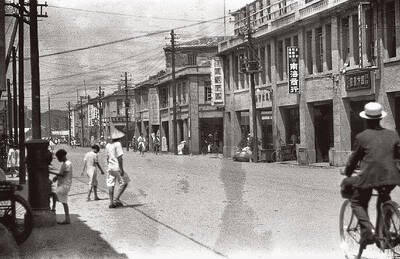
June 1 to June 7 "If all Taiwanese were as afraid of dying as you, then what would happen?” Physician Shih Chiang-nan (施江南) reportedly said this to his wife Chen Chiao-tung (陳焦桐) after she urged him to stop intervening on behalf of Taiwanese soldiers stranded overseas after serving in the Japanese Army during World War II. Shih had clashed with high-ranking officials over the issue, engaged in several heated arguments with Taiwan governor-general Chen Yi (陳儀) and allegedly shouted at general Ko Yuan-fen (柯遠芬), chief of staff of the Taiwan Garrison Command, over


 RSS
RSS