


A young musician from a well-to-do family studying at a private school hardly makes for a fascinating documentary, unless the subject is Wong Ka-jeng (黃家正), the music prodigy and tormented protagonist in KJ: Music and Life (音樂人生), a Hong Kong production that won top honors in three categories including Best Documentary, Best Editing and Best Sound Effects at this year’s Golden Horse Awards (金馬獎).
KJ is the stuff of genius. At the tender age of 11, he is playing in a professional orchestra in the Czech Republic. Six years later, he is conducting his own orchestra at a prestigious private school.
KJ is also a complex 17 year-old. He behaves arrogantly in front of friends, peers and family members, and cares little about competitions and awards. But he is also a sensitive soul, one who longs for recognition from the people he cares about and broods over existential questions.
With KJ’s compelling personality and the sense of closeness he shares with director Cheung King-wai (張經緯) in front to the camera, one immediately feels absorbed into his life story. We learn to understand KJ’s musical talent from multiple angles as Cheung aims to show KJ’s relationships with his mentor, his friends, his siblings and his father. The extensive interviews shot at two different periods of KJ’s career (ages 11 and 17) are deployed in an effective and coherent manner, as the film goes back and forth between the two time frames to paint an affecting portrait of a young, tormented mind.
Though KJ’s philosophical questioning about life and music may sound like the empty blather of your average melancholy adolescent, the sense of urgency and the candor in his voice will remind viewers of their own forgotten youthful passions.
With KJ’s mother curiously missing from the documentary, the father-son relationship is featured predominantly as a key factor in the young man’s music career. One of the most powerful moments of the film occurs when KJ explains the breakdown of his relationship with his father, which is intercut with a scene where the then-11-year-old boy weeps as his doctor father affectionately pats his head.
Ultimately, KJ: Music and Life paints a tragic figure whose far-too-early success and talent make him a vulnerable and sad outcast who desperately seeks what he cannot find in those close to him.
The film will screen at Vie Show Cinema, Xinyi District (信義威秀影城) in Taipei for a limited period of two weeks with only one screening per day. For show times, go to tw.myblog.yahoo.com/kjmusiclife.

Taiwan’s English education system is being pulled apart by three opposing forces. Bilingual Nation 2030 pulls students toward English and global communication. Artificial Intelligence (AI) readiness pulls them toward digital judgment, verification and AI-mediated work. But Taiwan’s old exam culture pulls them back toward memorization, grammar drills, timed reading and correct answers. If the education system keeps using old exams to define success, it risks producing graduates who are neither genuinely bilingual nor genuinely AI-ready, but trained for tasks machines can already perform. The first force is Bilingual Nation 2030. Launched in 2018, the policy aimed to “help Taiwan’s workforce connect
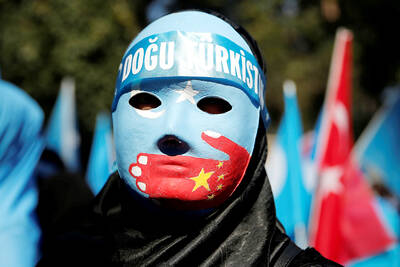
It seems every few days one bumps into one of those “real man” comments in which Taiwan is urged to “face reality” or similar, and “make a deal,” with the speaker implying that soon it will be too late. “Deal” advocates always present themselves as having a superior grip on reality, and the manly ability to make the “hard choice.” Their testosterone-laden language often echoes that of Taiwan sellout advocates. Note that such commentary always specifies a process (“make a deal, work with, make progress”), never the end state of what occupation by a violent authoritarian colonialist state will entail. In

There are shadowy cabals plotting to sell out Taiwan to be annexed by China, by invasion if necessary. Fortunately, they are buffoons. In 2019, former Bamboo Union gangster and founder of the China Unification Promotion Party (CUPP), Chang An-le (張安樂, colorfully known as “White Wolf”), led a protest at the Legislative Yuan against comments made by then-premier Su Tseng-chang (蘇貞昌) that in the event of an attack by China, he would never surrender, but would protect the nation by fighting to the end, even if he only had a broom. Chang had party members bring a wooden casket that they
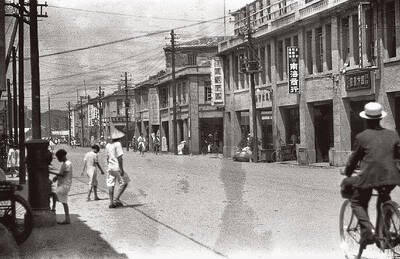
June 1 to June 7 "If all Taiwanese were as afraid of dying as you, then what would happen?” Physician Shih Chiang-nan (施江南) reportedly said this to his wife Chen Chiao-tung (陳焦桐) after she urged him to stop intervening on behalf of Taiwanese soldiers stranded overseas after serving in the Japanese Army during World War II. Shih had clashed with high-ranking officials over the issue, engaged in several heated arguments with Taiwan governor-general Chen Yi (陳儀) and allegedly shouted at general Ko Yuan-fen (柯遠芬), chief of staff of the Taiwan Garrison Command, over


 RSS
RSS