


Following hard on the heels of the Beijing opera version of The Wilderness (原野) by Taipei Li-Yuan Peking Opera Theater (台北新劇團) at Novel Hall (新舞臺) earlier this month, another version of the same work is being staged at the same venue, this time as a dramatic production by Tianjin Renmin Yishu Juyuan (天津人民藝術劇院).
The Wilderness is widely regarded as Cao Yu’s (曹禺) most complex and controversial work. Written in the late 1930s, no definitive version of the play was produced, the final stages of writing interrupted by Japan’s invasion of China in 1937. This has allowed directors considerable leeway to find their own interpretations, and the play has been adapted many times in many different mediums.
The adaptation by the Tianjin Renmin Yishu Juyuan, which premiered in 2006, has toured China with great success. Cao, as “China’s greatest modern playwright,” is sometimes acclaimed as Asia’s Shakespeare, and his works are given the same kind of canonical adulation. While the Tianjin production claims to be utterly faithful to the spirit of the original, the producers have taken a hatchet to the original play, cutting the text down from 80,000 words to just 30,000 and incorporating modern elements such as huge puppets that serve as a Greek chorus to the action, as well as occasionally doubling as elements within the set. A cellist performs sections from Mozart’s Requiem throughout.
In The Wilderness, Cao was moving away from the social realism that had dominated his earlier works such as Thunderstorm (雷雨) and Sunrise (日出), and he had begun to dabble in expressionism and symbolism. While this departure was not popular with audiences in early productions of the work, the dilution of the rather tub-thumping socialist polemic with a deeper exploration of human nature makes The Wilderness probably Cao’s most accessible work for modern audiences.
The Novel Hall does not often host foreign dramatic productions, but according to Vivien Ku (辜懷群), executive director of the Koo Foundation (辜公亮文教基金會), which operates the venue, the opportunity of juxtaposing two very different productions of the same work was too good to resist.
Cao’s works, with their roots in China’s socialist revolution, and with his own elevation to the position of literary doyen of the Communist establishment, were once banned in Taiwan. Now it is more a question of whether they have any relevance. In the case of The Wilderness, with its vast potential for re-interpretation, there is clearly much a director can do to bring a piece of China’s literary history into the 21st century.
The Tianjin Renmin Yishu Juyuan has condensed the involved melodrama of the original into something with a clearer focus. They have boiled it down and brought out the expressionist elements that Cao was still struggling to find in the 1930s. Given that drama is somewhat under-represented in the growing wave of cross-strait cultural exchanges, this is a valuable opportunity to see a first-class drama group dealing with the baggage of history.

Taiwan’s English education system is being pulled apart by three opposing forces. Bilingual Nation 2030 pulls students toward English and global communication. Artificial Intelligence (AI) readiness pulls them toward digital judgment, verification and AI-mediated work. But Taiwan’s old exam culture pulls them back toward memorization, grammar drills, timed reading and correct answers. If the education system keeps using old exams to define success, it risks producing graduates who are neither genuinely bilingual nor genuinely AI-ready, but trained for tasks machines can already perform. The first force is Bilingual Nation 2030. Launched in 2018, the policy aimed to “help Taiwan’s workforce connect
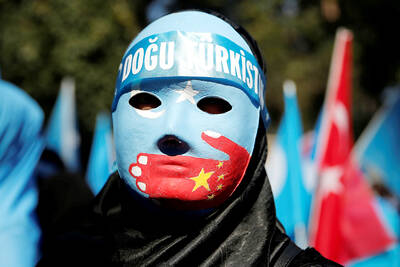
It seems every few days one bumps into one of those “real man” comments in which Taiwan is urged to “face reality” or similar, and “make a deal,” with the speaker implying that soon it will be too late. “Deal” advocates always present themselves as having a superior grip on reality, and the manly ability to make the “hard choice.” Their testosterone-laden language often echoes that of Taiwan sellout advocates. Note that such commentary always specifies a process (“make a deal, work with, make progress”), never the end state of what occupation by a violent authoritarian colonialist state will entail. In
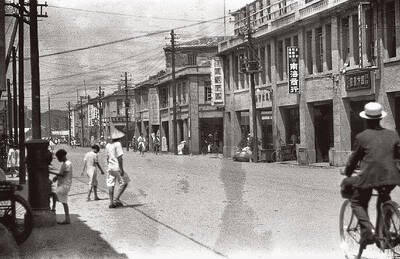
June 1 to June 7 "If all Taiwanese were as afraid of dying as you, then what would happen?” Physician Shih Chiang-nan (施江南) reportedly said this to his wife Chen Chiao-tung (陳焦桐) after she urged him to stop intervening on behalf of Taiwanese soldiers stranded overseas after serving in the Japanese Army during World War II. Shih had clashed with high-ranking officials over the issue, engaged in several heated arguments with Taiwan governor-general Chen Yi (陳儀) and allegedly shouted at general Ko Yuan-fen (柯遠芬), chief of staff of the Taiwan Garrison Command, over

“Taiwan’s Opposition Leader Comes to US With a Message Straight Out of Beijing” read a May 31 headline in the Wall Street Journal. Top US administration officials and members of Congress almost certainly read the WSJ, and if there was a bullet point takeaway that people in Washington should absorb ahead of Chinese Nationalist Party (KMT) Chair Cheng Li-wun’s (鄭麗文) arrival in DC on June 9, that headline is it. The last few columns have discussed this very topic, and the timing is not coincidental. While those top officials likely do not read the Taipei Times, judging by the number


 RSS
RSS