


As blue-eyed blondes increasingly hog the catwalks, discrimination is also at work in the weird and wonderful world of the fashion mannequin.
“Black mannequins don’t sell,” said Marc Lacroix, a manager at one of the world’s leading producers, Paris-based Cofrad which also owns Los Angeles firm Patina-V, a maker of ethnically diverse fashion mannequins.
“Black and Asian models have been doing fine for a long time in the US, and we have customers in Britain. But in France, Germany and Austria, forget it!” he said.
“The Anglo-Saxon world, it seems, is more open-minded than the old continent.”
Mannequins come in all shapes, colors and sizes but always come apart — just like jointed artists’ models made of a head, body, legs and arms.
“We only sell headless, limbless bodies to Saudi [Arabian] customers,” he said. “Couture clients too often like them headless as they want potential buyers to focus first on the clothes.”
“Asian customers,” Lacroix added, “which often represent big global labels, prefer European-looking mannequins as they have a more universal appeal.”
Mannequins, nowadays generally made in environmentally unfriendly fiberglass, are relatively new in historical terms — as are the top models they more than often mirror.
Initially a tool for a tailor or seamstress, dummies made of cane surfaced in the 18th century before being made of wire and later cardboard. But it was only in the 20th century that couture came up with the idea of using mannequins rather than live models to display clothes to wealthy women at private showings.
Their widespread use in shops and shop-windows followed in the 1950s and 1960s, when couture and ready-to-wear labels multiplied, and big-name top models such as Twiggy emerged.
“Mannequins are very important,” said Helene Lafourcade, who heads visual merchandising for French department store giant Galeries Lafayette. It uses 15,000 mannequins across its network, including 5,000 alone in its big central Paris stores near the Garnier Opera house.
“They’re not just objects you stand up in the store. They’re static salespeople,” said Lafourcade, who reckons mannequins multiply sales fourfold.
Mannequins are crafted by sculptors in a process every bit inspired by a catwalk show.
A manufacturer calls a modeling agency, organizes a casting session and commissions the male or female model chosen to pose for a photographer. The sculptor uses the pictures to make a cast.
With an average life-span of three to four years, mannequins can cost anywhere from US$220 to US$2,200 for the cream of the crop.
In the 1990s, said Franck Banchet, artistic manager for Paris department store Printemps, the trend was for hyper-realistic dummies.
“The Rolls Royces of the mannequins then were by Adel Rootstein in London, who used professional make-up artists and hairdressers to work on them.”
When minimalism became the design statement of the day, mannequins too became streamlined, “their faces just an oval shape with a line for a nose and a line for a mouth,” he said. “Top of the pops was a mannequin by Swiss firm Schlappi.”
Couture king Yves Saint-Laurent’s taste for such stylized faceless mannequins, often lacquered in white or black or gold, turned the tables on the trade.
“Most people nowadays use the cheaper stylized faceless mannequins,” said Banchet.
In Paris to launch his new collection of mannequins called Madame, New York’s Ralph Pucci said, “you have to create mannequins that are relevant to the times.”
“Mannequins are about change, about art, about sculpture,” said Pucci, who has worked with avant-garde artists such as Andree Putman, Ruben Toledo, Kenny Scharf and Stephen Sprouse.
“As for body shapes, every time we try different sizes, it fails. It’s not relevant. A mannequin has to have personality and has to sell the clothes.”

Yesterday, the Democratic Progressive Party (DPP) nominated legislator Puma Shen (沈伯洋) as their Taipei mayoral candidate, the Chinese Nationalist Party (KMT) put their stamp of approval on Wei Ping-cheng (魏平政) as their candidate for Changhua County commissioner and former legislator Tsai Pi-ru (蔡壁如) of the Taiwan People’s Party (TPP) has begun the process to also run in Changhua, though she has not yet been formally nominated. All three news items are bizarre. The DPP has struggled with settling on a Taipei nominee. The only candidate who declared interest was Enoch Wu (吳怡農), but the party seemed determined to nominate anyone
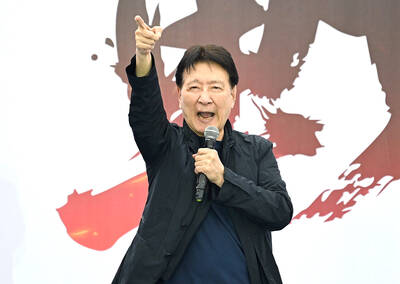
In a sudden move last week, opposition lawmakers of the Chinese Nationalist Party (KMT) and Taiwan People’s Party (TPP) passed a NT$780 billion special defense budget as a preemptive measure to stop either Chinese leader Xi Jinping (習近平) or US President Donald Trump from blocking US arms sales to Taiwan at their summit in Beijing, said KMT heavyweight Jaw Shaw-kong (趙少康), speaking to the Taipei Foreign Correspondents Club on Wednesday night in Taipei. The 76-year-old Jaw, a political talk show host who ran as the KMT’s vice presidential candidate in 2024, says that he personally brokered the deal to resolve
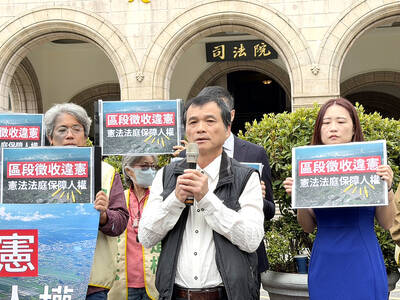
What government project has expropriated the most land in Taiwan? According to local media reports, it is the Taoyuan Aerotropolis, eating 2,500 hectares of land in its first phase, with more to come. Forty thousand people are expected to be displaced by the project. Naturally that enormous land grab is generating powerful pushback. Last week Chen Chien-ho (陳健和), a local resident of Jhuwei Borough (竹圍) in Taoyuan City’s Dayuan District (大園) filed a petition for constitutional review of the project after losing his case at the Taipei Administrative Court. The Administrative Court found in favor of nine other local landowners, but

The Chinese Nationalist Party (KMT) and its sock puppet, the Taiwan People’s Party (TPP), passed their version of the government’s proposed supplementary defense spending bill last week, engendering much commentary. While all eyes were on the defense budget, the PRC’s assault on Taiwan was advancing on other fronts. The removal of domestic drone production and other technologies critical to the nation’s asymmetrical defenses from the list of items purchased in the “compromise” bill shows how the KMT-TPP alliance appears to be serving the People’s Republic of China (PRC). Ironically, the cuts will impact industries heavily represented by tech firms in areas run


 RSS
RSS