


VIEW THIS PAGE The new owner of the London Evening Standard is a very unusual sort of billionaire, for he seems to care little for money. It might just be that I don’t know enough billionaires and that having that sort of money makes you very casual about it. But, still, Alexander Lebedev seems remarkably easy come, easy go about his fortune. His new possession is in a financially parlous state and in the middle of a crippling circulation war with News International’s the London Paper freesheet, not to mention the problems caused by its rival, the London Lite, launched by the Standard’s former owners the Daily Mail and General Trust, as a “defense mechanism.” Admittedly he bought the paper for the token sum of US$1.43, but he says he is willing to plough US$42 million into it over the next three years.
The Standard is but one part of his expanding media empire. Lebedev is already a large stakeholder, along with his friend Mikhail Gorbachev, in the independent Russian newspaper Novaya Gazeta, which employed Anna Politkovskaya until she was gunned down outside her Moscow flat in 2006. He is now planning to open two radio stations in Moscow, having bought two FM licenses. One will be an English-language service. The other aims to be a public service station. Neither will be music-based because he says, perhaps improbably, that he has no interest in making money: “Murdoch has three music stations. This is how you make money. I am about spending money on good causes,” he says.
Lebedev became friends with Gorbachev through his support of the former Russian leader’s special “good cause,” the Raisa Gorbachev Foundation. The two have also used their profile, and their support for Novaya Gazeta, to give voice to criticism of the current Russian regime. Lebedev, while admitting that Vladimir Putin is a charismatic leader
with much popular support, is highly critical of the Russian prime minister, particularly of his ability to guide the country out of the global economic crisis.
And Lebedev gives a clear sense that his acquisition of the Standard is part of this thread: both a good cause (he is eloquent on the virtues of the “free press” in Britain), and also by raising his profile giving greater weight to his opinions. While he says that he does not plan to interfere with the Standard’s editorial line (“It is not polite for a Russian to interfere in British politics”), he admits that it does give his viewpoint greater prominence. Having said that the Standard is unlikely to cover Russian politics often, he then suggests, perhaps mischievously, that the paper could even be sold in Moscow.
Lebedev — who is dressed in a style described by fashion journalists as part 19th-century landowner, part Take That member when he visited us last week to be interviewed in various formats, including this one — may not directly interfere with the Standard’s politics, but it was impossible not to notice last week that a new era had dawned with the publication of an interview with Ken Livingstone, the veteran left-wing politician it so relentlessly hounded during the London mayoral election last year.
What else will the new era bring for the Standard? Rather as football supporters welcome wealthy new benefactors when they take over their team — the obvious parallel being Roman Abramovich at Chelsea — Lebedev has mostly been greeted with open arms. Staff at the Standard have been looking at a grim future for some time. Now their publication seems secure. But reality is starting to bite already. It is understood that about 18 journalists are being made redundant. After a battle, the redundancy terms have at least been improved from the ones that were on offer when the Standard sale first went through. More redundancies are expected later in the year. The new editor-in-chief, Tatler’s Geordie Greig, is rumored to be on a US$700,000-plus salary.
Where did Lebedev’s billions come from? His answer is long and illuminates the point that he is not scared to lose as well as accumulate. He starts: “I remember how I lost the first money I made and I have done it many times since I left the government.
“Now the real money I made was in a bank, the Bank of Imperial. [I got] involved in a very high risk, high reward operation buying Venezuelan, Mexican, Nigerian, Argentinean, Polish, Brady bonds, which were secondary market, especially traded securities invented by the US to deal with the crisis of third world countries. I had some quite good contacts in the City of London — I convinced the bank to take a risk. They made 200 percent. I bought a very small bank, which is called National Reserve Bank. I was a moneymaker. By mid-98 my fortune was around US$1.7 billion. I lost it all [largely in the market crash of that year]. It evaporated — National Reserve Bank survived. Stock markets came up again. Ever since, I decided to go into the real economy — agriculture, airlines, affordable housing.”
He does not at this point mention his media investments. The Standard is believed to make losses of about US$14 million a year at the moment, and that is as part of the Daily Mail and General Trust’s stable, with back office resources shared with the other parts of Associated. The Lebedev-owned Standard will be part of a curiously brave new world at Daily Mail HQ. The London-based Independent newspaper is moving into the building too, although at this stage Lebedev says he is not planning to buy it.
Lebedev, 49 and due to become a father again soon, has created a small board to run the Standard, which also features his 28-year-old son Evgeny. Although his son is inexperienced in media matters, his life on the London social scene, plus socialites’ backing for the Raisa Gorbachev Foundation, may well have eased Lebedev Senior’s move into the British newspaper business. Lebedev has spent more than a year negotiating with the General Trust’s chairman, Harold Jonathan Esmond Vere Harmsworth, and is also friendly with Simon Kelner, editor-in-chief of the Independent.
How long before all three newspaper groups, in the same building, are sharing more? Outsourced or pooled production resources are almost commonplace in the UK national press now. When he talks about his vision and challenges for the “free press,” it is hard not to think about the specific ramifications of what Lebedev is suggesting.
“I have a vision that one day you will find some way of interacting between big brands and their audiences, good journalists and maybe some gadgets that simplify readers’ access to products. I have been discussing for more than a year with some proprietors and editors-in-chief and famous journalists. Nobody knows exactly how it will be.
“What about common investigations? Joining forces with other newspapers ?We are practicing this in Germany and Switzerland. Not in this country yet.”
This would have seemed impossible in the UK until recently. But declining newspaper revenues and the wider economic crisis are forcing newspapers to make cut upon cut. Some way out of this downward spiral needs to be found before the dire predictions of mass newspaper closures become reality. Shared resources would seem to have much to recommend it.
Lebedev, who is articulate in English but prone to talking around his point, says he will limit his personal journalistic participation in the Standard to rare appearances, most probably on the letters page. He adds that his most famous appearance on the pages of Novaya Gazeta was in a highly critical letter. He has appeared on the Standard’s letter pages once before in response to a piece about his fund-raising parties at Hampton Court palace in south-west London: “Your magazine article about my son Evgeny and myself makes out our life to be one long party. In Russia there are still weaknesses in press freedom. President Gorbachev’s critical remarks about elections on his recent London visit were widely reported worldwide but went unmentioned in the Russian media. Only by speaking abroad did his views receive publicity. In the same way, by mounting a fund-raiser for children with cancer, we get coverage in Britain which forces the Russian authorities, who would otherwise ignore us, to give us the permission to help these children ... People hold parties both to celebrate and draw attention to what they are doing. If that makes Evgeny or myself party animals, so be it.”
As well as “party animal,” the words most often used to describe Lebedev are “oligarch” and “former KGB spy.” Given some of the connotations of those words, the ease with which he bought the Standard has led some to raise questions about media ownership laws in Britain.
Lebedev hates to be described as an “oligarch.” And he says that Westerners have an outmoded view of what a KGB operative does, recalling that his time as a spy in London was spent reading British newspapers. As well as a knowledge of the British press, his KGB career also led to his memorable nickname: The Spy Who Came in for the Gold. VIEW THIS PAGE
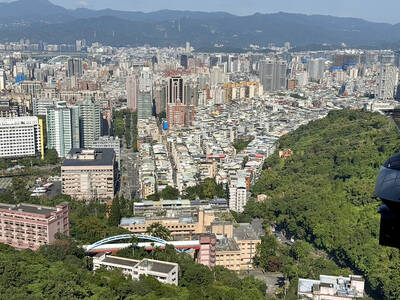
A recent report from the Environmental Management Administration of the Ministry of Environment highlights a perennial problem: illegal dumping of construction waste. In Taoyuan’s Yangmei District (楊梅) and Hsinchu’s Longtan District (龍潭) criminals leased 10,000 square meters of farmland, saying they were going to engage in horticulture. They then accepted between 40,000 and 50,000 cubic meters of construction waste from sites in northern Taiwan, charging less than the going rate for disposal, and dumped the waste concrete, tile, metal and glass onto the leased land. Taoyuan District prosecutors charged 33 individuals from seven companies with numerous violations of the law. This
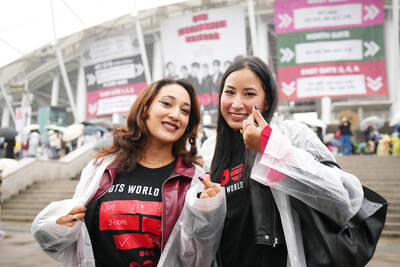
As mega K-pop group BTS returns to the stage after a hiatus of more than three years, one major market is conspicuously missing from its 12-month world tour: China. The omission of one of the group’s biggest fan bases comes as no surprise. In fact, just the opposite would have been huge news. China has blocked most South Korean entertainment since 2016 under an unofficial ban that also restricts movies and the country’s popular TV dramas. For some Chinese, that means flying to Seoul to see their favorite groups perform — as many were expected to do for three shows opening
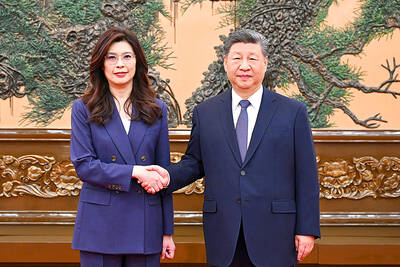
What is the importance within the Chinese Nationalist Party (KMT) of the meeting between Xi Jinping (習近平), the leader Chinese Communist Party (CCP), and Cheng Li-wun (鄭麗文), the leader of the KMT? Local media is an excellent guide to determine how important — or unimportant — a news event is to the public. Taiwan has a vast online media ecosystem, and if a news item is gaining traction among readers, editors shift resources in near real time to boost coverage to meet the demand and drive up traffic. Cheng’s China trip is among the top headlines, but by no means
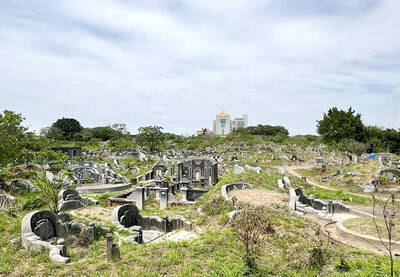
Apr. 13 to Apr. 19 From 17th-century royalty and Presbyterian missionaries to White Terror victims, cultural figures and industrialists, Nanshan Public Cemetery (南山公墓) sprawls across 95 hectares, guarding four centuries of Taiwan’s history. Current estimates show more than 60,000 graves, the earliest dating to 1642. Besides individual tombs, there are also hundreds of family plots, one of which is said to contain around 1,000 remains. As the cemetery occupies valuable land in the heart of Tainan, the government in 2018 began asking families to relocate the graves to make way for development. That


 RSS
RSS