


Could it be possible that Taiwanese cinema is set for a renaissance? This year boded well as young filmmakers delivered works diverse in content and style while polishing their storytelling competencies to attract rather than distract audiences.
In genre cinema, novice director Cheng Hsiao-tse (最苠?) turned heads with his debut feature Miao Miao (鏈鏈), a tale of adolescent romance. Up-and-coming director Tom Shu-yu Lin (輿?迻) caught the attention of both audiences and critics with his coming-of-age, autobiographic tale Winds of September (嬝蔥餫), which is set in mid-1990s Taiwan.
A disciple of Taiwanese New Wave cinema, actor-turned-director Niu Chen-zer*s (漃創?) award-winning debut effort What On Earth Have I Done Wrong?! (①準腕眒眳汜湔眳耋), a mockumentary in which the director plays himself, won many plaudits.
Veteran filmmaker Chang Tso-chi (?釬趬) returned to the director*s chair after a five-year hiatus with his sober human drama Soul of a Demon (維評).
Female directors also produced increasingly mature works. Director Singing Chen*s (?郋皊) second feature God Man Dog (霜檢朸僩?) tells an allegorical tale of contemporary Taiwan and firmly establishes Chen as a name to keep an eye on.
Berlinale-winning director Zero Chou (笚藝鍍) diverged from her usual surrealistic and metaphorical approach to storytelling and painted a realistic and earnest portrait of lesbian life in Taiwan in Drifting Flowers (か檢ч景).
And of course, let*s not forget Cape No. 7 (漆褒ほ?), the highest-grossing Chinese-language film ever screened in Taiwan, which as the overly sanguine media proclaims, single-handedly revived a local filmmaking industry that had been in the doldrums since the early 1990s.
In the light of the progress made last year, Taipei Times is abandoning the best-of format and lists in the five most memorable (good and bad) films of the year.
The top accolade goes to Cape No. 7. Like all blockbusters before it, Cape No. 7 is not an excellent work of filmmaking. The story offers nothing new and the way director Wei Te-sheng (庥肅癖) chooses to tell it can be best described as adequate. But unlike most commercial directors in Taiwan, Wei is a competent storyteller who has a fine command of the vernacular and is adept at creating lifelike characters and weaving them together into a feel-good movie about ordinary people.
However, the future is not as rosy as first appears if aspiring filmmakers still have to finance their movies by digging deep into their own pockets, as Wei did before he became famous.
A view widely circulated among local directors is that to make a local hit, one*s choices are either a youth drama starring pretty-faced idols or a warmhearted story about the beauty and history of Taiwan and its people, as best exemplified by last year*s hit Island Etude (??⑻) and, to a lesser extent, Cape No. 7.
Blue Brave: The Legend of Formosa in 1895 (189拻) is, however, where that sentiment goes terribly wrong. A feeble account of the Hakka militias* resistance to Japanese troops after Qing Dynasty China ceded Taiwan to Tokyo under the Treaty of Shimonoseki in 1895, the film*s makers forgot that audience don*t take kindly to history lessons that lack emotion.
Television commercial and music video director Leading Lee*s (燠隋) debut feature My So Called Love (?腔追???) unfortunately reinforces the common notion that when a music video director turns his or her eye to the big screen, the end product will likely turn out to be all looks and no content.
Beset with pretentious dialogue, an aimless story, forced plotlines and stiff performances, the film would undoubtedly Take care, the Golden Raspberry Award, if Taiwan*s film industry had one.
The reputation of commercial directors was eloquently restored thanks to seasoned television commercial director and cinematographer Chung Mong-hong (潝譁粽) and his debut feature Parking (礿?). With years of experience in making commercials behind him, Chung used richly colored tableaux and unusual camera movements and framings for a blackly comic Kafkaesque journey into the lives, pasts and memories of a mosaic of characters who seem to be trapped in a dilapidated apartment building that is frozen in time.
Last but by no means the least, award-winning playwright, novelist and director Yang Ya-che*s (?捇?) debut feature Orz Boyz (?鹹滯) is a reminder of how little attention has been paid to children*s film in Taiwanese cinema. From a well-written script, witty dialogue and imaginative animation sequences to two amazingly lovable and talented child actors, the film has all the elements to prove that a tale about the whimsical and fantastic world of childhood can be enjoyed by children and adults alike.

Taiwan’s English education system is being pulled apart by three opposing forces. Bilingual Nation 2030 pulls students toward English and global communication. Artificial Intelligence (AI) readiness pulls them toward digital judgment, verification and AI-mediated work. But Taiwan’s old exam culture pulls them back toward memorization, grammar drills, timed reading and correct answers. If the education system keeps using old exams to define success, it risks producing graduates who are neither genuinely bilingual nor genuinely AI-ready, but trained for tasks machines can already perform. The first force is Bilingual Nation 2030. Launched in 2018, the policy aimed to “help Taiwan’s workforce connect
It seems every few days one bumps into one of those “real man” comments in which Taiwan is urged to “face reality” or similar, and “make a deal,” with the speaker implying that soon it will be too late. “Deal” advocates always present themselves as having a superior grip on reality, and the manly ability to make the “hard choice.” Their testosterone-laden language often echoes that of Taiwan sellout advocates. Note that such commentary always specifies a process (“make a deal, work with, make progress”), never the end state of what occupation by a violent authoritarian colonialist state will entail. In

There are shadowy cabals plotting to sell out Taiwan to be annexed by China, by invasion if necessary. Fortunately, they are buffoons. In 2019, former Bamboo Union gangster and founder of the China Unification Promotion Party (CUPP), Chang An-le (張安樂, colorfully known as “White Wolf”), led a protest at the Legislative Yuan against comments made by then-premier Su Tseng-chang (蘇貞昌) that in the event of an attack by China, he would never surrender, but would protect the nation by fighting to the end, even if he only had a broom. Chang had party members bring a wooden casket that they
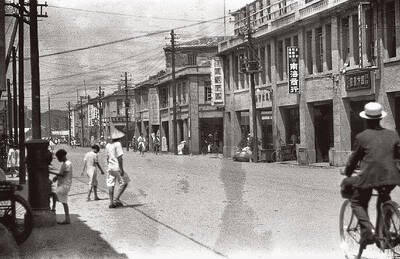
June 1 to June 7 "If all Taiwanese were as afraid of dying as you, then what would happen?” Physician Shih Chiang-nan (施江南) reportedly said this to his wife Chen Chiao-tung (陳焦桐) after she urged him to stop intervening on behalf of Taiwanese soldiers stranded overseas after serving in the Japanese Army during World War II. Shih had clashed with high-ranking officials over the issue, engaged in several heated arguments with Taiwan governor-general Chen Yi (陳儀) and allegedly shouted at general Ko Yuan-fen (柯遠芬), chief of staff of the Taiwan Garrison Command, over


 RSS
RSS