


After her 2007 movie Spider Lilies (刺青), which won last year’s Berlinale Teddy Award for Best Feature Film, Zero Chou (周美玲) returns to the big screen with Drifting Flowers (漂浪青春).
In contrast to the surrealistic and metaphorical tones of Spider Lilies, Chou’s latest work is a realistic and earnest portrait of lesbian life in Taiwan, told through three loosely connected stories.
The first story opens with two deeply attached sisters, 8-year-old Meigo (Pai Chih-ying, 白芝穎) and the beautiful, blind Jing (Serena Fang, 房思瑜), who works as a nightclub singer, struggling to make ends meet.
When the butch accordionist Diego (Chao Yi-lan, 趙逸嵐) comes into their lives, Meigo experiences her first lesbian crush. But as Jing embarks on a lesbian relationship with Diego, Meigo’s affections quickly turn into jealousy, which leads to the sisters’ painful separation.
Chapter two belongs to Lily (Lu Yi-ching, 陸奕靜), an Alzheimer’s patient who struggles to cope with her disintegrating memory. When Yen (Sam Wang, 王學仁), her husband of convenience, comes to visit, Lily mistakes him for her deceased lover Ocean.
Yen, who is living with AIDS, has given up on life after leaving his unfaithful boyfriend. Little by little, the two wounded friends form a companionship and rediscover the will to live.
The final segment follows a younger Diego, who is confused, binds her breasts and struggles to accept her changing body and homosexuality. An encounter with a young Lily, who is a self-assured lesbian showgirl, prompts Diego to embark on her life journey with courage and a sense of hope.
In terms of storytelling, Drifting Flowers sees a significant improvement over Splendid Float (豔光四射歌舞團, 2004) and Spider Lilies and is Chou’s strongest feature film to date. Though melodramatic cliches sometimes dominate the first segment, the film’s overall pace is smooth, and the garbled narrative construction of the director’s previous works has morphed into a focused and concise approach.
The film touches on various aspects of homosexual life in Taiwan and ingeniously weaves them together in a fluent narrative flow. In the second segment, issues such as gay marriage, welfare provision for elderly gay couples, discrimination and AIDS are addressed with sincerity and empathy. Both veteran actress Lu Yi-ching and the talented amateur Sam Wang, a regular cast member in Chou’s films, turn in affecting performances that make audiences laugh and move them to tears at the same time.
Diego’s story articulates the life of a tomboy, a term used for butch lesbians, through tracking the panic and confusion that an alternative sexuality and identity and consequent familial and societal pressures can cause.
The plot may sound like an overused coming-of-age formula, but here it is part of the lesbian community’s collective memory that is rarely, if ever, given a realistic cinematic representation.
A student at Taipei National University of the Arts’ (國立台北藝術大學) theater department, newcomer Chao Yi-lan (趙逸嵐) is the film’s most striking presence and creates a believable portrait of tomboys for Taiwanese queer cinema.
Chou uses a plebeian language to tell her protagonists’ stories, which belong to the pasts, presents and futures of countless male and female homosexuals in Taiwan. The inhabitants of Drifting Flowers are not rootless abstractions, but real people who have hometowns and histories.

Taiwan’s English education system is being pulled apart by three opposing forces. Bilingual Nation 2030 pulls students toward English and global communication. Artificial Intelligence (AI) readiness pulls them toward digital judgment, verification and AI-mediated work. But Taiwan’s old exam culture pulls them back toward memorization, grammar drills, timed reading and correct answers. If the education system keeps using old exams to define success, it risks producing graduates who are neither genuinely bilingual nor genuinely AI-ready, but trained for tasks machines can already perform. The first force is Bilingual Nation 2030. Launched in 2018, the policy aimed to “help Taiwan’s workforce connect
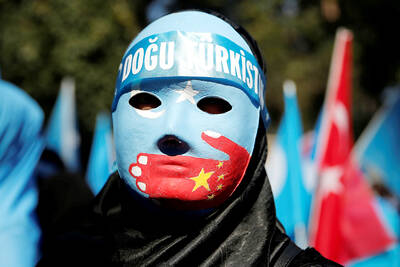
It seems every few days one bumps into one of those “real man” comments in which Taiwan is urged to “face reality” or similar, and “make a deal,” with the speaker implying that soon it will be too late. “Deal” advocates always present themselves as having a superior grip on reality, and the manly ability to make the “hard choice.” Their testosterone-laden language often echoes that of Taiwan sellout advocates. Note that such commentary always specifies a process (“make a deal, work with, make progress”), never the end state of what occupation by a violent authoritarian colonialist state will entail. In

There are shadowy cabals plotting to sell out Taiwan to be annexed by China, by invasion if necessary. Fortunately, they are buffoons. In 2019, former Bamboo Union gangster and founder of the China Unification Promotion Party (CUPP), Chang An-le (張安樂, colorfully known as “White Wolf”), led a protest at the Legislative Yuan against comments made by then-premier Su Tseng-chang (蘇貞昌) that in the event of an attack by China, he would never surrender, but would protect the nation by fighting to the end, even if he only had a broom. Chang had party members bring a wooden casket that they
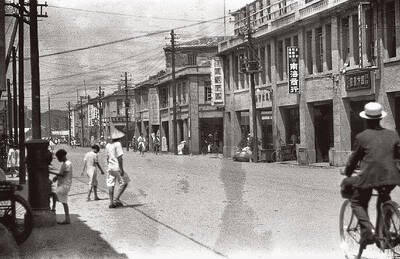
June 1 to June 7 "If all Taiwanese were as afraid of dying as you, then what would happen?” Physician Shih Chiang-nan (施江南) reportedly said this to his wife Chen Chiao-tung (陳焦桐) after she urged him to stop intervening on behalf of Taiwanese soldiers stranded overseas after serving in the Japanese Army during World War II. Shih had clashed with high-ranking officials over the issue, engaged in several heated arguments with Taiwan governor-general Chen Yi (陳儀) and allegedly shouted at general Ko Yuan-fen (柯遠芬), chief of staff of the Taiwan Garrison Command, over


 RSS
RSS