


There is no question that Angkor and its famed temples are among the world’s archaeological treasures, providing a window into the Cambodian dynasty that flourished there from the ninth century to the 15th century. But tourists who flock to the site in northwestern Cambodia say something is missing; few artifacts remain to help them imagine the customs and rituals of the ancient empire.
Numerous antiquities were looted over the centuries or appropriated by museums in France, the country’s former colonial ruler. Of those that remained, many were relocated to Cambodia’s National Museum, more than 298km from Angkor.
Now, a Thai company says it is trying to address the problem, opening a museum that borrows artifacts, including nearly 1,000 Buddhas, from the National Museum and elsewhere. It is just a few kilometers from Angkor Park, the sprawling area near here that is considered one of Southeast Asia’s most important archaeological sites and includes the celebrated temple known as Angkor Wat.
But the museum, Angkor National Museum, which opened in October, has already drawn criticism from powerful detractors. The critics include international restoration specialists who are fiercely concerned about anything that affects Angkor, which was restored by the UN Educational, Scientific and Cultural Organization, or UNESCO, and others after the wars of the 1970s.
Some quibble with the museum’s aesthetics — it includes a sprawling retail area — and with its sense of history. There are hundreds of Buddhas, for instance, that date back no further than the 20th century.
Other critics object to the Thai involvement; Angkor was once under Thai control, and Cambodians remain suspicious that Thailand retains designs on their patrimony.
Those suspicions were stoked in 1999 when large sections of walls with bas-relief images of the revered multiarmed figure Lokeshvara were looted from the 12th-century Banteay Chhmar temple near the Thai border. The stolen art was intercepted by the Thai police and returned to Cambodia.
Then in 2003, anti-Thai riots broke out in Phnom Penh, Cambodia’s capital, after a Thai actress was reported to have said that Angkor Wat still belonged to her country.
One of the critics, Darryl Collins, a historian based in Siem Reap, said the displeasure of some Cambodians was understandable. An enterprise that is foreign-led and “primarily interested in turning a profit,” he said, can hardly be called national, especially when Cambodia already has a National Museum.
Angkor National Museum was created by Vilailuck International Holdings, which is based in Bangkok. For 16 years Vilailuck’s parent company, the Samart Corp, has been a major investor in Cambodia’s telecommunications sector.
Under the terms of its contract with the Cambodian government, the company agreed to transfer control of the museum to the government after 30 years in exchange for the right to display treasures from the National Museum and from the Conservation d’Angkor, a national trove of some 6,000 artifacts. That collection includes important statues of Buddha from several historical periods.
The Thais involved in the museum have been stung by the criticism of the project, which Vilailuck spent US$15 million to build.
“We want to educate Cambodian people about their own history,” said the museum’s managing director, Sunaree Wongpiyabovorn. There are those “who know little about its monuments, and even less of the progress of Buddhism and what led up to it,” she added.
Wongpiyabovorn is especially sensitive to allegations that the company is motivated by economics. She said that Vilailuck had to triple its original investment of US$5 million because of cost overruns and did not expect to see a profit for at least 10 years.
Moreover, complications seem to have left the Thais frustrated, especially with regard to the terms and conditions of the loans. Under the original plan, the former director of the National Museum, Khun Samen, agreed to hand over as many as 1,000 artifacts during the 30-year contract, as well as 31 major pieces for a six-month loan.
His successor, Hab Touch, reduced the number of major pieces to be shared to 23. “I am not going to surrender important pieces that should be permanently displayed here for the integrity of the collection,” he said.
UNESCO, which has declared Angkor a World Heritage site, is generally supportive of the museum and is trying to help by providing advice on display and other aspects of museum practice.
Still, Azedine Beschaouch, an adviser to the organization, agrees with some of the criticism.
Beschaouch, an expert on Angkor and a special adviser to UNESCO’s assistant director general for culture, is no fan of the retail area that Vilailuck calls a “cultural mall.”
“This seems to have been foremost in the mind of the designers, while the collection came second,” Beschaouch said.
He is also impatient about what he called “presentation that cannot claim to reflect international standards in museology.”
It has not helped matters that although the museum opened months behind schedule, most of the artifacts still had not been labeled.
In the museum’s defense, Wongpiyabovorn said that the Conservation d’Angkor’s documentation of many of its works was lost during Pol Pot’s reign, leaving many artifacts with few historical records.
The museum insists that it needs more time to develop its identity. Its curator, Chann Charouen, who is Cambodian, plans to rotate artifacts and bring in new pieces from Cambodian provincial museums.
It remains to be seen whether the museum will embrace the growing scholarship and broad debates that currently characterize Angkorian studies, or be content to lure tourists making an obligatory stop to see the knickknacks of the cultural mall.
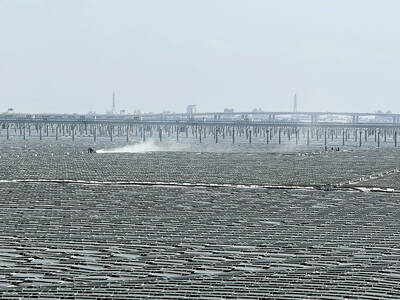
The arithmetic is straightforward and uncomfortable. By the end of 2025, Taiwan had committed itself to a 50-30-20 electricity mix — half natural gas, 30 per cent coal, 20 per cent renewables. The Ministry of Economic Affairs’s (MOEA) own monthly energy reports tell a different story. Natural gas reached 47.8 per cent of generation last year. Coal stood at 35.4 per cent, comfortably above its target ceiling. Renewables came in at 13.1 per cent, well short of the 20 per cent Taipei had pledged a decade earlier. Installed renewable capacity reached roughly half of the 12 gigawatts (GW) the government
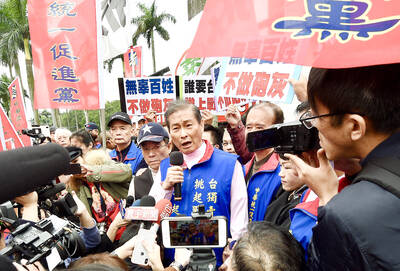
There are shadowy cabals plotting to sell out Taiwan to be annexed by China, by invasion if necessary. Fortunately, they are buffoons. In 2019, former Bamboo Union gangster and founder of the China Unification Promotion Party (CUPP), Chang An-le (張安樂, colorfully known as “White Wolf”), led a protest at the Legislative Yuan against comments made by then-premier Su Tseng-chang (蘇貞昌) that in the event of an attack by China, he would never surrender, but would protect the nation by fighting to the end, even if he only had a broom. Chang had party members bring a wooden casket that they
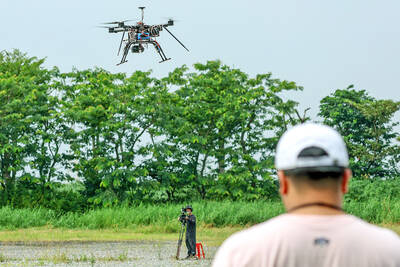
Taiwan’s drone exports are taking off, fuelled by the war in Ukraine, as Taiwanese companies seek a stake in the fast-growing global market for unmanned aerial vehicles (UAV). Low-cost drones used for reconnaissance and strikes are in high demand as governments around the world boost defense spending in the face of intensifying conflicts. A relative new player in the increasingly competitive industry, Taiwan’s pitch is to be an “Asian hub” for the production of UAVs and components free of Chinese materials, or “non-red.” That means its UAVs can be up to three times more expensive than their Chinese competitors, like the world’s biggest
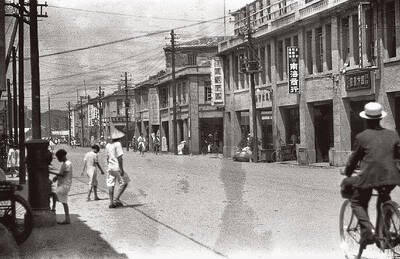
June 1 to June 7 "If all Taiwanese were as afraid of dying as you, then what would happen?” Physician Shih Chiang-nan (施江南) reportedly said this to his wife Chen Chiao-tung (陳焦桐) after she urged him to stop intervening on behalf of Taiwanese soldiers stranded overseas after serving in the Japanese Army during World War II. Shih had clashed with high-ranking officials over the issue, engaged in several heated arguments with Taiwan governor-general Chen Yi (陳儀) and allegedly shouted at general Ko Yuan-fen (柯遠芬), chief of staff of the Taiwan Garrison Command, over


 RSS
RSS