


The section of Fuxing South Road near Civil Boulevard has become a nexus for trendy restaurants, the most recent being Jiau's, which opened last Friday as part of a four-story lifestyle center ambitiously called MOT (Museum of Tomorrow). The venture has an outlet for designer furniture, an art gallery and a coffee shop. On the ground floor is Jiau's, named after and created by Zhuang Yue-jiau (莊月嬌), one of the biggest names in organic and healthy dining in Taiwan.
This high-concept establishment takes the simplest traditional Taiwanese dishes and turns them into gourmet fare intended to be savored not just for their superior flavor, but also for their health value. The centerpiece of the restaurant's menu is its lu rou fan (滷肉飯, rice topped with stewed meat), a dish available at any night market for around NT$20, but priced at NT$120 and renamed drunken wuson rice (酒打烏松飯) at Jiau's.
But don't feel ripped off. The organic rice, wine-flavored fatty pork that avoids being too oily and the contrast provided by pine nuts and two slices of quality mullet roe make drunken wuson rice a virtuoso variation on a perennial theme.
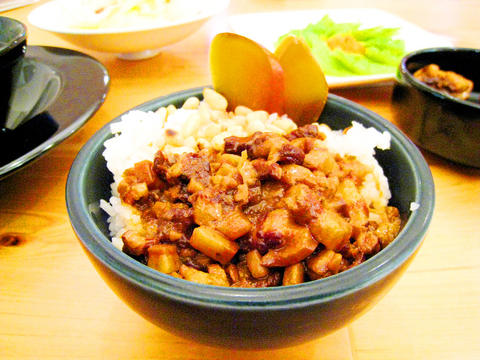
PHOTO: IAN BARTHOLOMEW, TAIPEI TIMES
The same philosophy has gone into the other dishes on the menu. They're all based on simple Taiwanese snacks - roast sausage, stir-fried cabbage, cold bitter gourd, spare rib and taro soup - and use high quality organic ingredients from specially contracted farmers around Taiwan.
The grilled salted pork (complained pork, 獨鹹豬肉, NT$220), is also a revelation. This dish, which is usually tough, fatty and salty when purchased at a night market, was presented at Jiau's in thin, tender slices with a ginger vinaigrette. The fat, the lean meat and the grilled crust formed a symphony of tastes and textures. Zhuang has taken a Taiwanese staple and transformed it into something spectacular.
Extreme simplicity in preparation and presentation emphasizes the amount of thought that has gone into creating each dish.
It would be nice if a similar amount of thought had gone into other aspects of the restaurant. The service staff tried hard to be sophisticated and helpful, but the young servers lacked the urbanity and confidence to compliment the suave and casual ambiance that the minimal lines, polished wood and undressed stone of the decor sought to create. Many dishes on the menu were unavailable, and the menu itself, which featured some truly gorgeous photography, was unfinished, and had the kind of peculiar English that seemed out of place at an establishment with such high aspirations.

Taiwan’s English education system is being pulled apart by three opposing forces. Bilingual Nation 2030 pulls students toward English and global communication. Artificial Intelligence (AI) readiness pulls them toward digital judgment, verification and AI-mediated work. But Taiwan’s old exam culture pulls them back toward memorization, grammar drills, timed reading and correct answers. If the education system keeps using old exams to define success, it risks producing graduates who are neither genuinely bilingual nor genuinely AI-ready, but trained for tasks machines can already perform. The first force is Bilingual Nation 2030. Launched in 2018, the policy aimed to “help Taiwan’s workforce connect

It seems every few days one bumps into one of those “real man” comments in which Taiwan is urged to “face reality” or similar, and “make a deal,” with the speaker implying that soon it will be too late. “Deal” advocates always present themselves as having a superior grip on reality, and the manly ability to make the “hard choice.” Their testosterone-laden language often echoes that of Taiwan sellout advocates. Note that such commentary always specifies a process (“make a deal, work with, make progress”), never the end state of what occupation by a violent authoritarian colonialist state will entail. In
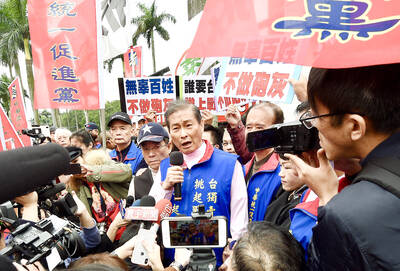
There are shadowy cabals plotting to sell out Taiwan to be annexed by China, by invasion if necessary. Fortunately, they are buffoons. In 2019, former Bamboo Union gangster and founder of the China Unification Promotion Party (CUPP), Chang An-le (張安樂, colorfully known as “White Wolf”), led a protest at the Legislative Yuan against comments made by then-premier Su Tseng-chang (蘇貞昌) that in the event of an attack by China, he would never surrender, but would protect the nation by fighting to the end, even if he only had a broom. Chang had party members bring a wooden casket that they
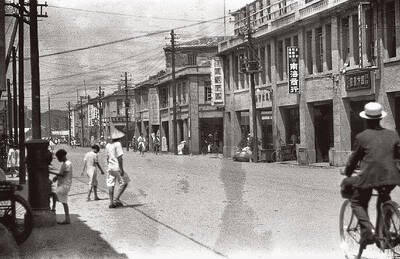
June 1 to June 7 "If all Taiwanese were as afraid of dying as you, then what would happen?” Physician Shih Chiang-nan (施江南) reportedly said this to his wife Chen Chiao-tung (陳焦桐) after she urged him to stop intervening on behalf of Taiwanese soldiers stranded overseas after serving in the Japanese Army during World War II. Shih had clashed with high-ranking officials over the issue, engaged in several heated arguments with Taiwan governor-general Chen Yi (陳儀) and allegedly shouted at general Ko Yuan-fen (柯遠芬), chief of staff of the Taiwan Garrison Command, over


 RSS
RSS