


The Indian car industry was all revved up to hit the international scene at the ninth Auto-Expo, which saw over two dozen launches including the world's cheapest car.
The Auto-Expo, which opened in New Delhi on Thursday was twice the size of the Tokyo Motor Show and, with delegates and firms from 25 countries expected to attend, attests to the growing importance of the Indian automotive industry in the world.
The expo has been accredited as the biggest auto exhibition in Asia by the International Organization of Motor Vehicle Manufacturers.
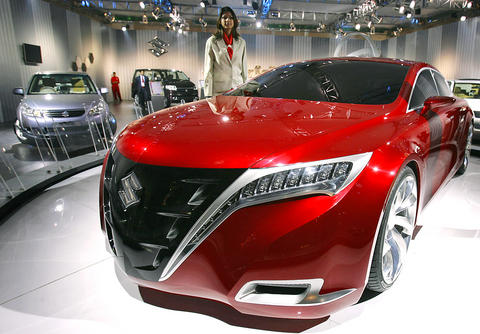
PHOTO: AP
Organizers said the exhibition had a display area of 36,506m2 and hosted 1.5 million visitors, an increase of 50 percent from the show's last edition in 2006.
The eight-day event saw the largest global participation with 2,000 automobile and automotive manufacturers as well as ancillaries from countries like the US, Germany, Japan, China, France and Italy.
Many models, like Honda's Jazz, Volkswagen's UP!, Polo, Fox and Beetle, the Fiat Grande Punto and the Skoda Fabia were showcased. There were also special pavilions such as Diesel City, Infotronics, Design Pavilion and Auto Enterprise to educate and enlighten.
But the spotlight during the expo, which used the theme Mobility for All was on Tata's People's Car, priced at US$2,500, which was unveiled at a special ceremony Thursday.
The car, which has captured global attention, costs less than half of the cheapest car on the Indian market, the Maruti 800, and more than double an entry-level motorcycle.
The rear-engine four-seater is expected to find a market among millions of middle-income buyers looking to upgrade from scooters particularly in India, where small cars are expected to dominate roads in the near future.
Meanwhile, India's leading motorcycle maker, Bajaj, has already announced plans to make a low-cost small car called Lite along with Renault.
According to local news reports, Tata Motors is considering setting up a plant to roll out the car in Thailand in the next three years.
India's biggest car-maker, Maruti Suzuki also displayed its A-Star Concept hatchback car on the eve of the show on Wednesday.
General Motors' best-selling Sports Utility Vehicle Captiva, which was launched for the Indian market will be on display at the show, as will Japan's Honda Motors' technologically advanced fuel cell car FCX and hybrid Civic.
Industry experts say such an interest in India, which is expected to emerge as the second-fastest growing automobile market over the next 10 years, is only natural.
Foreign players have been lining up to make additional investments and have drawn ambitious plans to capture a share in the Indian market, which till now has been dominated by domestic players like Tata and Mahindra.
According to forecasts, the Indian passenger car market is projected to nearly double to 2 million units a year by 2010, helped by rising incomes and installment and loan schemes offered by banks and financial institutions.
Ravi Kant, president of the Society of Indian Automobile Manufacturers Association, one of the organizers, described 2008 as a "watershed year" for the US$34 billion Indian automotive industry.
"The industry is on the cusp of a major growth, on account of major urbanization of the Indian mind and rising incomes, and this is acknowledged internationally," he said.
The Indian market has seen a number of changes over the past few years. Last year, Ashok Leyland and Bajaj signed tie-ups with France's Renault, Hero Group with Germany's Daimler Trucks, Eicher Motors formed a joint venture with Sweden's Volvo even as Tata is all set to acquire Jaguar and Land Rover.

Yesterday, the Democratic Progressive Party (DPP) nominated legislator Puma Shen (沈伯洋) as their Taipei mayoral candidate, the Chinese Nationalist Party (KMT) put their stamp of approval on Wei Ping-cheng (魏平政) as their candidate for Changhua County commissioner and former legislator Tsai Pi-ru (蔡壁如) of the Taiwan People’s Party (TPP) has begun the process to also run in Changhua, though she has not yet been formally nominated. All three news items are bizarre. The DPP has struggled with settling on a Taipei nominee. The only candidate who declared interest was Enoch Wu (吳怡農), but the party seemed determined to nominate anyone
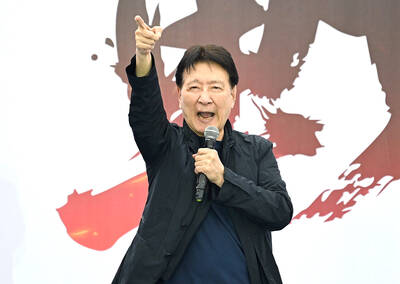
In a sudden move last week, opposition lawmakers of the Chinese Nationalist Party (KMT) and Taiwan People’s Party (TPP) passed a NT$780 billion special defense budget as a preemptive measure to stop either Chinese leader Xi Jinping (習近平) or US President Donald Trump from blocking US arms sales to Taiwan at their summit in Beijing, said KMT heavyweight Jaw Shaw-kong (趙少康), speaking to the Taipei Foreign Correspondents Club on Wednesday night in Taipei. The 76-year-old Jaw, a political talk show host who ran as the KMT’s vice presidential candidate in 2024, says that he personally brokered the deal to resolve
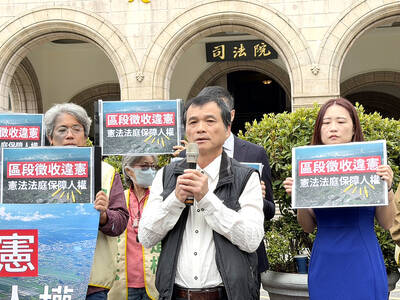
What government project has expropriated the most land in Taiwan? According to local media reports, it is the Taoyuan Aerotropolis, eating 2,500 hectares of land in its first phase, with more to come. Forty thousand people are expected to be displaced by the project. Naturally that enormous land grab is generating powerful pushback. Last week Chen Chien-ho (陳健和), a local resident of Jhuwei Borough (竹圍) in Taoyuan City’s Dayuan District (大園) filed a petition for constitutional review of the project after losing his case at the Taipei Administrative Court. The Administrative Court found in favor of nine other local landowners, but

The Chinese Nationalist Party (KMT) and its sock puppet, the Taiwan People’s Party (TPP), passed their version of the government’s proposed supplementary defense spending bill last week, engendering much commentary. While all eyes were on the defense budget, the PRC’s assault on Taiwan was advancing on other fronts. The removal of domestic drone production and other technologies critical to the nation’s asymmetrical defenses from the list of items purchased in the “compromise” bill shows how the KMT-TPP alliance appears to be serving the People’s Republic of China (PRC). Ironically, the cuts will impact industries heavily represented by tech firms in areas run


 RSS
RSS