


Joe Wright's Atonement begins in the endlessly photogenic, thematically pregnant interwar period. The setting is a rambling old British country estate where trim dinner jackets and shimmering silk dresses are worn; cigarettes are smoked with sharp inhalations that create perfect concavities of cheekbone; and the air is thick with class tension and sexual anxiety. Heavy clouds are gathering on the geopolitical horizon, which lends a special poignancy to the domestic comings and goings. This charged, hardly unfamiliar atmosphere provides, in the first section of the film, some decent, suspenseful fun, a rush of incident and implication. Boxy cars rolling up the drive; whispers of scandal and family secrets; coitus interruptus in the library, all set to the implacable rhythm of typewriter keys.
Two characters make significant use of a typewriter - one is an aspiring playwright, the other a yearning rural swain - but the sound of the machine is co-opted by Dario Marianelli, who wrote the movie's score and who conjoins the clack-clacking of mechanical composition with the steady plink of a repeated piano note. At a climactic moment Brenda Blethyn, who can be as subtle an actress as Marianelli is a composer, leaps screaming from the darkness and begins beating on the hood of a car with an umbrella, a tocsin that joins the plink and the clack in a small symphony of literal-minded irrelevance.
That pretty much describes the rest of Atonement, piously rendered by the screenwriter Christopher Hampton from Ian McEwan's novel. This is not a bad literary adaptation; it is too handsomely shot and Britishly acted to warrant such strong condemnation. Atonement is, instead, an almost classical example of how pointless, how diminishing, the transmutation of literature into film can be. The respect that Wright and Hampton show to McEwan is no doubt gratifying to him, but it is fatal to their own project.
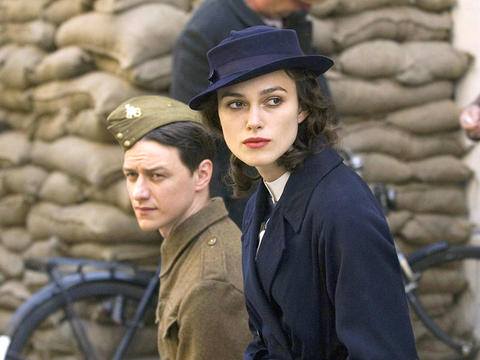
PHOTO: COURTESY OF UIP
Unlike Wright's brisk, romantic film version of Jane Austen's Pride and Prejudice, Atonement fails to be anything more than a decorous, heavily decorated and ultimately superficial reading of the book on which it is based. McEwan's prose pulls you in immediately and drags you through an intricate, unsettling story, releasing you in a shaken, wrung-out state. The film, after a tantalizing start, sputters to a halt in a welter of grandiose imagery and hurtling montage.
Keira Knightley, who also starred in Pride and Prejudice, plays Cecilia Tallis, a rich girl who discovers she is loved by and in love with Robbie (James McAvoy), the son of one of her family's servants. Their furtive, ardent courtship is observed by Cecilia's younger sister, Briony (played at 13 by the remarkably poised Saoirse Ronan - pronounced SEER-Sha), whose combination of precocity and confusion precipitates a household catastrophe.
A bigger one arrives in the form of World War II, and it is here, in the transition from hothouse psychodrama to historical pseudo-epic, that Atonement runs aground, losing dramatic coherence and intellectual focus. Romola Garai has taken over the role of Briony (in a coda, she will age gracefully into Vanessa Redgrave), who works as a nurse in London. Cecilia, now estranged from the family, does similar duty, and Robbie stumbles toward the beach at Dunkirk.
There are some powerful images - of scared and tired soldiers in France, of bloody wounds and shattered limbs in London - but the film's treatment of the war has a detached, secondhand feeling. And even the most impressive sequences have an empty, arty virtuosity. The impression left by a long, complicated battlefield tracking shot is pretty much "Wow, that's quite a tracking shot," when it should be "My God, what a horrible experience that must have been."
The main casualty of the film's long, murky middle and end sections is the big moral theme - and also the ingenious formal gimmick - that provides the book with some of its intensity and much of its cachet. As the title suggests, Atonement is fundamentally about guilt and the attempt to overcome it, and about the tricky, tragically imperfect power of art to compensate for real-life crimes and misdemeanors.
Without giving too much away, I will say that the power of the story depends on its believability, on the audience's ability to perceive Robbie and Cecilia in wartime as suffering, flesh-and-blood creatures. McAvoy and Knightley sigh and swoon credibly enough, but they are stymied by the inertia of the filmmaking, and by the film's failure to find a strong connection between the fates of the characters and the ideas and historical events that swirl around them.

For many people, Bilingual Nation 2030 begins and ends in the classroom. Since the policy was launched in 2018, the debate has centered on students, teachers and the pressure placed on schools. Yet the policy was never solely about English education. The government’s official plan also calls for bilingualization in Taiwan’s government services, laws and regulations, and living environment. The goal is to make Taiwan more inclusive and accessible to international enterprises and talent and better prepared for global economic and trade conditions. After eight years, that grand vision is due for a pulse check. RULES THAT CAN BE READ For Harper Chen (陳虹宇), an adviser

Traditionally, indigenous people in Taiwan’s mountains practice swidden cultivation, or “slash and burn” agriculture, a practice common in human history. According to a 2016 research article in the International Journal of Environmental Sustainability, among the Atayal people, this began with a search for suitable forested slopeland. The trees are burnt for fertilizer and the land cleared of stones. The stones and wood are then piled up to make fences, while both dead and standing trees are retained on the plot. The fences are used to grow climbing crops like squash and beans. The plot itself supports farming for three years.

President William Lai (賴清德) on Nov. 25 last year announced in a Washington Post op-ed that “my government will introduce a historic US$40 billion supplementary defense budget, an investment that underscores our commitment to defending Taiwan’s democracy.” Lai promised “significant new arms acquisitions from the United States” and to “invest in cutting-edge technologies and expand Taiwan’s defense industrial base,” to “bolster deterrence by inserting greater costs and uncertainties into Beijing’s decision-making on the use of force.” Announcing it in the Washington Post was a strategic gamble, both geopolitically and domestically, with Taiwan’s international credibility at stake. But Lai’s message was exactly

May 4 to May 10 It was once said that if you hadn’t performed at the Sapphire Grand Cabaret (藍寶石大歌廳), you couldn’t truly be considered a star. Taking the stage at the legendary Kaohsiung club was more than just a concert. Performers were expected to entertain in every sense, wearing outlandish or revealing costumes and staying quick on their feet as sharp-tongued, over-the-top hosts asked questions and delivered jokes that would be seen as vulgar, even offensive, by today’s standards. Opening in May 1967 during a period of strict political and social control, Sapphire offered a rare outlet for audiences in


 RSS
RSS