


The Butterfly Dream, Contemporary Legend Theater's (當代傳奇劇場, CLT) upcoming production, seems a conventional work of Chinese opera compared to 108 Heroes the troupe's most recent piece. Although it blurs the boundaries between Chinese operatic forms and includes Western instruments in the orchestra, there is no sign of the hip-hop and pop orchestration that distinguished 108 Heroes. But under the surface of convention, what is happening in The Butterfly Dream is as modern and experimental as anything the CLT has ever done.
Billed as a work of contemporary Kun opera (崑劇), it has a completely new score by composer Jia Daqun (賈達群) and features the talents of US-based Kun opera star Qian Yi (錢熠). The production also highlights the creative efforts of Lin Hsiu-wei (林秀偉), the CLT's producer.
The Butterfly Dream is based on the Beijing opera Tian Breaks Open Her Husband's Coffin (田氏劈棺). It tells the story of Zhuang Zhou (莊周), the great Taoist philosopher, and how he tests his wife's love for him after returning from 10 years of spiritual and magical training. He pretends to die, returns as a handsome prince while his wife is still in mourning, woos her unsuccessfully but finally convinces her that he is about to die and that only a preparation made from a human brain will save him. Tian, who by this time has given in to the handsome prince's cajoling, decides to break open her deceased husband's coffin to obtain what is required. The prince reveals himself to be her husband in disguise, and in a fit of anguish, Tian commits suicide.
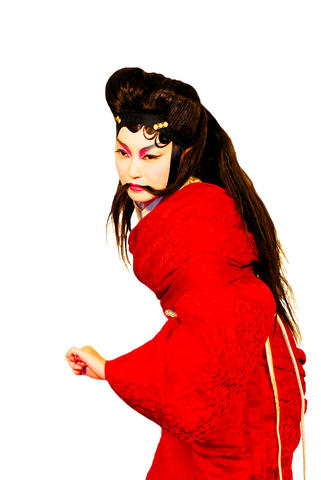
PHOTO: COURTESY OF CLT
The Beijing opera repertoire has more than its fair share of such morally despicable and misogynistic content, and on the face of it this would seem an unusual subject for the CLT. But dramatically, the story offers considerable potential for Wu Hsing-kuo (吳興國), the CLT's founder, to interact first as husband and then as lover with his co-star Qian. It also allowed Lin to draw on the profound and colorful meditations of Zhuang, who has experienced a huge international revival due to his concerns about the environment and creating a good life in the midst of chaotic times.
In first-time scriptwriter Lin's hands, The Butterfly Dream has undergone a massive transition. Though the plot itself hasn't changed much, the way the story is interpreted has. It's become a way of exploring the nature of love and an exposition on the long-standing relationship between Lin and Wu.
Lin found Kun to be an excellent vehicle for such a project.
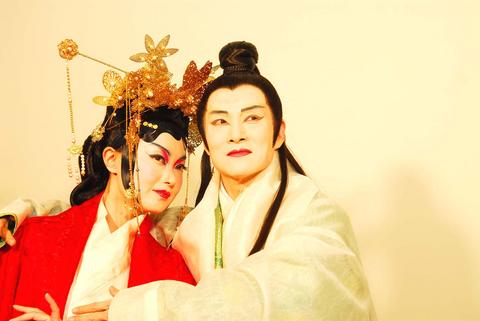
PHOTO: COURTESY OF CLT
"What distinguishes Kun opera from other operatic forms," said Wang An-chi (王安祈), artistic director of the National Guoguang Opera Company (國光劇團) in a lecture about Kun opera and its use in The Butterfly Dream, "is that its focus is not narrative or even descriptive. Beijing opera is great at telling a story, ... but Kun follows a heritage taken from Tang and Song [dynasty] poetry. ... This poetic tradition means that nothing is said directly, but it uses words to build up layer upon layer of images, and these images reveal the emotions of the characters. And in Kun, the favored emotions are ambiguous, and often not even clearly understood by the characters themselves, ... so it is a great tool for exploring the unconscious."
In The Butterfly Dream, the CLT has taken this expressive element and incorporated the stronger dramatic drive of Beijing opera. Musically, the production has also sought to remedy Kun opera's narrow focus on lyrical beauty. According to composer Jia, "Kun's music is very elegant and refined, but in listening to Kun opera as a whole, in musical terms, it is low on dramatic tension, it lacks fullness and color, so my job was to see how we could adapt Kun to a new environment." Jia is a prolific composer and a professor at the Shanghai Conservatory of Music (上海音樂學院).
Kun opera, which has been designated a masterpiece of the oral and intangible heritage of humanity by UNESCO, managed to survive over the centuries through a process of change, and the CLT, in this new work, has continued the process, hoping that this more personal, philosophical and contemporary collage made up of strands drawn from China's cultural heritage, will win recognition for this beautiful operatic form in a new time and in a new world.
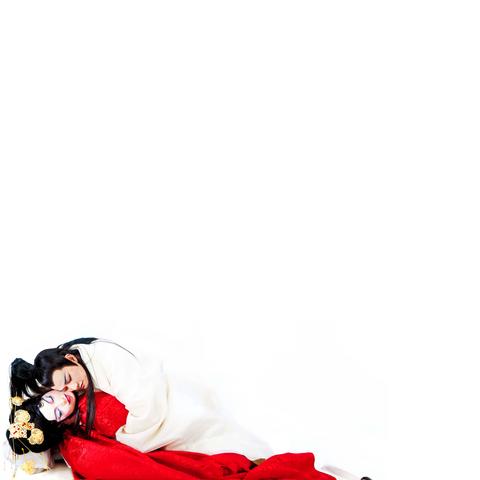
PHOTO: COURTESY OF CLT
Interview with Lin Hsiu-wei, producer
Taipei Times: How did you come to write The Butterfly Dream?
Lin Hsiu-wei: I never really wanted to be a scriptwriter. Writing this show happened more by accident than design, but this did have a great advantage. It needed very few revisions during rehearsal. I have worked so closely with Wu [Hsing-kuo (吳興國), CLT's founder] over the last 21 years, so I know what he wants in the performance. He simply had to tell me his idea, and I would get it, even down to how it should be performed and how the scenes would progress. As soon as the script was finished, it was as if we could already see it all on stage, from the first moment to the last second. [Kun opera star] Qian Yi (錢熠) said she felt the whole opera was really me talking about my relationship with Wu. We started dating when I was 18, and we got married when I was 23, so we have been together for a very long time. You can see from this a person's ideals, and their love, and how in between these there are so many contradictions and conflicts. Eventually you see the other person with a tenderness born of your life experiences. I found that I incorporated so much of my feeling for him into the script.
TT: Did you bring your experience as a dancer into The Butterfly Dream?
LHW: I really like the idea of a dun (頓) - the idea of a pause. It is the pause when you have a moment of realization. The (Taoist) spirit of emptiness exists in the momentary pause between one action and another. ... [Taoist philosopher] Zhuang's emphasis on the "in between" appeals to me, this moment so full of potential, the idea that nothing is ever quite completed. Zhuang also emphasized ways of slowing yourself down - this can be a slow dance, the aesthetic of slow motion.
I choreographed all the movements in the show. I took the movements themselves from Kun opera, but the context, combination or the pacing might differ, which changes their significance, making something that is different from conventional Kun opera.
TT: Is The Butterfly Dream a departure from CLT's past work?
LHW: It has the same spirit. It is based in a classical tradition, but with a contemporary spirit. It is about taking something from the past and putting it in a new environment, a new time, and letting it generate new ideas and a new aesthetic. We naturally hope to generate an emotional response from our modern-day audience, and also hope that this might inspire people to go back and read Zhuang's works and listen to Kun opera.

It seems every few days one bumps into one of those “real man” comments in which Taiwan is urged to “face reality” or similar, and “make a deal,” with the speaker implying that soon it will be too late. “Deal” advocates always present themselves as having a superior grip on reality, and the manly ability to make the “hard choice.” Their testosterone-laden language often echoes that of Taiwan sellout advocates. Note that such commentary always specifies a process (“make a deal, work with, make progress”), never the end state of what occupation by a violent authoritarian colonialist state will entail. In
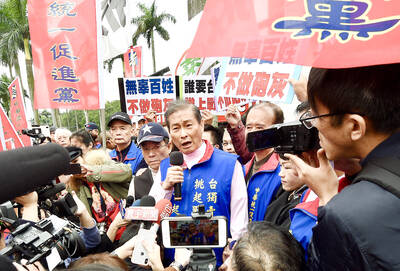
There are shadowy cabals plotting to sell out Taiwan to be annexed by China, by invasion if necessary. Fortunately, they are buffoons. In 2019, former Bamboo Union gangster and founder of the China Unification Promotion Party (CUPP), Chang An-le (張安樂, colorfully known as “White Wolf”), led a protest at the Legislative Yuan against comments made by then-premier Su Tseng-chang (蘇貞昌) that in the event of an attack by China, he would never surrender, but would protect the nation by fighting to the end, even if he only had a broom. Chang had party members bring a wooden casket that they
June 1 to June 7 "If all Taiwanese were as afraid of dying as you, then what would happen?” Physician Shih Chiang-nan (施江南) reportedly said this to his wife Chen Chiao-tung (陳焦桐) after she urged him to stop intervening on behalf of Taiwanese soldiers stranded overseas after serving in the Japanese Army during World War II. Shih had clashed with high-ranking officials over the issue, engaged in several heated arguments with Taiwan governor-general Chen Yi (陳儀) and allegedly shouted at general Ko Yuan-fen (柯遠芬), chief of staff of the Taiwan Garrison Command, over

Food prices have often played a major role in Taiwan’s history. The first major wave of migration from China occurred in 1628. A moderate drought, the Ming Dynasty maritime ban that prohibited fishing and trading (intended to reduce piracy) and a temporary tax, conspired to exhaust local resources, leading to famine in Fujian Province. The famed pirate and trader Zheng Zhilong (鄭芝龍), scooped up starving people from Fujian and transported them across the Taiwan Strait, where they settled under the Dutch. Two factors enabled Zheng. First, by 1624 he had settlements around today’s Beigang (北港) in Yunlin County with a small


 RSS
RSS