


The late 1990s saw a plethora of biennials sprouting up around the world as organizers realized the benefits these art showcases brought to their cities. Some are well known, like Venice and Sao Paulo, but all bring some level of international recognition and create important cross-cultural ties.
Taipei's first international biennial happened in 1998 at the Taipei Fine Arts Museum and was initiated by Lin Mun-lee (林曼麗), now director of the National Palace Museum.
Formerly known as the forerunner of Asian biennials, the Taipei Biennial lost some of its prestige in 2004. Furthermore, most biennials scheduled for 2008 formally announced their curators at the Venice Biennale in June 2007, so Taiwan, having just made the formal announcement last week, is a bit late.
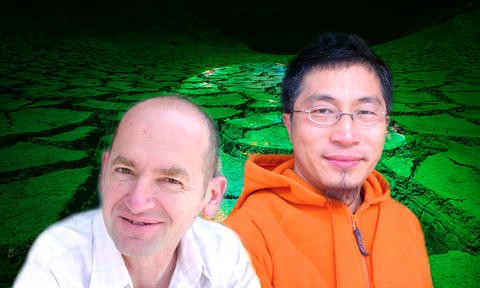
PHOTO: COURTESY OF PET TEAM
Some would say it was worth the wait, though, as the Taipei Biennial 2008 curators are Manray Hsu (徐文瑞) and Vasif Kortun.
Taiwanese curator Manray Hsu is no newcomer to the biennial. He was co-curator for the year 2000 event, titled The Sky is the Limit, and co-curated Naked Life at the Museum of Contemporary Art (台北當代藝術館) last year.
Vasif Kortun is the Director of Platform Garanti Contemporary Art Center in Istanbul and received the award for Curatorial Excellence from the Center for Curatorial Studies, Bard College in New York last year. He also served as director of the Istanbul Biennial in 1992 and 2005.
Taipei's biennials usually open in November, but next year's will take place in September in order to coordinate with the seven other biennial cities: Guangzhou and Shanghai, China; Busan and Gwangju, South Korea; Yokohama, Japan; Singapore; and Sydney, Australia.
The 2004 event took place on two floors of the Taipei Fine Arts Museum and felt more like an exhibition than a biennial. This year, museum organizers plan to expand the biennial with lectures and art exhibitions outside of the museum. This should attract foreign visitors, who will also help boost the local economy.
It is the museum's hope that the Taipei Biennial 2008 can strengthen Taiwan's position in the international art world, while establishing a major cultural network island-wide.
After the biennial in 2004, local artists petitioned for an outside committee to oversee subsequent events and called for an overhaul of the Taipei Biennial. Its six-month preparatory time-frame, limited budget, minimal promotion and pairing of experienced Western and Taiwanese curators have, in the past, led to problems.

Taiwan’s English education system is being pulled apart by three opposing forces. Bilingual Nation 2030 pulls students toward English and global communication. Artificial Intelligence (AI) readiness pulls them toward digital judgment, verification and AI-mediated work. But Taiwan’s old exam culture pulls them back toward memorization, grammar drills, timed reading and correct answers. If the education system keeps using old exams to define success, it risks producing graduates who are neither genuinely bilingual nor genuinely AI-ready, but trained for tasks machines can already perform. The first force is Bilingual Nation 2030. Launched in 2018, the policy aimed to “help Taiwan’s workforce connect
It seems every few days one bumps into one of those “real man” comments in which Taiwan is urged to “face reality” or similar, and “make a deal,” with the speaker implying that soon it will be too late. “Deal” advocates always present themselves as having a superior grip on reality, and the manly ability to make the “hard choice.” Their testosterone-laden language often echoes that of Taiwan sellout advocates. Note that such commentary always specifies a process (“make a deal, work with, make progress”), never the end state of what occupation by a violent authoritarian colonialist state will entail. In
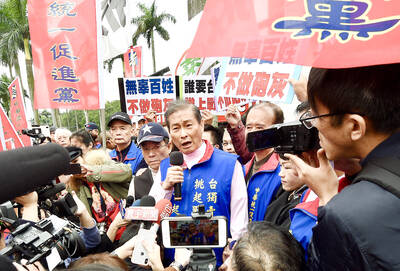
There are shadowy cabals plotting to sell out Taiwan to be annexed by China, by invasion if necessary. Fortunately, they are buffoons. In 2019, former Bamboo Union gangster and founder of the China Unification Promotion Party (CUPP), Chang An-le (張安樂, colorfully known as “White Wolf”), led a protest at the Legislative Yuan against comments made by then-premier Su Tseng-chang (蘇貞昌) that in the event of an attack by China, he would never surrender, but would protect the nation by fighting to the end, even if he only had a broom. Chang had party members bring a wooden casket that they
June 1 to June 7 "If all Taiwanese were as afraid of dying as you, then what would happen?” Physician Shih Chiang-nan (施江南) reportedly said this to his wife Chen Chiao-tung (陳焦桐) after she urged him to stop intervening on behalf of Taiwanese soldiers stranded overseas after serving in the Japanese Army during World War II. Shih had clashed with high-ranking officials over the issue, engaged in several heated arguments with Taiwan governor-general Chen Yi (陳儀) and allegedly shouted at general Ko Yuan-fen (柯遠芬), chief of staff of the Taiwan Garrison Command, over


 RSS
RSS