


Behind the 150-year-old granite walls of San Quentin State Prison lies a brutal world of physical confinement and mind-numbing monotony, a place where violence constantly threatens. It is not a place where you expect to find beauty, and perhaps this best explains the dumbfounded reaction of a first-time visitor to the prison's cavernous dining hall, where six epic murals - each measuring roughly 3.7m high by 30m long - depict a populist vision of California history.
Remarkably powerful and almost unknown to the outside world, the sepia-tone murals were created more than 50 years ago by a young Mexican-American prisoner who, after serving four years for possession of heroin, went on to a successful career as an artist. Painted mostly in a style that recalls Diego Rivera or Works Progress Administration murals from the 1930s, they almost certainly would have been protected long ago with a landmark designation if they were in a building to which the public had access. But hidden away in an overcrowded and decaying prison whose own fate is up in the air, the murals face an uncertain future.
The murals' creator, Alfredo Santos, was 24 when he arrived at San Quentin in 1951 in the back of an ambulance. "I had a bum leg from an infection," Santos, 80, said by telephone from San Diego, where he now lives on Social Security. "They put me in the convalescent wing, and the prison doc told me, 'Keep quiet, kid, and I'll let you stay here.'"

PHOTO: NY TIMES NEWS SERVICE
Santos, who had taken high school art classes until he was expelled from 10th grade for striking a teacher, remained in convalescent cells his entire prison stay. At first he read books voraciously, he said, and drew portraits of other inmates and, from photographs, their families. "I got paid a lot of cigarettes," he recalled, referring to the standard currency behind bars. "But I also got to really focus on art. San Quentin is where I became an artist."
In 1953, two years after he was locked up, Santos submitted the winning sketch in a competition among the inmates to paint a mural on one side of a dining hall partition. After inexplicably being denied the use of other colors, he began to apply thinned, raw sienna oil paint directly to plaster. Before long the warden ordered Santos to paint all three double-sided walls in the dining area.
For two years he worked at night in the company of guards and two other inmates, who helped with the scaffold. "Sometimes I painted for a couple of hours, and sometimes I kept at it until sunrise," he said. "They let me go at my own pace."
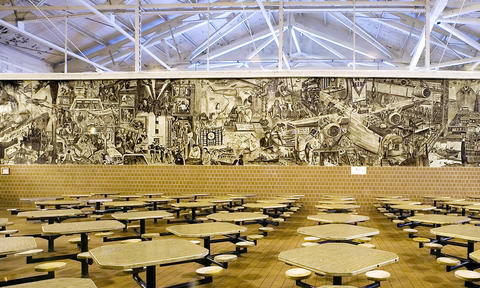
PHOTO: NY TIMES NEWS SERVICE
The murals chronicle not only California's history, but also the evolution of Santos' style. The first scenes, including an Indian village and the Franciscan missionary Junipero Serra, are rendered in the listless fashion of a 1950s textbook illustration, with isolated vignettes surrounded by areas of blank wall. "At the beginning I wanted to be conservative, to please the prison officials," he said.
But soon vignettes crowd the walls, playing like a crazy newsreel of random images; at one point a covered wagon rumbles westward not far from where an owlish Groucho Marx peeps over a movie screen. Unifying compositional elements - the World War II bomber that dominates the fourth mural, for example - lend a WPA-era monumentality.
The fifth mural, with its oil well gushing from a huge human arm and its gargantuan hog carcasses dangling from the San Francisco-Oakland Bay Bridge, feels far more hallucinatory and dreamlike. Interspersed with the grand images are small, humorous scenes, like a man with binoculars gazing at a high-rise window where a woman is undressing and a burly World War II inductee (the portrait of a much-hated prison guard) wincing as a doctor gives him a shot.
The sixth and final mural, whose style might be best described as Expressionism meets Saturday morning cartoons, depicts rodeos, fairs, football games and other public events. It fairly explodes with comical, hatchet-faced characters, from flamenco dancers at a mission fiesta to fans thronging a Hollywood premiere. "That mural is 100 percent original," Santos said. "I wanted to give the guys something to laugh at, but I can tell you that I worked real fast on it, since my parole date was coming up. I didn't want to give anyone an excuse to keep me."
Eduardo Pineda, a longtime community muralist, is the director of education for the Museum of the African Diaspora in nearby San Francisco and has visited the murals. "What Santos does with space and perspective is very sophisticated," he said. "The murals are highly cinematic, with powerful narration."
Though for decades the murals remained in excellent condition, they now are defaced in places by prisoner graffiti. "San Quentin used to be populated exclusively by long-term inmates, and respect for the murals was part of the older prison culture," said Lieutenant Eric Messick, San Quentin's public information officer. "But around 1988 we also became a reception center for newly sentenced inmates, and most of them are younger guys who just don't have the connection with the murals. That's when the tagging started."
Steve Emerick, who runs the prison's Arts in Corrections program, said that the inmates themselves could do the required restoration if they were trained or supervised by an expert. "But that requires funding we simply don't have," he said. Restorations were carried out in the late 1960s, when a clear protective coating was applied, and again in the 1990s.
A greater threat to the murals may be the continuing tug of war over closing all or part of San Quentin. Established in 1852, it is California's oldest and possibly most dilapidated prison, and its 432 prime waterfront acres are coveted by developers and local governments. A 2003 preliminary redevelopment study called for preserving the murals but without indicating how or where. A current bill in the California Assembly would prohibit construction of a proposed new death row at San Quentin until the state studies moving the execution chamber elsewhere.
After his parole in 1955, Santos worked at Disneyland as a caricaturist and then opened a studio and gallery in San Diego, his hometown. But after pleading guilty to possession of marijuana, he fled to Mexico, where he owned a succession of galleries in Guadalajara, Mexico City and Acapulco. Returning to the US in 1967, he painted, made sculptures of carved wood and found objects and ran a popular gallery and bohemian gathering spot in the Catskills village of Fleischmanns, New York (An exhibition of his work is on display there through Aug. 31 at the Art et cetera gallery.) More than 20 years ago, after a divorce and a heart attack, he moved back to San Diego.
Though his San Quentin murals are among the most significant works of Santos' career, for years even close friends knew nothing of them. "I never bragged about the murals because I was too embarrassed to tell people I'd been to prison as a young man," he said.
In 2003 he returned to San Quentin to see the murals for the first time in nearly a half century. "Someone put a shiny varnish on them that I didn't like," he recalled, "but it made me happy to look at them again and to think about all the guys who might have enjoyed them over the years."

Taiwan’s English education system is being pulled apart by three opposing forces. Bilingual Nation 2030 pulls students toward English and global communication. Artificial Intelligence (AI) readiness pulls them toward digital judgment, verification and AI-mediated work. But Taiwan’s old exam culture pulls them back toward memorization, grammar drills, timed reading and correct answers. If the education system keeps using old exams to define success, it risks producing graduates who are neither genuinely bilingual nor genuinely AI-ready, but trained for tasks machines can already perform. The first force is Bilingual Nation 2030. Launched in 2018, the policy aimed to “help Taiwan’s workforce connect

It seems every few days one bumps into one of those “real man” comments in which Taiwan is urged to “face reality” or similar, and “make a deal,” with the speaker implying that soon it will be too late. “Deal” advocates always present themselves as having a superior grip on reality, and the manly ability to make the “hard choice.” Their testosterone-laden language often echoes that of Taiwan sellout advocates. Note that such commentary always specifies a process (“make a deal, work with, make progress”), never the end state of what occupation by a violent authoritarian colonialist state will entail. In

There are shadowy cabals plotting to sell out Taiwan to be annexed by China, by invasion if necessary. Fortunately, they are buffoons. In 2019, former Bamboo Union gangster and founder of the China Unification Promotion Party (CUPP), Chang An-le (張安樂, colorfully known as “White Wolf”), led a protest at the Legislative Yuan against comments made by then-premier Su Tseng-chang (蘇貞昌) that in the event of an attack by China, he would never surrender, but would protect the nation by fighting to the end, even if he only had a broom. Chang had party members bring a wooden casket that they
June 1 to June 7 "If all Taiwanese were as afraid of dying as you, then what would happen?” Physician Shih Chiang-nan (施江南) reportedly said this to his wife Chen Chiao-tung (陳焦桐) after she urged him to stop intervening on behalf of Taiwanese soldiers stranded overseas after serving in the Japanese Army during World War II. Shih had clashed with high-ranking officials over the issue, engaged in several heated arguments with Taiwan governor-general Chen Yi (陳儀) and allegedly shouted at general Ko Yuan-fen (柯遠芬), chief of staff of the Taiwan Garrison Command, over


 RSS
RSS