


When a trio of 20- to 30-something friends opened the brunch joint two months ago, they wanted nothing more than a cozy, homey business that could generate enough money for them to get by and support their occasional itches to travel abroad. The spot soon become a favorite among the office-worker demographic with its quality menu of omelets, salads, Mexican and Italian light repasts available from day to night at budget prices.
Though young and spry, the proprietors/staff are an accomplished bunch. Chef Davin Yeh (葉家銘) has over 10 years of experience in the restaurant business that started at the kitchen of Grandma Nitti's (中西美食) and there is the good-natured Ellen Ling (凌怡恬), who has previously run three restaurants; Omelet to Go is her fourth venture.
Fresh fruits with homemade yogurt (NT$90) and Caesar salad with savory sauteed chicken (NT$120) are popular choices to begin the day at the relaxing joint where diners can enjoy a nice chitchat with the neighborly proprietors.
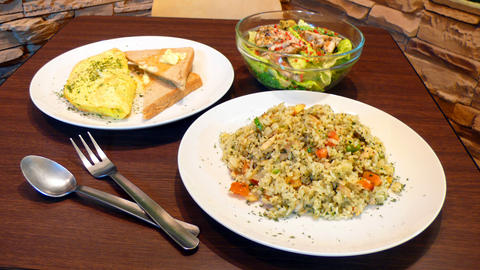
PHOTO: HO YI, TAIPEI TIMES
"I've always felt that the restaurant is a perfect place to make friends and have fun. People come here to share their lives and experiences, to enjoy the food and a good chat," Ling said.
The NT$90 omelet doesn't come any better. Options include onion and mushroom, sausage, Greek and Denver omelets and Mexican omelets with homemade chili sauce. The more creative can design their own.
If you think Omelet to Go would skimp on quality ingredients and use off-the-rack products to cut costs, the chicken pesto fried rice uses premium olive oil and baked pine nuts will prove you wrong. All the sauces and dressings are homemade from fresh ingredients bought at traditional markets and occasionally at high-end supermarkets.
The restaurant's specialties include chicken and beef burritos, enchilada and quesadilla as chef Yeh is a Mexican cuisine enthusiast and Ling's homemade cheesecake and brownies with ice cream could certainly satisfy dessert addicts.
Last words of warning for first-time diners: it can be rather difficult to find the joint, which is hidden in the labyrinth of alleys near Taipei City Council (台北市議會) at then end of Renai Road (仁愛路). Ringing the English-fluent staff for directions can save you lots of time.

Taiwan’s English education system is being pulled apart by three opposing forces. Bilingual Nation 2030 pulls students toward English and global communication. Artificial Intelligence (AI) readiness pulls them toward digital judgment, verification and AI-mediated work. But Taiwan’s old exam culture pulls them back toward memorization, grammar drills, timed reading and correct answers. If the education system keeps using old exams to define success, it risks producing graduates who are neither genuinely bilingual nor genuinely AI-ready, but trained for tasks machines can already perform. The first force is Bilingual Nation 2030. Launched in 2018, the policy aimed to “help Taiwan’s workforce connect

It seems every few days one bumps into one of those “real man” comments in which Taiwan is urged to “face reality” or similar, and “make a deal,” with the speaker implying that soon it will be too late. “Deal” advocates always present themselves as having a superior grip on reality, and the manly ability to make the “hard choice.” Their testosterone-laden language often echoes that of Taiwan sellout advocates. Note that such commentary always specifies a process (“make a deal, work with, make progress”), never the end state of what occupation by a violent authoritarian colonialist state will entail. In

There are shadowy cabals plotting to sell out Taiwan to be annexed by China, by invasion if necessary. Fortunately, they are buffoons. In 2019, former Bamboo Union gangster and founder of the China Unification Promotion Party (CUPP), Chang An-le (張安樂, colorfully known as “White Wolf”), led a protest at the Legislative Yuan against comments made by then-premier Su Tseng-chang (蘇貞昌) that in the event of an attack by China, he would never surrender, but would protect the nation by fighting to the end, even if he only had a broom. Chang had party members bring a wooden casket that they
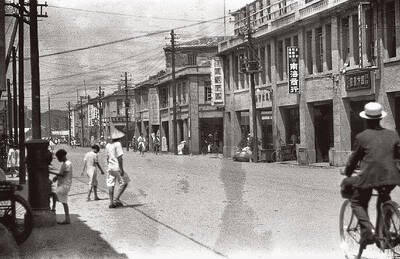
June 1 to June 7 "If all Taiwanese were as afraid of dying as you, then what would happen?” Physician Shih Chiang-nan (施江南) reportedly said this to his wife Chen Chiao-tung (陳焦桐) after she urged him to stop intervening on behalf of Taiwanese soldiers stranded overseas after serving in the Japanese Army during World War II. Shih had clashed with high-ranking officials over the issue, engaged in several heated arguments with Taiwan governor-general Chen Yi (陳儀) and allegedly shouted at general Ko Yuan-fen (柯遠芬), chief of staff of the Taiwan Garrison Command, over


 RSS
RSS