


When Han-Tang Yuefu Ensemble (漢唐樂府) first staged The Feast of Han Xizai (韓熙載夜晏圖) to great acclaim back in 2002 (reviewed in Taipei Times, April 19), the ensemble followed the centuries-old tradition of using male musicians.
The musicians rehearsing in a subterranean space on Nanjing East Road on Tuesday, however, are predominately female - a major change made by the ensemble's founder Chen Mei-o (陳美娥) and one that harks back to the period on which the opera is based.
The painting, of the same name, upon which Chen drew inspiration for The Feast of Han Xizai, depicts the lifestyle of the upper-class, with concubines performing for officials reclining on extravagant sofas.
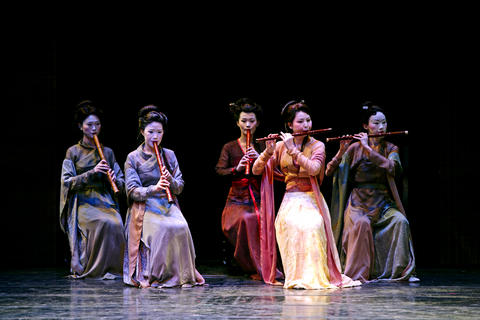
PHOTO: COURTESY OF NTCH
"After the Tang Dynasty, women were less commonly used in nanguan (南管) performances," Chen said. She added that women were often seen as more suited to learning the refined gestures and intricate music that are hallmarks of the nanguan style.
Knowledge of both music and movement are necessary to pulling off a nanguan performance. "The music and dance are intimately related," said 24-year old Angie Huang (黃淨偉). "If you don't understand the music you can't do the dance." The percussionist has studied and worked as a nanguan performer for over 10 years and says she is thrilled to have the opportunity to work with Chen.
According to Chen, following the demise of the Tang Dynasty, nanguan moved outside the palace walls and the upper class circles and gradually became an art form for commoners. Over the next century male actors replaced women as the performers due to the many dangers faced by traveling theater troupes.
For Chen, the painting not only serves as a departure to investigate people but also the period it depicts.
Han Xizai was a respected government official in the latter part of the Tang Dynasty and tutor to the emperor. He grew disenchanted with court intrigue and gave himself over to a life of pleasure, gaining a reputation for holding wild and lavish parties - events the emperor didn't attend because he was forbidden to leave the palace.
Learning of Han Xizai's activities, the emperor sent an artist to paint one of these great parties. Upon seeing the painting, the emperor became jealous of Han Xizai's lifestyle and stripped him of his titles.
Though the opera's players have changed to reflect greater historical verisimilitude to the painting's era, the sumptuous costumes and modern approach to stage design remain intact. Chen has retained Tim Yip (葉錦添), the Oscar-winning designer for Crouching Tiger, Hidden Dragon (臥虎藏龍), for costume and stage design.
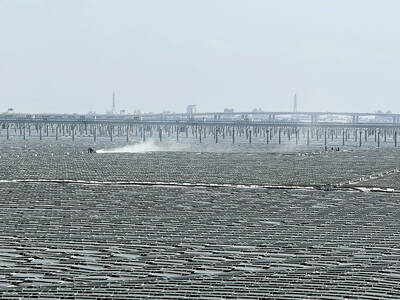
The arithmetic is straightforward and uncomfortable. By the end of 2025, Taiwan had committed itself to a 50-30-20 electricity mix — half natural gas, 30 per cent coal, 20 per cent renewables. The Ministry of Economic Affairs’s (MOEA) own monthly energy reports tell a different story. Natural gas reached 47.8 per cent of generation last year. Coal stood at 35.4 per cent, comfortably above its target ceiling. Renewables came in at 13.1 per cent, well short of the 20 per cent Taipei had pledged a decade earlier. Installed renewable capacity reached roughly half of the 12 gigawatts (GW) the government
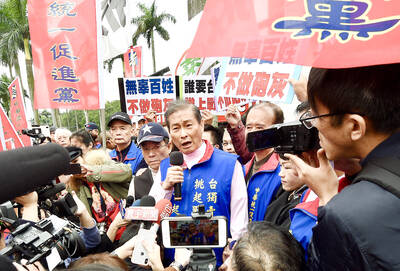
There are shadowy cabals plotting to sell out Taiwan to be annexed by China, by invasion if necessary. Fortunately, they are buffoons. In 2019, former Bamboo Union gangster and founder of the China Unification Promotion Party (CUPP), Chang An-le (張安樂, colorfully known as “White Wolf”), led a protest at the Legislative Yuan against comments made by then-premier Su Tseng-chang (蘇貞昌) that in the event of an attack by China, he would never surrender, but would protect the nation by fighting to the end, even if he only had a broom. Chang had party members bring a wooden casket that they
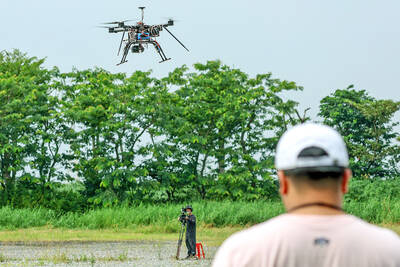
Taiwan’s drone exports are taking off, fuelled by the war in Ukraine, as Taiwanese companies seek a stake in the fast-growing global market for unmanned aerial vehicles (UAV). Low-cost drones used for reconnaissance and strikes are in high demand as governments around the world boost defense spending in the face of intensifying conflicts. A relative new player in the increasingly competitive industry, Taiwan’s pitch is to be an “Asian hub” for the production of UAVs and components free of Chinese materials, or “non-red.” That means its UAVs can be up to three times more expensive than their Chinese competitors, like the world’s biggest
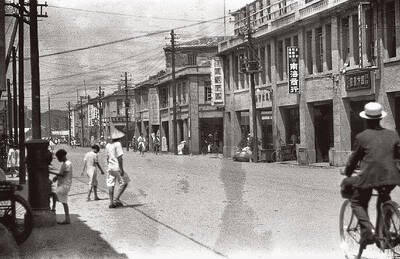
June 1 to June 7 "If all Taiwanese were as afraid of dying as you, then what would happen?” Physician Shih Chiang-nan (施江南) reportedly said this to his wife Chen Chiao-tung (陳焦桐) after she urged him to stop intervening on behalf of Taiwanese soldiers stranded overseas after serving in the Japanese Army during World War II. Shih had clashed with high-ranking officials over the issue, engaged in several heated arguments with Taiwan governor-general Chen Yi (陳儀) and allegedly shouted at general Ko Yuan-fen (柯遠芬), chief of staff of the Taiwan Garrison Command, over


 RSS
RSS