


Group 13 moves graffiti from the street into the gallery. The curator takes scrawls in an alley and passes them off as legitimate works of art. It's a transformation that has already happened elsewhere but has found a home of sorts in Taipei, at AMPM.
The Canadian aerosol artist Dbsk1 founded the gallery in Ximending at the beginning of the year and it has held a number of graffiti and photography exhibitions, including installations.
The route from avant-garde to mainstream, from the underground to overground, is a well-trodden one and the only surprise is established gallery owners here have not capitalized on it sooner.
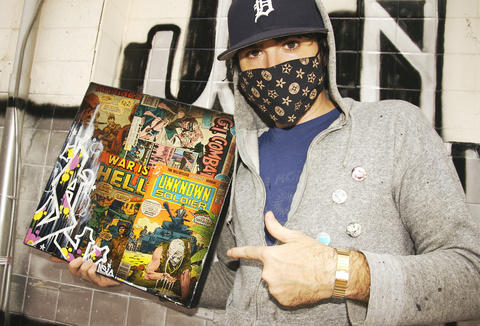
PHOTOS: JULES QUARTLY, TAIPEI TIMES
"We show the low-brow and underground because no-one else is doing that here. At home [Montreal] there's plenty of shows," says Dbsk1, who uses a number of aliases and is usually photographed with a face mask.
"I have to protect myself. I still do a lot of street stuff and it also keeps the mysterious street scene vibe goin', as opposed to the commercial scene."
Writing graffiti in Taipei is a public order offence under the category of defacing public property and offenders are subject to fines of NT$4,500.
In practice, however, the authorities are fairly lenient and Taipei seems liberal compared with some Western countries. Dbsk1 says he has been pulled a couple of times for tagging but was not fined.
In the UK, former prime minister Tony Blair signed a charter saying, "Graffiti is not art, it's crime," New York set up an anti-graffiti task force and Chicago fines perpetrators US$500.
"It's more easygoing than back in Canada. There's places here where you can do stuff legally - like the levee walls - and where it's kinda accepted," Dbsk1 says.
You can check graffiti out for yourself at sites like the Jianguo Beer Factory, Huashan Culture Park, all around Ximending (especially Cinema Park) and the East Side shopping district around Zhongxiao East Road.
CityStalker is possibly the most famous/infamous local graffiti artist and has been working since 2000, when tags in New Zealand inspired him. He was caught once in Ximending.
"I was working on a piece and this guy was watching me, but I paid no attention. Then the police turned up and it turned out the guy watching was a community officer," CityStalker says.
"They started writing me a red ticket when the [community officer] says, 'Why don't you let him finish the piece, it will look better if he does.'"
Despite the gallery, Dbsk1 emphasizes the "close-to-the-edge" buzz of illegal graffiti work. He admits to walking a "blurry line" between sellout and commercial artist.
Though he has done work for Philips, the city's MRT company and worked as a graphic artist on games, the credibility factor is important to him.
CityStalker, on the other hand, seems more comfortable with the transition. He studied art at college and calls himself a "new school artist," working primarily with stencils and spray paint.
He sees the AMPM show as a way to move out of the shadows and into the spotlight, where he can make a living doing what he's good at.
From its anti-establishment roots in 1970s New York, graffiti has moved from the underpass into the art arena where it is commoditized.
It mirrors the history of art production, which often begins with outsiders and the critics saying, 'That's not art,' then it becomes the norm.
Writing graffiti is as ancient as cave painting and tagging is about as basic as a dog marking its territory by urinating against the wall. Even so, in addition to being ascribed a value, graffiti has developed an aesthetic.
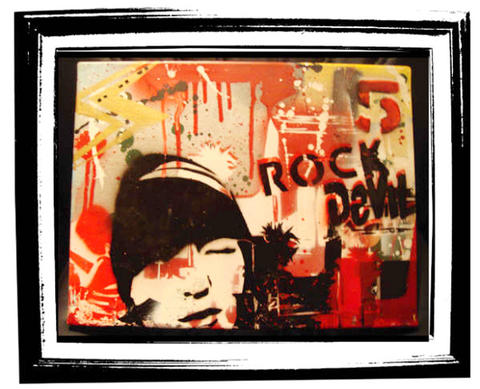
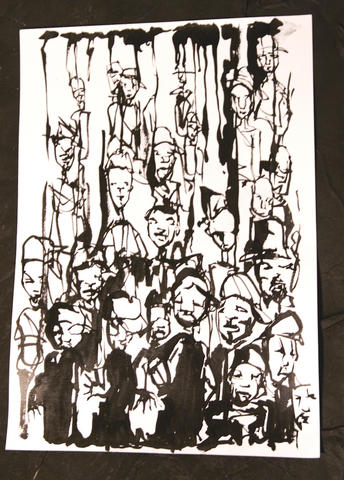
As such, the artist's medium has changed even though the intent is the same, namely to express something. The 13 local and international artists presented at AMPM all do so in fresh, colorful and innovative ways.
From the lettering and anime-inspired work of Jahan, to the graphic designs of Winston and combo lettering of Dabs1, the Group 13 Exhibition shows off the best in local street art.
Trick and Utah's photo installation, Setr's freight train documentary and the film Reefer Madness add to the mix. There will also be DJs, refreshments and an art raffle at the opening.

Taiwan’s English education system is being pulled apart by three opposing forces. Bilingual Nation 2030 pulls students toward English and global communication. Artificial Intelligence (AI) readiness pulls them toward digital judgment, verification and AI-mediated work. But Taiwan’s old exam culture pulls them back toward memorization, grammar drills, timed reading and correct answers. If the education system keeps using old exams to define success, it risks producing graduates who are neither genuinely bilingual nor genuinely AI-ready, but trained for tasks machines can already perform. The first force is Bilingual Nation 2030. Launched in 2018, the policy aimed to “help Taiwan’s workforce connect

It seems every few days one bumps into one of those “real man” comments in which Taiwan is urged to “face reality” or similar, and “make a deal,” with the speaker implying that soon it will be too late. “Deal” advocates always present themselves as having a superior grip on reality, and the manly ability to make the “hard choice.” Their testosterone-laden language often echoes that of Taiwan sellout advocates. Note that such commentary always specifies a process (“make a deal, work with, make progress”), never the end state of what occupation by a violent authoritarian colonialist state will entail. In
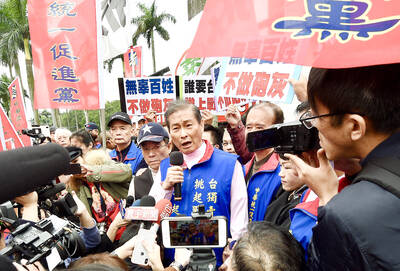
There are shadowy cabals plotting to sell out Taiwan to be annexed by China, by invasion if necessary. Fortunately, they are buffoons. In 2019, former Bamboo Union gangster and founder of the China Unification Promotion Party (CUPP), Chang An-le (張安樂, colorfully known as “White Wolf”), led a protest at the Legislative Yuan against comments made by then-premier Su Tseng-chang (蘇貞昌) that in the event of an attack by China, he would never surrender, but would protect the nation by fighting to the end, even if he only had a broom. Chang had party members bring a wooden casket that they
June 1 to June 7 "If all Taiwanese were as afraid of dying as you, then what would happen?” Physician Shih Chiang-nan (施江南) reportedly said this to his wife Chen Chiao-tung (陳焦桐) after she urged him to stop intervening on behalf of Taiwanese soldiers stranded overseas after serving in the Japanese Army during World War II. Shih had clashed with high-ranking officials over the issue, engaged in several heated arguments with Taiwan governor-general Chen Yi (陳儀) and allegedly shouted at general Ko Yuan-fen (柯遠芬), chief of staff of the Taiwan Garrison Command, over


 RSS
RSS