


Design professor Kristy Cha Ray Chu (曲家瑞) had a student who painted nipples on a T-shirt and sold it at an art market. Chu normally shops in San Francisco and New York but was impressed by the statement and bought the shirt.
"I asked her if she was embarrassed and she said no. She doesn't like wearing bras but you can't do that in Taiwan. So she painted nipples on a T-shirt," Chu said.
Handmade items like Chu's shirt have been gaining popularity through Taiwan's growing number of art markets. High school and college students flock to the city-hopping Campo Life Art Carnival (CAMPO生活藝術狂歡節) for cheap, non-corporate clothing and accessories. Fashionistas and stylists find more expensive items at the monthly market held at Eslite Bookstore Dunnan Branch (敦南誠品書店) in Taipei, which evolved from an illegal street market that pops up outside the store at night.
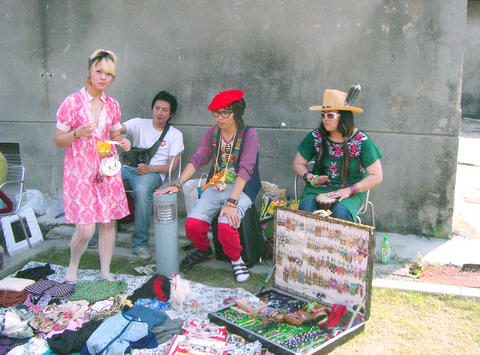
PHOTO: COURTESY OF CAMPO
Late last year, the first Urban Simple Life (簡單生活節) music festival selected 100 independent vendors through a competitive process to sell clothes, furniture and jewelry inside festival grounds. Next month's Taipei Film Festival will incorporate an art market. Even Starbucks is planning one.
"Everyone wants to have something to do with the creative market thing," said Chu, director of Shih-Chien University's (實踐大學) Institute of Fashion and Communications Design. "Before these people used the make these things at home behind closed doors. Now they have a stage."
The next Campo starts tomorrow at 2pm in Bitan (碧潭) a three-minute walk from the Xindian (新店) MRT station in Sindian, Taipei County. There, 60 independent vendors will sell T-shirts, bags, stationery and dolls. Campo is taking a cue from recent music festivals and has reserved booths for groups like Purple Ribbon (天空紫絲帶), which fights domestic violence. Indie-electronica bands Nylas and Varo will provide musical entertainment at the market between 2pm and 4pm. Following that, DJs from Lim Giong's (林強) Her-He Party crew will take over until Campo closes at 9pm. Last month's Campo, also held at Bitan, featured 100 designers and attracted around 3,000 visitors. Organizer A-li (陳昱興) said the market is looking for a permanent home in Taipei, after spending the last year touring the island and staging one event in Beijing.
Then on Saturday, June 30, from 10am to 9pm, several dozen Shih-Chien University students, 40 other designers, and a few indie-rock bands will stage their own art market in Taipei's Huashan Arts District at 1 Bade Rd, Taipei (台北市八德路一段1號). The students will sell T-shirts and post cards bearing their graphic art and photography. Expect more avant-garde work here, because the Shih-Chien students will be selling things they made for class projects.
Chu thinks creative markets like Campo could be a passing fad, because the vendors focus on short-term profits instead of developing radical designs that might take years to become trendy. And fashion houses go to student exhibitions and the annual Taiwan New Designer's Exhibition (新一代設計展) to look for inspiration and talent to hire. "I think we're not really good at organizing markets [in Taiwan] because you see all sorts of things in one market, unlike in New York or London where you have markets that specialize in different things, like antiques or vintage clothes," she said.
Eyes (大眼) - a Campo regular whose clothes and accessories sell under the eyesQ label at Zabu in the Shida area and JuJu AMa on Dunhua South Road - said many vendors go to Campo to make money or break even. "But the other half aren't there to make money," she said, "they're there because it's fun."
To be sure, Chu has seen students, such as Wu Cheng-an (吳政安), parlay a Campo booth into successful business ventures. And she praises Campo for showing people that you don't have to be a formally trained artist or designer to do good work. "A lot of people at Campo have no design or art background … but it's amazing how creative they can be," she said.
Taiwan’s English education system is being pulled apart by three opposing forces. Bilingual Nation 2030 pulls students toward English and global communication. Artificial Intelligence (AI) readiness pulls them toward digital judgment, verification and AI-mediated work. But Taiwan’s old exam culture pulls them back toward memorization, grammar drills, timed reading and correct answers. If the education system keeps using old exams to define success, it risks producing graduates who are neither genuinely bilingual nor genuinely AI-ready, but trained for tasks machines can already perform. The first force is Bilingual Nation 2030. Launched in 2018, the policy aimed to “help Taiwan’s workforce connect
It seems every few days one bumps into one of those “real man” comments in which Taiwan is urged to “face reality” or similar, and “make a deal,” with the speaker implying that soon it will be too late. “Deal” advocates always present themselves as having a superior grip on reality, and the manly ability to make the “hard choice.” Their testosterone-laden language often echoes that of Taiwan sellout advocates. Note that such commentary always specifies a process (“make a deal, work with, make progress”), never the end state of what occupation by a violent authoritarian colonialist state will entail. In
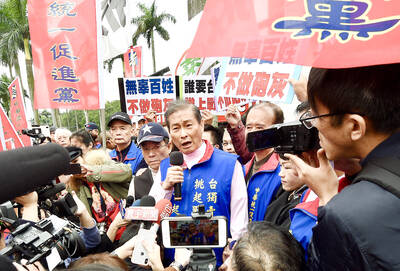
There are shadowy cabals plotting to sell out Taiwan to be annexed by China, by invasion if necessary. Fortunately, they are buffoons. In 2019, former Bamboo Union gangster and founder of the China Unification Promotion Party (CUPP), Chang An-le (張安樂, colorfully known as “White Wolf”), led a protest at the Legislative Yuan against comments made by then-premier Su Tseng-chang (蘇貞昌) that in the event of an attack by China, he would never surrender, but would protect the nation by fighting to the end, even if he only had a broom. Chang had party members bring a wooden casket that they
June 1 to June 7 "If all Taiwanese were as afraid of dying as you, then what would happen?” Physician Shih Chiang-nan (施江南) reportedly said this to his wife Chen Chiao-tung (陳焦桐) after she urged him to stop intervening on behalf of Taiwanese soldiers stranded overseas after serving in the Japanese Army during World War II. Shih had clashed with high-ranking officials over the issue, engaged in several heated arguments with Taiwan governor-general Chen Yi (陳儀) and allegedly shouted at general Ko Yuan-fen (柯遠芬), chief of staff of the Taiwan Garrison Command, over


 RSS
RSS