


In his third feature film, Chinese director Teng Huatao (滕華濤) turns to horror, a genre that has been mostly overlooked by contemporary Chinese cinema. Set in 1930s Shanghai, The Matrimony starts on a melodramatic note when radio hostess Manli (Fan Bingbing) dies in a car accident in front of her cinematographer boyfriend Junchu (Leon Lai), who had been about to propose to her. In his anguish, Junchu shuts himself off from everyone, including Sansan (Rene Liu), the woman his mother forces him to marry after Manli's death.
fil
Tortured by her unrequited love for Junchu, Sansan wanders their mansion, which is filled with strange whispers and shadows at night. One night, Manli's spirit appears out of nowhere and proposes a deal. The ghost will possess Sansan's body and visit Junchu, who at this point is in the hospital with a life-threatening illness.

Sansan agrees, and after further possessions comes to resemble Manli more and more. She grows closer to her husband, who seems to be learning how to move on with life. Manli is furious. Consumed with jealousy, she is determined to get her lover back at any cost.
World-class cinematographer Mark Lee Pingbing (李屏賓), who has worked with first-rate directors like Hou Hsiao-hsien (侯孝賢) and Wong Kar-wai (王家衛), paints The Matrimony with a cold, bluish palette for an eerie, mysterious mood. Thrill-seekers looking for a good scare will be disappointed, however, as this movie is not designed to terrify viewers so much as it is to use horror as a vehicle for what would otherwise be just another hackneyed triangular love story.
Apart from a narrative twist that only reveals itself at the end, the storyline is straightforward and offers few surprises. Some viewers will no doubt see the film as simply the fulfillment of a man's wish to be desired by two beautiful women, one seductive and the other virtuous and subservient.

More charitably, the movie could also be seen as a reflection on how love can bring out the worst in people. Though depicted as a tender, caring lover, Junchu is also weak-willed and selfish. Both traits are revealed early in the story when he acquiesces to his arranged marriage, then treats his new wife with indifference while he pines for Manli. Sansan is the incarnation of virtue and selfless love, but she also compromises herself by making a deal with a ghost in order to win Junchu's affections.
It is Manli's desire to possess her lover that gives the film its psychologically chilling moments. Her ghost is the archetypal goddess of revenge whose insanity destroys all in the name of love.
The Matrimony boasts a star-studded cast from Taiwan, Hong Kong and China, but suffers from a mediocre script and lackluster performances. In the end, it's just another love story interspersed with a few scary scenes and special effects.

PHOTOS: COURTESY OF SWALLOW WINGS

Taiwan’s English education system is being pulled apart by three opposing forces. Bilingual Nation 2030 pulls students toward English and global communication. Artificial Intelligence (AI) readiness pulls them toward digital judgment, verification and AI-mediated work. But Taiwan’s old exam culture pulls them back toward memorization, grammar drills, timed reading and correct answers. If the education system keeps using old exams to define success, it risks producing graduates who are neither genuinely bilingual nor genuinely AI-ready, but trained for tasks machines can already perform. The first force is Bilingual Nation 2030. Launched in 2018, the policy aimed to “help Taiwan’s workforce connect
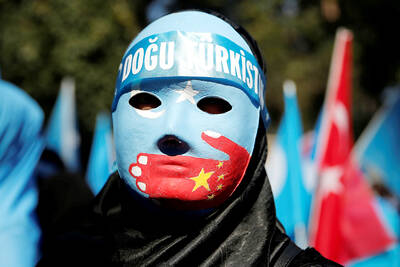
It seems every few days one bumps into one of those “real man” comments in which Taiwan is urged to “face reality” or similar, and “make a deal,” with the speaker implying that soon it will be too late. “Deal” advocates always present themselves as having a superior grip on reality, and the manly ability to make the “hard choice.” Their testosterone-laden language often echoes that of Taiwan sellout advocates. Note that such commentary always specifies a process (“make a deal, work with, make progress”), never the end state of what occupation by a violent authoritarian colonialist state will entail. In
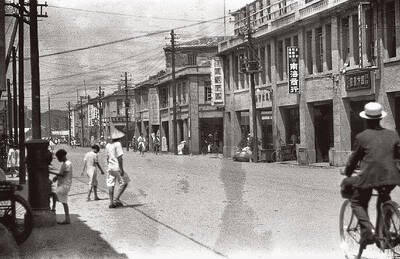
June 1 to June 7 "If all Taiwanese were as afraid of dying as you, then what would happen?” Physician Shih Chiang-nan (施江南) reportedly said this to his wife Chen Chiao-tung (陳焦桐) after she urged him to stop intervening on behalf of Taiwanese soldiers stranded overseas after serving in the Japanese Army during World War II. Shih had clashed with high-ranking officials over the issue, engaged in several heated arguments with Taiwan governor-general Chen Yi (陳儀) and allegedly shouted at general Ko Yuan-fen (柯遠芬), chief of staff of the Taiwan Garrison Command, over

“Taiwan’s Opposition Leader Comes to US With a Message Straight Out of Beijing” read a May 31 headline in the Wall Street Journal. Top US administration officials and members of Congress almost certainly read the WSJ, and if there was a bullet point takeaway that people in Washington should absorb ahead of Chinese Nationalist Party (KMT) Chair Cheng Li-wun’s (鄭麗文) arrival in DC on June 9, that headline is it. The last few columns have discussed this very topic, and the timing is not coincidental. While those top officials likely do not read the Taipei Times, judging by the number


 RSS
RSS