


Ganovak (潘永福) felt the spirits of his ancestors all around him as he scaled Chenfengshih Mountain (真風矢山) in search of a 500 year-old legendary settlement called Vata (瓦達). Over the years, several members of the Majia (瑪家) tribe, from which Ganovak hails, had hacked their way through the thick jungle blanketing the mountains in search of their ancestral home, abandoned over 100 years ago.
All had failed.
But last April, Ganovak's party of four stumbled onto part of the settlement's remains — three traditional slate houses ravaged by time and hidden amongst the dense underbrush. Later that day, an earthquake struck as the party was descending the mountain.
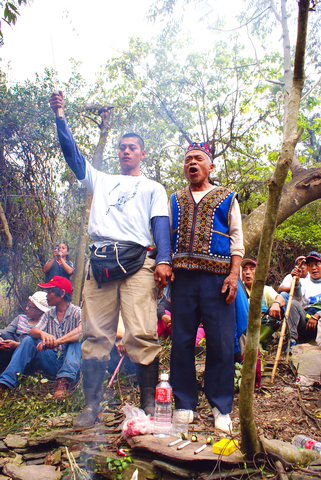
PHOTOS: NOAH BUCHAN, TAIPEI TIMES
"The earthquake was a sign that our ancestors were touched by what we found," Ganovak said.
Earlier this month, Ganovak led a different party up the mountain. The group of 30 people didn't only consist of woodsmen: there were farmers and housewives, grandmothers, elders and several young members of the tribe.
Part of the Paiwan group of indigenous peoples, the Majia live in the mountainous regions of Pingtung, close to Sandimen (三地門), where the elders communicate with each other using their own language and Mandarin to speak with outsiders.
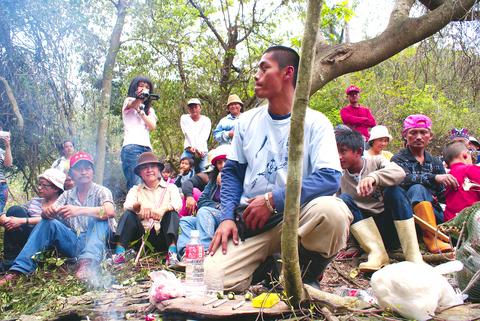
The houses that Ganovak found prove that the Majia tribe has inhabited the area for centuries.
Root searching
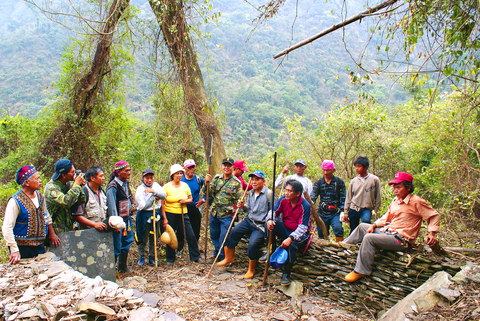
The assembled group has come to participate in an activity that is becoming increasingly common among Taiwan's indigenous population: searching for their roots (尋根). The tribe will spend the morning hiking up the mountain and meeting up with another group of Aboriginals from the same tribe, who are hiking in from a different direction. Together they will perform a ritual that is symbolically meant to recover the land. It will also provide the tribe's elders an opportunity to impart some wisdom to members of the younger generation.
As Ganovak leads the group from the bottom of the mountain, up a dry riverbed to the jungle and eventually one of the settlement's houses, he spray paints red arrows on the rocks to show the way and carves symbols into trees so that people don't get lost. One hunter carries a musket-like rifle, fashioned with his own hands and brought for the purpose of shooting mountain boar or any other animal that might attack.
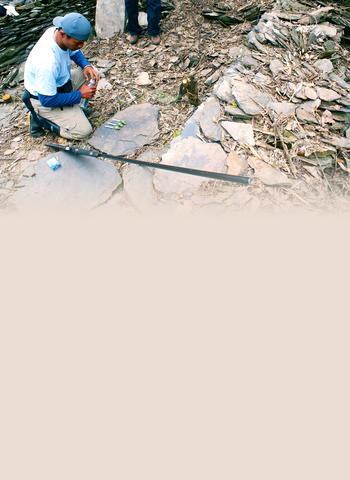
A few hunters reach the camp before the rest of the party and decide to hike further up the mountain where other houses have been found.
As the smaller party passes a ruin, Ganovak says, "This house here is about 660 years old."
Though the settlement's age has yet to be independently verified by experts, Ganovak is convinced of its antiquity because of the stories handed down from his ancestors.
Barilas (蔡花仔) — the tribe's most revered hunter — sits with another hunter on the crumbling slate house and reminisces about his ancestors. This is the first time the 80-year-old elder has visited the settlement.
"We have come here to tell stories about our ancestors and the settlement," he says when asked why he joined the trip. "[We also] want to create some memories for the younger generation," he adds while chewing betel nut.
Barilas is one of many elders who feel that tracing their tribe's history is important as many of the younger generation are moving to the cities and leaving their cultural roots behind.
After 30 minutes, the party that hiked in from another direction comes crashing out of the jungle. There are about a dozen people, including a chief's son Valjakas. The group surveys the scene in front of them and then wanders back to where the rest of the party is located, about a 10-minute hike.
Once assembled, Ljaljeqelan (拉勒峨嵐, pronounced La-la-ke-lan) — the activity's head organizer — leads the group in prayer, a reminder of the influence Christianity holds over the tribe.
When the prayer is finished, Valjakas (江信忠 — pronounced Val-a-kas), performs a ritual that at once gives thanks to his ancestors and begs for their protection. With slabs of mountain pig sizzling on a slate barbeque close by, he lays out three betel nuts and three cigarettes on the remains of one of the old houses.
Aware that he is performing a ritual traditionally left to elders, Valjakas is a little circumspect as he lights offerings of cigarettes one by one.
"The first cigarette and betel nut are for the spirits that live here," he says in Mandarin. "Thank you for protecting this place."
"The second is for our ancestors. May they remain and protect our homeland. The third is for the ghost. May it not disturb this sacred place"
After lighting the last cigarette, he picks up a bottle of rice wine and says "My name is Valjakas and I show my respect to you all with this rice wine."
The root of the matter
According to Hu Chia-yu (胡家瑜), a professor of anthropology at National Taiwan University who participated in this and other trips, such research is at the center of Aboriginal identity, which was largely defined by different colonial regimes.
During the Qing Dynasty, the indigenous peoples of Taiwan were classified into those who gave tribute to their Chinese rulers — thus classified as Han people — and the "savages" who did not.
When Japan took over the island at the end of the 19th century the authorities embarked on a policy of first classifying the indigenous population and then "civilizing" them. To implement this policy, the Japanese relocated remote mountain villages to areas where they could be placed under administrative control and anthropologists could study their way of life.
This could explain why Vata was abandoned 100 years ago.
"Paiwan was [a name] assigned by Japanese anthropologists at the end of the nineteenth century and they said 'okay these few villages belong to Paiwan' and in these 100 years they developed [the] identity of Paiwan. But they still have different diversity inside. Some language is different within the Paiwan," Hu said.
Using primitive methods of classification, Japanese anthropologists identified nine distinct indigenous groups and as the Japanese bureaucracy further infiltrated all parts of the island, tribal life was replaced by so-called civilizing policies, meant to bring the indigenous people into Japan's fold.
The Chinese Nationalist Party (KMT) policy on the island after 1949 stressed sinicization, with an emphasis on Mandarin, history, customs and an educational curriculum steeped in KMT ideology.
Greater recognition
With democratization, the island's indigenous peoples demanded greater control over their identity. Responding to the needs of indigenous peoples, the central government formed a Cabinet-level Aboriginal Affairs Commission in December, 1999, renamed the Council of Indigenous Peoples, Executive Yuan (行政院原住民族委員會), in March 2002.
Since the council was established, four new tribes have been added to the original nine.
Formal recognition by the Council confers legal benefits and rights upon a group. It also provides the tribe with the satisfaction of recovering their separate identity as a people.
Though the process for recognition is not directly based on root searching, the trip is a powerfully symbolic way for local Aboriginal leaders to increase their power and awareness of a tribe's uniqueness.
According to Lin Chiang-i (林江義), the council's director for planning, tribes wanting recognition must gather a body of supportive evidence in order to successfully petition the council.
"This includes their language, history and the locations where the tribe currently resides. But one of the most important factors is tracing the genealogical roots of members of the group," he said.
Back on the mountain Baribas stands with Valjakas and calls out to their ancestral spirits. Four hunters lift their guns and fire into the air and a feast consisting of sticky rice wrapped in leaves and mountain boar begins.
Valjakas says he is looking forward to the stories told by the elders.
"It is the best way to keep contact with our ancestors," he says.

Michael slides a sequin glove over the pop star’s tarnished legacy, shrouding Michael Jackson’s complications with a conventional biopic that, if you cover your ears, sounds great. Antoine Fuqua’s movie is sanctioned by Jackson’s estate and its producers include the estate’s executors. So it is, by its nature, a narrow, authorized perspective on Jackson. The film ends before the flood of allegations of sexual abuse of children, or Jackson’s own acknowledgment of sleeping alongside kids. Jackson and his estate have long maintained his innocence. In his only criminal trial, in 2005, Jackson was acquitted. Michael doesn’t even subtly nod to these facts.
Writing of the finds at the ancient iron-working site of Shihsanhang (十 三行) in New Taipei City’s Bali District (八里), archaeologist Tsang Cheng-hwa (臧振華) of the Academia Sinica’s Institute of History and Philology observes: “One bronze bowl gilded with gold, together with copper coins and fragments of Tang and Song ceramics, were also found. These provide evidence for early contact between Taiwan aborigines and Chinese.” The Shihsanhang Web site from the Ministry of Culture says of the finds: “They were evidence that the residents of the area had a close trading relation with Chinese civilians, as the coins can be

The March/April volume of Foreign Affairs, long a purveyor of pro-China pablum, offered up another irksome Beijing-speak on the issues and solutions for the problems vexing the People’s Republic of China (PRC) and the US: “America and China at the Edge of Ruin: A Last Chance to Step Back From the Brink” rang the provocative title, by David M. Lampton and Wang Jisi (王緝思). If one ever wants to describe what went wrong with US-PRC relations, the career of Wang Jisi is a good place to start. Wang has extensive experience in the US and the West. He was a visiting

The January 2028 presidential election is already stirring to life. In seven or eight months, the primary season will kick into high gear following this November’s local elections. By this point next year, we will likely know the Democratic Progressive Party (DPP) candidate and whether the Taiwan People’s Party (TPP) will be fielding a candidate. Also around this time, the Chinese Nationalist Party (KMT) will either have already completed their primary, or it will be heading into the final stretch. By next summer, the presidential race will be in high gear. The big question is who will be the KMT’s


 RSS
RSS