


If you're wondering why the new movie 300 looks like nothing you've ever seen, the basic reasons are as old as civilization itself: art and commerce.
Director Zack Snyder was determined to render the drawings of Frank Miller's graphic novel, about the 480BC Battle of Thermopylae, as faithfully as a movie could.
Warner Bros, which has been burned recently on such sword-and-sandal epics as Troy and Alexander, wanted the tale of the 300 Spartans who stood against a quarter-million-man Persian army made inexpensively.

PHOTOS COURTESY OF WARNER BROS
The solution to both concerns? Shoot the actors in a converted locomotive factory against a blank bluescreen in tax-break haven Montreal. Then fill in ancient Greece digitally.
"The idea was to create a world, more than anything, that you hadn't seen before," says Bernie Goldmann, one of so many producers of the movie that they jokingly refer to themselves as 300, too.
"The thinking was that the epic was dead and needed to be reinvented. This movie was made at a third of the (usual) cost of those movies, and that was part of it. But it was also to make something that was going to ignite an audience and bring them into that world; to create the world of 480BC, or, more accurately, a fantastic version of that world."
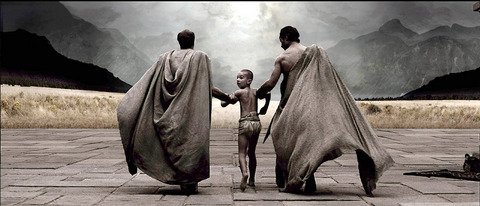
Doesn't sound all that different from what Robert Rodriguez did with his movie version of one of Miller's graphic novels, Sin City.
Except that it's in color. And was shot on film instead of videotape to give it a grittier, more naturalistic look.
And there's the fact that 300 is based on an historical event. Although, by sticking to the comic's narrative, Snyder sees the film more as a piece of heroic propaganda, told by one escaped Spartan for the purpose of rallying other Greeks against the invaders.
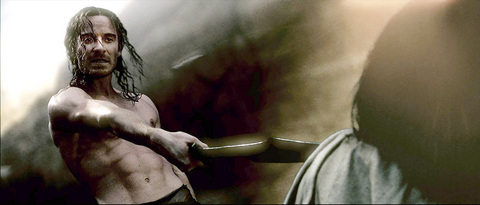
"I would say 90 percent of the scenes in the movie are from the graphic novel, and the dialogue as well," says Snyder, a commercials/music video veteran whose first feature was the well-received Dawn of the Dead remake. "I was really conscious of that. It was my goal to get the tone of the graphic novel — not just the shots, but the feeling that you get from it."
That feeling is one of masculine bravado, with one strong gal added to the mix. Scottish actor Gerard Butler plays Sparta's King Leonidas, and England's Lena Headey is his wife, Queen Gorgo. While he heads off with his personal guard to hold the Hot Gates, she tries to convince the city-state's council to back the war.
The rest of the movie is pretty much mayhem, with the Spartan soldiers fighting off all the troops (plus a few creatures that seem to have wandered in from Middle-earth) under the command of Persian Emperor Xerxes (Brazil's Rodrigo Santoro, from TV's Lost).
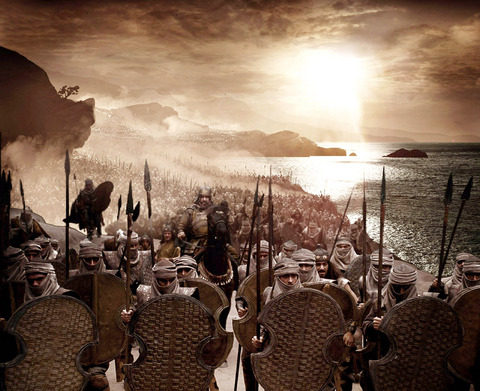
Sporting their famous shields and clad in little more than helmets and capes, the Spartans had to look and move like the superb fighting machines that the culture made of its men. To buff up the actors, Snyder brought in world-class sadists ... er, physical trainers.
"Mark Twight is this nut-job mountain climber who trains other mountain climbers, cage fighters and undercover operatives," Butler growls. "We would do competitive circuit training against each other, running around with very primitive tools such as Kettlebells and medicine balls. You were dead by the end of it.
"That was mental conditioning, too; you really had to endure exhaustion and pain."
"Their bodies were their characters," Snyder explains. "It wasn't like I made them work out because there was a scene in the movie where they were going to get naked and they needed to look good.
"That's vanity, and that's fine. But as Spartans, when the actors worked out, they were working on their characters."
As for reports that some of the Spartan muscle is as virtual as Xerxes' thousand-ship fleet, "There is no CG work, we didn't have enough money for that," Snyder responds. "Every now and then, there was a little bit of makeup. But they've still gotta move, they've still gotta be lit. You can't just paint on abs."
Looking good fighting was one thing. Figuring out how to fight against foes and weaponry that weren't really there took a whole different kind of mental conditioning.
"It's restrictive because the actors have to understand where they are in three-dimensional space, and they don't have landmarks to help them with that," Snyder acknowledges. "But once they started to trust that I knew where they were, I think it was OK. I would say, like, 'Don't get hit in the head by this guy's stick,' and that worked pretty good."
"There were a few times when I had to shout at armies that didn't exist, or Xerxes was a point in the roof," Butler recalls of working on the essentially empty soundstages. "That's the weird thing about doing a film like this, but you know what? This is cool. It's a whole new way of acting; let's just dig it rather than bitch about it."
So just how Spartan were the bluescreen stages? Parts of the city of Sparta were physically constructed, as was some of Thermopylae's rocky terrain. Most everything else, though — mountains, roiling seascapes, surrealistically atmospheric skies — was achieved via some 1,300 visual-effects shots.
"We had a philosophy that, if you touched it, we should build it, but if you don't touch it, sorry," Snyder says, chuckling. "As you can imagine, it creates some freedom. We could go anywhere and still stay in the same place. But the difficulty came from the fact that it was a process that took steps. It was a long process of discovery. But when you finally get the final shot back, I've got to say it's a rewarding experience because, in some ways, it's so different from what you filmed that it's almost like seeing another movie."
So how much, exactly, does 300 owe to the method used for Sin City?
"Shooting a guy against bluescreen, then putting a background behind him, is not a super-new concept," Snyder says. "You see it on the news, really, in the weather report. But what Sin City did do was make the idea of a Frank Miller aesthetic a commercial and viable thing for the studio. They understood the concept of making a movie exactly as it appears in the graphic novel. Before that, the idea of 'we're just going to shoot the comic book' wasn't a thing that they necessarily wanted."
The Comic Con crowd has been droolingly awaiting the movie for more than a year — but the same types were also excited about Snakes on a Plane, and we all know how that did. And though the movie never hints at the homosexuality that was endemic to Spartan culture, a strong gay audience seems assured. But will other audience segments, like women in general, go for a film with such copious butchery?
"To me — and maybe it's because I'm spending a lot of time with my husband, who seems to really enjoy the violence — it's very beautiful in the movie," says Deborah Snyder, the director's wife and another one of 300's producers. "It's still a battle, and it's still brutal, but it's done in such a beautiful way that I don't think it affects me in the same way as a Saving Private Ryan.
"It also has a really strong female character who is central," she adds. "And the guys ... there's a lot to look at."
Former Warner Bros executive and now, yes, another 300 producer, Mark Canton, claims that 300 is already a template for future ambitious productions, even before the response comes in.
"One of the things that makes it a new-fashioned movie is that it's not a very expensive movie," Canton says. "The reference in the community already is, 'How do we make movies like they made 300?' in terms practical and audacious at the same time."

By global standards, the traffic congestion that afflicts Taiwan’s urban areas isn’t horrific. But nor is it something the country can be proud of. According to TomTom, a Dutch developer of location and navigation technologies, last year Taiwan was the sixth most congested country in Asia. Of the 492 towns and cities included in its rankings last year, Taipei was the 74th most congested. Taoyuan ranked 105th, while Hsinchu County (121st), Taichung (142nd), Tainan (173rd), New Taipei City (227th), Kaohsiung (241st) and Keelung (302nd) also featured on the list. Four Japanese cities have slower traffic than Taipei. (Seoul, which has some

Michael slides a sequin glove over the pop star’s tarnished legacy, shrouding Michael Jackson’s complications with a conventional biopic that, if you cover your ears, sounds great. Antoine Fuqua’s movie is sanctioned by Jackson’s estate and its producers include the estate’s executors. So it is, by its nature, a narrow, authorized perspective on Jackson. The film ends before the flood of allegations of sexual abuse of children, or Jackson’s own acknowledgment of sleeping alongside kids. Jackson and his estate have long maintained his innocence. In his only criminal trial, in 2005, Jackson was acquitted. Michael doesn’t even subtly nod to these facts.

Writing of the finds at the ancient iron-working site of Shihsanhang (十 三行) in New Taipei City’s Bali District (八里), archaeologist Tsang Cheng-hwa (臧振華) of the Academia Sinica’s Institute of History and Philology observes: “One bronze bowl gilded with gold, together with copper coins and fragments of Tang and Song ceramics, were also found. These provide evidence for early contact between Taiwan aborigines and Chinese.” The Shihsanhang Web site from the Ministry of Culture says of the finds: “They were evidence that the residents of the area had a close trading relation with Chinese civilians, as the coins can be
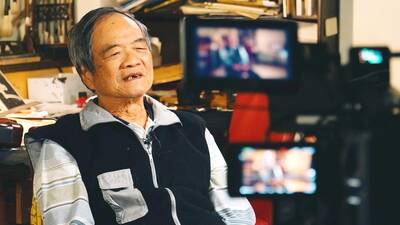
During her 2015 trip to Taiwan, Sophia J. Chang (張詠慧) got fewer answers than she’d hoped for, but more revelations than she could have imagined. “That was the year I last saw my grandmother. She was in hospice care in Tainan, and it was painful to see her in bed, barely able to open her eyes,” says Los Angeles-born Chang. “The grandma I’d known, a fantastic cook and incredibly kind, was already gone.” After their visit, Chang and her grandfather went back to his apartment. There she asked him how he’d met her grandmother. “He hesitated, then started talking a bit.


 RSS
RSS