


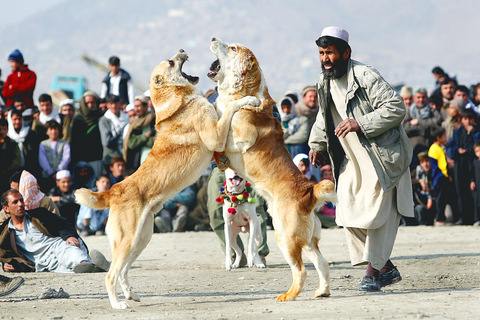
The two opponents padded and paced on a snow-covered basketball court, waiting for their fight to begin.
They were adult Central Asian wolf dogs in the middleweight class. Both were undefeated in a combined 42 appearances in Russia's fightingdog rings. Each weighed more than 45kg.
The referee gave the sign. Their trainers released them. The dogs growled, lunged and met, locking jaws on each other's faces. They began pulling and twisting, each trying to force the other to the snow.
PHOTOS: AP
About 150 people lined the fences to watch. The most intense match-up of the fourth stage of the all-Russian dogfighting championship had begun.
Dogfighting is prohibited in much of the West, and animal rights advocates have long wished to have it banned in Russia and the rest of the former Soviet world, labeling it a cruel and a bloody diversion for gamblers and thugs. They have succeeded in Moscow, where the fights are forbidden by mayoral decree.
But throughout Central Asia and the Caucasus, and extending to the outskirts of Russia's capital, a form of the sport has thrived, cementing local legitimacy and gaining new followers since the Soviet Union's collapse 15 years ago. It has also returned to Afghanistan, where it was forbidden during the Taliban's rule.
The sport involves massive, thick-headed breeds, including Central Asian shepherd dogs and Caucasian ovcharka, bred by livestock herders across the continent to defend sheep and cattle in the mountains and on the steppe. Collectively the dogs are called volkodavs, the wolf-killers.
The All-Russian Association of Russian Volkodavs, which sponsors a national fighting championship and participates in fights in other nations, claims to have more than 1,000 breeders among its members and another 1,000 owners who enter dogs in fights.
It holds tournaments almost openly, and has enough fans to support a glossy magazine, a Web site and an annual championship tournament.
Its members brush aside criticism as ill-informed and superficial, saying the sport has roots in traditional contests in which shepherds tested their work dogs and celebrated their stamina and wolf-fighting skills. They also insist that their tournaments, unlike secretive fights with pit bulls and other fighting breeds, never involve contests to the death, and that the dogs are rarely injured seriously.
"Only people who have not seen it, and do not understand it, dislike this," said Stanislav Mikhailov, the association's president, as owners gathered recently for the latest tournament, held in a sanitarium in the Tula region, in the forest south of Moscow.
This event was at once open and partly closed. The fans streamed in. But one Western and three Russian journalists were admitted on condition that the sanitarium's location not be disclosed, out of fear of vandalism or protests by opponents of the fights. In the Caucasus and in Asia, dog owners said, such precautions are not necessary.
In the ring the fight continued. The dogs tugged each other in tight circles by their snouts and then broke free, snarled and attacked again. Sometimes they rose up, pressing for leverage with forepaws while driving forward on hind legs and seeking a purchase for their bared teeth.
Their handlers crouched beside them, shouting encouragement.
One dog, a reddish-tan shepherd's dog called Sarbai, took an early advantage. He weighed about 61kg, at least 13kg more than his foe. "Good boy, Sarbai!" his handler shouted. "Bite him well! Work!"
Sarbai wagged the stump of his clipped tail.
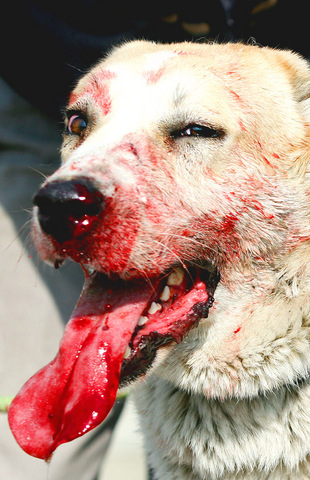
His opponent, Jack, had a slightly crooked left rear leg, which his owner said had been broken when he was hit by a car five years ago. He could not match Sarbai's strength. But he was quick. He refused to submit. As he yielded ground, he clamped onto Sarbai several times, sometimes biting the larger dog's neck, sometimes lunging for his legs.
The legality of such spectacles is unclear. Russia's criminal code includes a statute forbidding cruelty to animals, but to date, animal rights advocates and dog breeders agree, it has not been used against volkodav fights.
The statute's language is vague, and Elena Maruyeva, director of the Vita Center for Animal Rights Protection, a private organization in Moscow, said the government did not interpret it broadly. "In practice it is very, very hard to prosecute a person under this law," she said.
The dog owners say that because the fights are not forbidden, they are allowed. They note that government officials know about the tournaments, and the association publicizes the results. Fans also sell plainly labeled videos of the fights.
"We are a semi-open organization," said Yuri Yevgrashin, the chief referee for the day's events.
Whatever its official status, the sport appears to be under no significant threat. Maruyeva and an official at another of the principal animal protection organizations in Moscow said that so far, they had not pushed for bans on wolf dog fighting. Instead, they hope for other measures, like restrictions on the breeding of attack dogs, registration of wolf dog breeders and enacting standards for their care.
On the court, the second round began. The dogs locked jaws and began tumbling against snow banks. Jack still would not quit. The momentum seemed to turn. Could the smaller dog win?
"I am with you, Jack!" a red-faced man screamed, holding a plastic cup of vodka. But the second round ended like the first — with two exhausted dogs.
Under the association's rules, dogs are sorted into two classes for age and weight. They are juniors until age two and a half, when they are classified as adults. Middleweights must weigh less than 62kg. Any dog larger is a heavyweight.
The largest, weighing roughly 90kg, are not highly regarded. "They are too slow," Yevgrashin said.
Each fight lasts until one dog shows fear or pain — by dropping its tail, squeaking, whimpering, refusing to fight or snapping its jaws defensively, all grounds for instant disqualification. There is no scoring. There are only winners and losers or, in fights that continue for three rounds without an animal yielding, draws.
Sometimes the outcome is clear within a minute. Other times, fights last more than 45 minutes. A veterinarian is always on hand, Mikhailov and Yevgrashin said.
Between Sarbai and Jack's rounds, other dogs fought. One was called Koba, the nickname used by Stalin. He won.
Another was named Khattab, after a Jordanian-born terrorist who fought in Afghanistan, Tajikistan and Chechnya before Russia's intelligence service killed him with a poison-soaked letter in 2002. He won, too, in the junior middleweight class, extending his undefeated record to eight wins.
Many dogfights in Russia are said to be tainted, with steroid-swelled dogs, or animals smeared with wolf fat to confuse or intimidate their foes, or dogs' mouths injected with Novocain to make them fight without hesitation. But Edgar Grigorian, Khattab's owner, said that at this level the matches were clean.
"We are adamantly against cheating," he said. "I can always tell a dirty dog in a fight, and a good judge will always see it."
Grigorian and several other breeders and association members said that there was no prize money, but that successful fighters were used to sire puppies, which could sell for more than US$500 each.
In two days at the sanitarium, no admission fee was charged and no gambling was visible, although the breeders said there might be some private side bets.
The previous night, owners and fans had gathered in the sanitarium to celebrate their sport. Behind a hotel room door, a huge dog guarded a metal bowl of meat. When Yevgrashin opened the door, the dog stared at a stranger and growled.
Yevgrashin closed the door. Shamil Dotdayev, who sells videotapes of fights and copies of his book, Caucasian Volkodavs, reflected on the tournament ahead.
The fights, he said, help preserve breeds with ancient roots in Central Asian and Caucasus life and with a continuing utility in food production. The dogs that succeed, he said, are an essential part of this hard, canine lot — the pack leaders.
Animal rights groups disagree. They say the breeding system rewards the attributes needed for fighting, which are narrower than those for guarding a livestock herd or leading a pack.
Dotdayev admitted that his interests were broader. He poured shots of vodka and said that dogfighting had an almost irresistible draw, and that studying fighting dogs can become a shepherd's or mountain man's obsession.
"The dogs teach us," he said. "You cannot look at a dog and tell who it is. The dog is on the inside, not on the outside. It is in his spirit."
"It is the same with people," he added, and lifted his glass.
On the basketball court, Jack and Sarbai were led back for a third round.
Sarbai quickly pulled Jack to the snow. Each time Jack escaped he was pinned anew, until he was spent and began to snap his jaws, signaling defeat. His tournament was over. Sarbai advanced to the next round.

For many people, Bilingual Nation 2030 begins and ends in the classroom. Since the policy was launched in 2018, the debate has centered on students, teachers and the pressure placed on schools. Yet the policy was never solely about English education. The government’s official plan also calls for bilingualization in Taiwan’s government services, laws and regulations, and living environment. The goal is to make Taiwan more inclusive and accessible to international enterprises and talent and better prepared for global economic and trade conditions. After eight years, that grand vision is due for a pulse check. RULES THAT CAN BE READ For Harper Chen (陳虹宇), an adviser
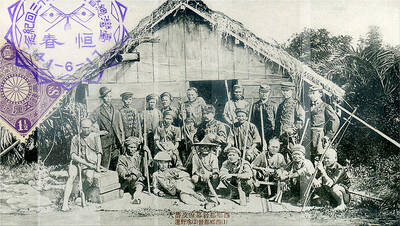
Traditionally, indigenous people in Taiwan’s mountains practice swidden cultivation, or “slash and burn” agriculture, a practice common in human history. According to a 2016 research article in the International Journal of Environmental Sustainability, among the Atayal people, this began with a search for suitable forested slopeland. The trees are burnt for fertilizer and the land cleared of stones. The stones and wood are then piled up to make fences, while both dead and standing trees are retained on the plot. The fences are used to grow climbing crops like squash and beans. The plot itself supports farming for three years.

President William Lai (賴清德) on Nov. 25 last year announced in a Washington Post op-ed that “my government will introduce a historic US$40 billion supplementary defense budget, an investment that underscores our commitment to defending Taiwan’s democracy.” Lai promised “significant new arms acquisitions from the United States” and to “invest in cutting-edge technologies and expand Taiwan’s defense industrial base,” to “bolster deterrence by inserting greater costs and uncertainties into Beijing’s decision-making on the use of force.” Announcing it in the Washington Post was a strategic gamble, both geopolitically and domestically, with Taiwan’s international credibility at stake. But Lai’s message was exactly

May 4 to May 10 It was once said that if you hadn’t performed at the Sapphire Grand Cabaret (藍寶石大歌廳), you couldn’t truly be considered a star. Taking the stage at the legendary Kaohsiung club was more than just a concert. Performers were expected to entertain in every sense, wearing outlandish or revealing costumes and staying quick on their feet as sharp-tongued, over-the-top hosts asked questions and delivered jokes that would be seen as vulgar, even offensive, by today’s standards. Opening in May 1967 during a period of strict political and social control, Sapphire offered a rare outlet for audiences in


 RSS
RSS