


This year's Taipei Biennial recently opened at the Taipei Fine Arts Museum and runs to Feb. 25. Its provocative and elusive title, Dirty Yoga, created much discussion among viewers over the opening weekend in trying to pinpoint a direct definition. Do we interpret the words literally, singularly or together? Effective exhibition titles whet the appetite, raise questions and psyche out the viewer.
One third of the world's biennials take place in the Asia Pacific region and the Taipei Biennial is one of the more respected and prestigious as it is international in scope. Dan Cameron, the senior curator of the New Museum paired up with artist Wang Jun-jieh (王俊傑) — who had exhibited in the 1998 Taipei Biennial — to curate this, the fifth version. They brought together 34 artists from around the world with a high number of female artists and artists from under-represented areas. With a limited budget of NT$20 million (small for a biennial), the exhibition takes place within the museum confines with only 13 site-specific works. Despite these budgetary limits, the video, photo, painting, sound, and sculpture on show allow for reverie and demonstrates that a biennial does not need deep pockets.
In planning for the Taipei Biennial, the museum used the same system that was initiated in 2000, whereby a Western curator is selected first by the museum and then comes to Taipei to choose a Taiwanese co-curator. This paternalistic system has been criticized as a remnant of colonial thinking and unrepresentative of globalization.
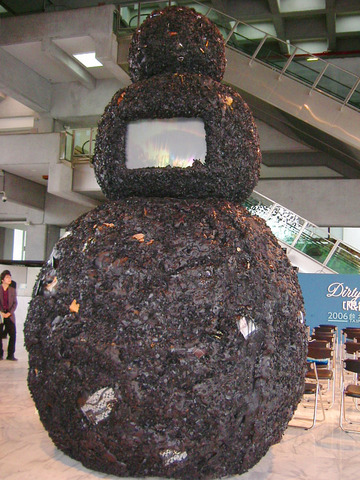
PHOTO: SUSAN KENDZULAK
The art on view is fun, visual, some of it political, and some of it personal, such as Nari Ward's tar snowman, Regina Silveria's footprints all over the museum's facade, Jonas Dahlberg's eerie video, El Perro's skateboard video and Kazuna Taguchi's riveting photo portraits.
Cheang Shu-lea (鄭淑麗) is back in town with her London-based collective TAKE2030. The group has an interactive workshop where design students help sew attractive slings to carry wireless equipment allowing the wearer to transmit wireless messages as one way to create open access to Taipei's citizens. Ironically though, Taipei's main promoter of a wireless capital Mayor Ma Ying-jeou (馬英九) was most notably absent at last Friday's gala opening.
Taiwanese artists not often showing here have been given exposure, such as taxi driver/painter Chou Ming-te (周孟德) who is showing his paintings of Taipei's night life and bar scenes. Cartoonist VIVA offers manga-like panels of his military experiences filed away in cabinets.
E Chen's (陳逸堅) installation of common objects such as a mail box, cinder blocks and plants are all made from knitted yarn, and as each day of the exhibition passes, a little bit of the knitted installation becomes undone so that in the end there will be nothing left except for a pile of yarn. This work pessimistically looks at Taiwan's traditional industries such as the textile industry and how it has been unraveled by the onset of globalization.
Political messages abound. The most poignant, relevant and perhaps controversial project is the site-specific one by Cao Fei (曹斐). The site is not that of the museum, but of Taiwan and its ambiguous relation with China. To push the point, there is a documentary video airing anti-President Chen Shui-bian (陳水扁) views. Cao Fei, who is gaining recognition in the West as one of China's hot young art stars, invited her father Cao Chang-en, a notable sculptor, to create images of Sun Yat-sen (孫逸仙). One of his bronze sculptures is on display at the Sun Yat-sen Memorial Hall. Sun Yat-sen, the founder of modern China, is admired on both sides of the Taiwan Strait. This ode to fathers — the father of China and the artist's father — is deeply moving.
Besides bringing international viewpoints to Taipei, a positive message emerges from the biennial: good art is happening all around the world and that ultimately art can provide us with a deeper sense of ourselves and understanding of our tumultuous world.
Taiwan’s English education system is being pulled apart by three opposing forces. Bilingual Nation 2030 pulls students toward English and global communication. Artificial Intelligence (AI) readiness pulls them toward digital judgment, verification and AI-mediated work. But Taiwan’s old exam culture pulls them back toward memorization, grammar drills, timed reading and correct answers. If the education system keeps using old exams to define success, it risks producing graduates who are neither genuinely bilingual nor genuinely AI-ready, but trained for tasks machines can already perform. The first force is Bilingual Nation 2030. Launched in 2018, the policy aimed to “help Taiwan’s workforce connect
It seems every few days one bumps into one of those “real man” comments in which Taiwan is urged to “face reality” or similar, and “make a deal,” with the speaker implying that soon it will be too late. “Deal” advocates always present themselves as having a superior grip on reality, and the manly ability to make the “hard choice.” Their testosterone-laden language often echoes that of Taiwan sellout advocates. Note that such commentary always specifies a process (“make a deal, work with, make progress”), never the end state of what occupation by a violent authoritarian colonialist state will entail. In
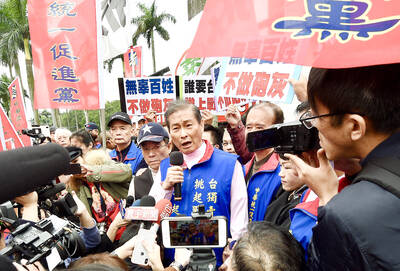
There are shadowy cabals plotting to sell out Taiwan to be annexed by China, by invasion if necessary. Fortunately, they are buffoons. In 2019, former Bamboo Union gangster and founder of the China Unification Promotion Party (CUPP), Chang An-le (張安樂, colorfully known as “White Wolf”), led a protest at the Legislative Yuan against comments made by then-premier Su Tseng-chang (蘇貞昌) that in the event of an attack by China, he would never surrender, but would protect the nation by fighting to the end, even if he only had a broom. Chang had party members bring a wooden casket that they
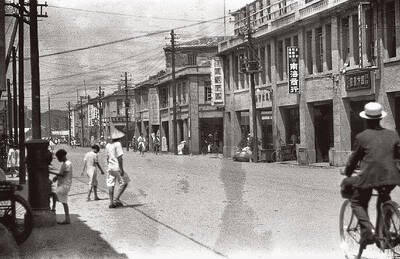
June 1 to June 7 "If all Taiwanese were as afraid of dying as you, then what would happen?” Physician Shih Chiang-nan (施江南) reportedly said this to his wife Chen Chiao-tung (陳焦桐) after she urged him to stop intervening on behalf of Taiwanese soldiers stranded overseas after serving in the Japanese Army during World War II. Shih had clashed with high-ranking officials over the issue, engaged in several heated arguments with Taiwan governor-general Chen Yi (陳儀) and allegedly shouted at general Ko Yuan-fen (柯遠芬), chief of staff of the Taiwan Garrison Command, over


 RSS
RSS