


Who could have guessed that deep in the heart of the average Taiwanese lurked the passionate, tempestuous soul of a gypsy, yearning to stamp across a stage to the music of a flamenco guitar? There must be thousands of them, from Taipei to Tainan, all quivering at the chance to shout “Ole” at the click of a castanet.
They will have their chance over the next two weeks, as the Ballet Teatro Espanol de Rafael Aguilar returns for its third tour of Taiwan in less than a year. Previous performances have ended with repeated shouts of “Encore” and the promoters — Kuang Hong Arts (Kham) — have obviously taken this to heart.
This time, however, the promoters have felt confident enough of the appeal of the company's 35 dancers and musicians to book them into the National Theater for a five-day run, a step up from their previous Taipei venue, the Taipei International Convention Center.
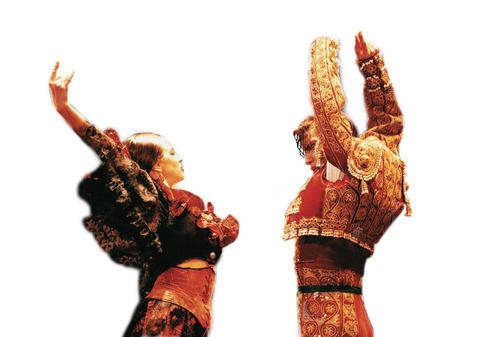
PHOTO COURTESY OF KHAM
The company will be performing two different shows at the National Theater, Bolero Flamenco and Carmen Flamenco but will only be performing Carmen Flamenco outside of Taipei. Both productions have been seen on the company's previous visits, Carmen last October and Bolero Flamenco this past March.
Bolero Flamenco is actually a mixed bill of three pieces, El Rango, Bolero Flamenco and Suite Flamenca.
El Rango, which premiered in 1963, is an adaptation of Frederico Garcia Lorca's play The House of Bernada Alba, which tells the story of a woman who tries to ensure the virtue of her five daughters by being overprotective and stifling her children — until one of them rebels. The music is an interesting combination of Gregorian chants and flamenco.
Bolero Flamenco was created in 1987 to mark the 50th anniversary of composer Maurice Ravel's death. Similar to Maurice Bejart's Bolero, the piece centers on a shirtless male soloist, encircled by a troupe of seated women snapping their fans and opening their legs while the man works himself into a frenzy, as the music builds to its climax.
Suite Flamenca is an anthology of diverse Spanish dance styles based on a string of six solos, set to traditional music and songs from four provinces.
The second program, Aguilar's Carmen, is famous for its sensual choreography and heady mixing of flamenco and ballet. Aguilar combined flamenco music with the most famous arias and music from Georges Bizet opera. Hopefully the sound system at the National Theater will be able to provide a better balance of the recorded music and the live musicians and singers on stage than was heard last fall.
With minimal props and sets, the power of Carmen Flamenco depends on the skill and personalities of dancers, and company principals Trinidad Artiguez, Francisco Guerrero and Ivan Gongora have proven their ability to quickly have audiences eating out of their hands.
While some critics have carped about the showiness of Aguilar's creations, his company continues to dazzle audiences around the world more than a decade after his death. He obviously touched a chord that resonates regardless of cultural differences.
Performance Notes:
What:Ballet Teatro Espanol de Rafael Aguilar
WhereNational Theater, Taipei, 21-1, Zhongshan S Rd, Taipei (北市中正區中山南路21-1號)
When: Sept. 13 to Sept. 17. Evening performances start at 7:30pm; Saturday and Sunday matinees start at 2:30pm
Tickets From NT$600 to NT$3,600
Additional performances:
Tuesday, Sept. 19, National Chunghsing University, Taichung(台中中興大學);
Wednesday, Sept. 20, Tainan Municipal Cultural Center (台南市立文化中心);
Thursday, Sept. 21, Hsinchu City Performance Hall (新竹市立演藝廳);
Friday, Sept. 22, Chungli Arts Center (中壢藝術館);
Saturday, Sept. 23, Chideh Hall, Kaohsiung (高雄至德堂);
Sunday, Sept. 24, at Chiayi City's Cultural Affairs Bureau (嘉義市文化局); All shows begin at 7:30. Ticket prices range from NT$500 to NT$2,500.

Most heroes are remembered for the battles they fought. Taiwan’s Black Bat Squadron is remembered for flying into Chinese airspace 838 times between 1953 and 1967, and for the 148 men whose sacrifice bought the intelligence that kept Taiwan secure. Two-thirds of the squadron died carrying out missions most people wouldn’t learn about for another 40 years. The squadron lost 15 aircraft and 148 crew members over those 14 years, making it the deadliest unit in Taiwan’s military history by casualty rate. They flew at night, often at low altitudes, straight into some of the most heavily defended airspace in Asia.

This month the government ordered a one-year block of Xiaohongshu (小紅書) or Rednote, a Chinese social media platform with more than 3 million users in Taiwan. The government pointed to widespread fraud activity on the platform, along with cybersecurity failures. Officials said that they had reached out to the company and asked it to change. However, they received no response. The pro-China parties, the Chinese Nationalist Party (KMT) and Taiwan People’s Party (TPP), immediately swung into action, denouncing the ban as an attack on free speech. This “free speech” claim was then echoed by the People’s Republic of China (PRC),
Many people in Taiwan first learned about universal basic income (UBI) — the idea that the government should provide regular, no-strings-attached payments to each citizen — in 2019. While seeking the Democratic nomination for the 2020 US presidential election, Andrew Yang, a politician of Taiwanese descent, said that, if elected, he’d institute a UBI of US$1,000 per month to “get the economic boot off of people’s throats, allowing them to lift their heads up, breathe, and get excited for the future.” His campaign petered out, but the concept of UBI hasn’t gone away. Throughout the industrialized world, there are fears that
Like much in the world today, theater has experienced major disruptions over the six years since COVID-19. The pandemic, the war in Ukraine and social media have created a new normal of geopolitical and information uncertainty, and the performing arts are not immune to these effects. “Ten years ago people wanted to come to the theater to engage with important issues, but now the Internet allows them to engage with those issues powerfully and immediately,” said Faith Tan, programming director of the Esplanade in Singapore, speaking last week in Japan. “One reaction to unpredictability has been a renewed emphasis on


 RSS
RSS