


Hong Kong's newest film festival doesn't feature Jackie Chan (成龍) or Jet Li (李連杰) kicking down doors and punching villains. This one is all about prostitutes.
The inaugural three-day Hong Kong Sex Workers' Film Festival that kicks off today is an under funded but comprehensive look at the lives of prostitutes across Asia — told by the sex workers themselves.
The festival, hosted by the Hong Kong sex worker support group Zi Teng (紫藤), aims to offer an alternative to the stylized and stereotypical portrayals of prostitutes in mainstream cinema, curator Yau Ching said.
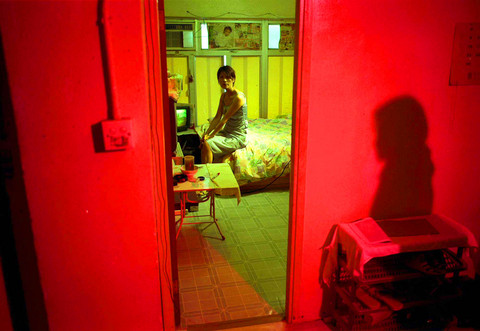
PHOTO: AFP
The nine-movie program includes contributions from Canada, the US, Taiwan, India and Hong Kong. The films are not only about sex workers, but are either made entirely by them or in conjunction with a director.
Yau, who teaches cultural studies at Hong Kong's Lingnan University, said that mainstream filmmakers tend to take a “whore or Madonna” approach to depicting prostitutes, painting them as either victim or predator.
She said she hopes to break such stereotypes by presenting a series of documentaries that address the day-to-day realities of prostitution from the perspective of sex workers.
“Very few films talk about their job specifically or their relationship with society as a sex worker,” she said.
Letting the subjects tell their own stories offers a unique viewpoint, Yau said.
“They (prostitutes) try to support a family, just like other mothers, so their self-perception, the level of self-respect is different,” she said.
Among the offerings is The Story of the Taipei Prostitutes, about a campaign to fight a ban on prostitution in Taiwan's capital. Another short film outlines the “sex worker's manifesto” drafted at the first National Conference of Sex Workers in Calcutta, India, in 1997.
Two films revolve around pioneer sex worker activist Carol Leigh, who is credited with coining the term “sex worker” and who founded the San Francisco Sex Worker Film and Video Festival.
One obvious gap is the lack of films from China, where unlike in Hong Kong sex work is illegal. Curator Yau said she knows of underground films about sex workers in China but didn't have the resources to bring them to Hong Kong.
Yau, who volunteered her services to Zi Teng, said the festival was organized on a shoestring budget. Filmmakers donated their movies and a friend offered cheap printing services for publicity materials.
The films will be shown at Zi Teng's small office space that accommodates about 50 people, located in a run-down pink building that also houses an hourly motel, or “love hotel.”
Another obstacle has been what organizers allege is government harassment.
Zi Teng staff member Elaine Lam said the Food and Environmental Hygiene Department called the group Monday ordering them to obtain a license for the film festival, saying the public event turns its offices into an entertainment venue.
Lam suspects bias, characterizing the film festival as a small-scale event that doesn't justify a strict interpretation of the law. Organizers have sidestepped the legal problem by asking ticket buyers to join Zi Teng, hence making the film festival a private, members-only activity.
“A lot of groups organize film showings. Officials haven't tried to enforce the law on them,” she said.
Asked for comment Wednesday, the Food and Environmental Hygiene Department didn't respond immediately.
Sex work is not illegal in Hong Kong, but it is against the law to solicit for business, or live off the earnings of prostitution of others.
On the Net:
Zi Teng's official Web site (also includes program of film festival) is www.ziteng.org.hk

Yesterday, the Democratic Progressive Party (DPP) nominated legislator Puma Shen (沈伯洋) as their Taipei mayoral candidate, the Chinese Nationalist Party (KMT) put their stamp of approval on Wei Ping-cheng (魏平政) as their candidate for Changhua County commissioner and former legislator Tsai Pi-ru (蔡壁如) of the Taiwan People’s Party (TPP) has begun the process to also run in Changhua, though she has not yet been formally nominated. All three news items are bizarre. The DPP has struggled with settling on a Taipei nominee. The only candidate who declared interest was Enoch Wu (吳怡農), but the party seemed determined to nominate anyone

In a sudden move last week, opposition lawmakers of the Chinese Nationalist Party (KMT) and Taiwan People’s Party (TPP) passed a NT$780 billion special defense budget as a preemptive measure to stop either Chinese leader Xi Jinping (習近平) or US President Donald Trump from blocking US arms sales to Taiwan at their summit in Beijing, said KMT heavyweight Jaw Shaw-kong (趙少康), speaking to the Taipei Foreign Correspondents Club on Wednesday night in Taipei. The 76-year-old Jaw, a political talk show host who ran as the KMT’s vice presidential candidate in 2024, says that he personally brokered the deal to resolve
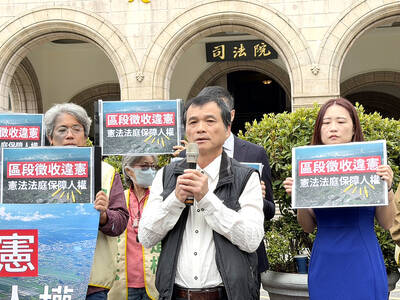
What government project has expropriated the most land in Taiwan? According to local media reports, it is the Taoyuan Aerotropolis, eating 2,500 hectares of land in its first phase, with more to come. Forty thousand people are expected to be displaced by the project. Naturally that enormous land grab is generating powerful pushback. Last week Chen Chien-ho (陳健和), a local resident of Jhuwei Borough (竹圍) in Taoyuan City’s Dayuan District (大園) filed a petition for constitutional review of the project after losing his case at the Taipei Administrative Court. The Administrative Court found in favor of nine other local landowners, but

The Chinese Nationalist Party (KMT), alongside their smaller allies the Taiwan People’s Party (TPP), are often accused of acting on behalf of the Chinese Communist Party (CCP). Some go so far as to call them “traitors.” It is not hard to see why. They regularly pass legislation to stymie the normal functioning of the ruling Democratic Progressive Party’s (DPP) administration, and they have yet to pass this year’s annual budget. They slashed key elements of the government’s proposed NT$1.25 trillion (US$40 billion) special military budget, and in the smaller NT$780 billion package they did pass, it is riddled with provisions that


 RSS
RSS