


The band 1976 is a popular favorite with Taiwan's "artsy" youth and has released four albums since 1999. They are scheduled to release their latest album on July 20, and re-launch their second album, Direction (
Started in 1996 when they were college students, three of the four members of 1976 are now pushing 30 but they are not embracing their role as a not-so-young alt-rock band. In fact, lead singer and song writer for the band Raykai Chen (
Although they've been around a long time, 1976's music still has wide appeal among young audiences. "Their music is like a mark of my youth," said Rita Hsieh (
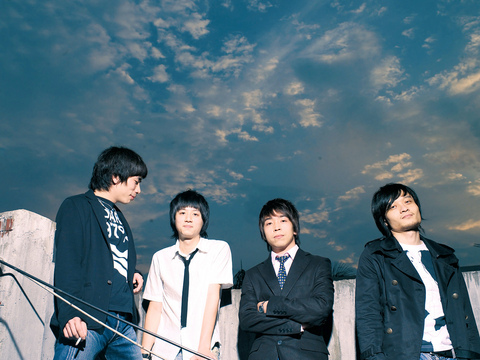
PHOTO COURTESY OF RAYKAI CHEN
"Our fans range from 15 to 35. I believe we can reach a wider group of people than other bands," Chen said.
Chen is a charismatic figure on the stage, in contrast to his somewhat earnest everyday demeanor. His tough on-stage image, smoking and drinking during the silence between songs, enhances his appeal among his young female fans.
Chen has long been dissatisfied with his appearance. "If I were taller and more handsome, I could have been a member of an idle boy band," Chen said. "Good looks are absolute. ... Anything can be changed and improved, except your appearance."
In addition to his own singing, Chen was also elected as a judge for this year's Golden Melody Awards, among other music contests, and like many other local artists, has traded on his celebrity to enter the hospitality industry.
His coffee shop Kafka on the Shore (海邊的卡夫卡) consciously differentiates itself from chain-cafes like Starbucks. The music fits with the alt-rock theme, as does the decor, with its shelves of literature, indie-music CDs and regular schedule of indie music performances. As befits a cafe named after a book by Haruki Murakami, a great favorite of the "literary" youth who constitute a large part of 1976's fan base, the film version the Murakami novel Tony Takitani premiered here.
Another attraction is the coffee, for Kafka is co-owned by Yu Yung-kuan (
For Sunday's concert Chen will be joined by long-time friend Deserts Chang, whose debut album My Life Will..., launched in June, is currently topping local Mandarin music charts. 1976 will also be playing a selections from its new album.
Notes:
● Kafka on the Beach is located at 2F, 2, Ln 244, Roosevelt Rd Sec 3, Taipei (台北市羅斯福路三段244號2樓). Call (02) 2364-1996.
● Free performance on Saturday 7:30pm at Eslite Dunhua South Road plaza (
● 1976 will play at the Riverside Cafe (河岸留言) on Sunday, B1, 2, Ln 244, Roosevelt Rd, Sec 3, Taipei (台北市羅斯福路三段244巷2號B1). Tickets for the show are NT$350.

Taiwan’s English education system is being pulled apart by three opposing forces. Bilingual Nation 2030 pulls students toward English and global communication. Artificial Intelligence (AI) readiness pulls them toward digital judgment, verification and AI-mediated work. But Taiwan’s old exam culture pulls them back toward memorization, grammar drills, timed reading and correct answers. If the education system keeps using old exams to define success, it risks producing graduates who are neither genuinely bilingual nor genuinely AI-ready, but trained for tasks machines can already perform. The first force is Bilingual Nation 2030. Launched in 2018, the policy aimed to “help Taiwan’s workforce connect
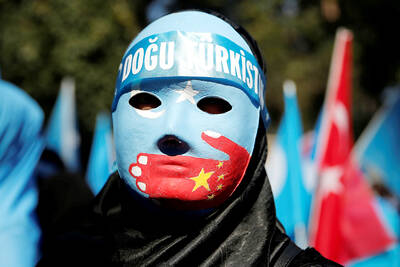
It seems every few days one bumps into one of those “real man” comments in which Taiwan is urged to “face reality” or similar, and “make a deal,” with the speaker implying that soon it will be too late. “Deal” advocates always present themselves as having a superior grip on reality, and the manly ability to make the “hard choice.” Their testosterone-laden language often echoes that of Taiwan sellout advocates. Note that such commentary always specifies a process (“make a deal, work with, make progress”), never the end state of what occupation by a violent authoritarian colonialist state will entail. In

There are shadowy cabals plotting to sell out Taiwan to be annexed by China, by invasion if necessary. Fortunately, they are buffoons. In 2019, former Bamboo Union gangster and founder of the China Unification Promotion Party (CUPP), Chang An-le (張安樂, colorfully known as “White Wolf”), led a protest at the Legislative Yuan against comments made by then-premier Su Tseng-chang (蘇貞昌) that in the event of an attack by China, he would never surrender, but would protect the nation by fighting to the end, even if he only had a broom. Chang had party members bring a wooden casket that they
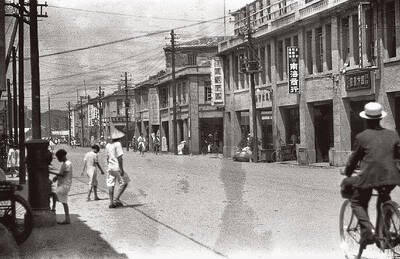
June 1 to June 7 "If all Taiwanese were as afraid of dying as you, then what would happen?” Physician Shih Chiang-nan (施江南) reportedly said this to his wife Chen Chiao-tung (陳焦桐) after she urged him to stop intervening on behalf of Taiwanese soldiers stranded overseas after serving in the Japanese Army during World War II. Shih had clashed with high-ranking officials over the issue, engaged in several heated arguments with Taiwan governor-general Chen Yi (陳儀) and allegedly shouted at general Ko Yuan-fen (柯遠芬), chief of staff of the Taiwan Garrison Command, over


 RSS
RSS