


This is the sort of book that gives the Left a bad name.
In Dark Ages America: The Final Phase of Empire, the cultural historian Morris Berman delivers a vituperative, Spenglerian screed that makes Michael Moore seem like a rah-rah American cheerleader: a screed that describes this country as "a cultural and emotional wasteland," suffering from "spiritual death" and intent on exporting its false values around the world at the point of a gun; a republic-turned-empire that has entered a new Dark Age and that is on the verge of collapsing like Rome.
Berman argues that the terrorist attacks of Sept. 11 "were the tragic but inevitable outcome of our foreign policy," and refers to them as "the so-called attack on civil-ization," asking whether America is "really the standard bearer of a genuine civilization that it was, say, only 60 years ago." He goes on to suggest that the American people are stupid, ignorant, violent and greedy, and that they "get the government they deserve."
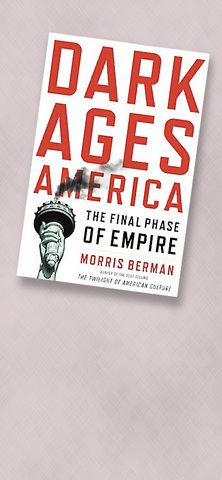
A sequel of sorts to Berman's 2000 book, The Twilight of American Culture -- which described the country as a highly dysfunctional society afflicted with apathy, cynicism, alienation and rabid consumerism -- Dark Ages America begins as a grim prophecy of decline and fall, citing four traits shared, he says, by the late Roman Empire and the US today, namely, "the triumph of religion over reason," "the breakdown of education and critical thinking," the "legalization of torture" and declining respect and financial power on the world stage.
Instead of explicating this theme with carefully reasoned analysis, Berman allows his narrative to devolve into an all-purpose rant against virtually everything American, from the country's foreign policy to its embrace of cars, fast food, television, cell phones and shopping malls; from US President George W. Bush's decision to invade Iraq to America's celebration of individ-ualism and free enterprise.
Dark Ages turns out to be less of an original (and coherent) argument than a compendium of complaints -- some well grounded, others petty and disingenuous -- harvested from a wide array of scholars and writers.
Much of the volume reads like a series of summaries of -- and commentaries on -- other people's books, including much-discussed ones like Robert Putnam's Bowling Alone and Samuel Huntington's Clash of Civilizations and the Remaking of World Order, and lesser-known ones like The Tragedy of American Diplomacy by William Appleman Williams.
Throughout this volume Berman assumes a grating tone of sanctimonious, know-it-all condescension, as though only an enlightened few will understand what he is saying. He is smugly fatalistic and sweepingly dismissive of political debate within the country. "The distinction between red and blue states doesn't mean very much," he writes, "because John Kerry's election would not have altered the nation's course."
His most dismissive words are reserved for President Bush, but he doesn't really see that much difference between Bush and Bill Clinton; Clinton's imperialism, he suggests, would simply have been a kinder, gentler sort.
This failure to draw distinctions culminates in Berman's lumping together of "the Serbs, the Sudanese, the Afghanis, and of course, Saddam Hussein" as people whom "we didn't like" and whom we punished by using American military force.
In excoriating American culture, Berman also makes the broadest sorts of generalizations, based on the most anecdotal of evidence. He cites bits of chatter he's heard on television or the radio -- or overheard in a bar -- to back up his assertion that "lack of the most basic knowledge is so extreme in the United States that one has to wonder if we are talking about ignorance or just outright stupidity." And he cites the case of a Capitol Hill staff assistant, who slept with several men concurrently and then posted a chronicle of her bedroom antics on the Web, as embodying "the dominant secular ethos of the contemporary United States, in which it's all about pleasure, PR and (self) promotion."
Berman writes that "up and down the scale in the United States, a lack of empathy, an almost congenital inability to imagine the pain or the reality of the Other, is bred in the bone." He refers to what he calls an "American hatred of freedom." And he asserts that "the value system of at least 90 percent of the American population (at a conservative estimate), down through the decades, has acted to exclude a number of options that are essential for a healthy society. On one level, one might say that America takes away love and gives its citizens gadgets in return, which most of them regard as a terrific bargain."
So indiscriminate and intemperate are Berman's complaints that they undermine the valid points he wants to make about the role the Iraq war has played in fomenting further terrorism, the moral implications of torture at Abu Ghraib and the dangers of a ballooning trade deficit and an overextended military.
But his apparent hatred of all things American will give right-wing ideologues like Bill O'Reilly and Ann Coulter an opportunity to tar and feather those citizens who do not share Berman's contempt for America but who happen to share his concern about the Iraq war and the policies of the Bush administration.

Taiwan’s English education system is being pulled apart by three opposing forces. Bilingual Nation 2030 pulls students toward English and global communication. Artificial Intelligence (AI) readiness pulls them toward digital judgment, verification and AI-mediated work. But Taiwan’s old exam culture pulls them back toward memorization, grammar drills, timed reading and correct answers. If the education system keeps using old exams to define success, it risks producing graduates who are neither genuinely bilingual nor genuinely AI-ready, but trained for tasks machines can already perform. The first force is Bilingual Nation 2030. Launched in 2018, the policy aimed to “help Taiwan’s workforce connect
It seems every few days one bumps into one of those “real man” comments in which Taiwan is urged to “face reality” or similar, and “make a deal,” with the speaker implying that soon it will be too late. “Deal” advocates always present themselves as having a superior grip on reality, and the manly ability to make the “hard choice.” Their testosterone-laden language often echoes that of Taiwan sellout advocates. Note that such commentary always specifies a process (“make a deal, work with, make progress”), never the end state of what occupation by a violent authoritarian colonialist state will entail. In

There are shadowy cabals plotting to sell out Taiwan to be annexed by China, by invasion if necessary. Fortunately, they are buffoons. In 2019, former Bamboo Union gangster and founder of the China Unification Promotion Party (CUPP), Chang An-le (張安樂, colorfully known as “White Wolf”), led a protest at the Legislative Yuan against comments made by then-premier Su Tseng-chang (蘇貞昌) that in the event of an attack by China, he would never surrender, but would protect the nation by fighting to the end, even if he only had a broom. Chang had party members bring a wooden casket that they

June 1 to June 7 "If all Taiwanese were as afraid of dying as you, then what would happen?” Physician Shih Chiang-nan (施江南) reportedly said this to his wife Chen Chiao-tung (陳焦桐) after she urged him to stop intervening on behalf of Taiwanese soldiers stranded overseas after serving in the Japanese Army during World War II. Shih had clashed with high-ranking officials over the issue, engaged in several heated arguments with Taiwan governor-general Chen Yi (陳儀) and allegedly shouted at general Ko Yuan-fen (柯遠芬), chief of staff of the Taiwan Garrison Command, over


 RSS
RSS