


Wet weather has been the topic of much discussion in Taiwan in the past few weeks, amid a heavier than normal plum rain season. So it might be difficult to believe that many people have been looking forward to seeing a great deal of rain in Taipei.
But it is not weather forecasters, but dance fans, who have been eagerly anticipating the arrival of Rain, the critically acclaimed work by Belgian choreographer and filmmaker Anne Teresa de Keersmaeker, and her 10-member company, Rosas.
De Keersmaeker has been making headlines in the European dance world from the very start of her company in 1983. Trained at Maurice Bejart's dance school in Brussels, MUDRA, and at the Tisch School of the Arts in New York City, where she first encountered American post-modern dance, De Keersmaeker choreographed her first dance, Fase when she was just 20.
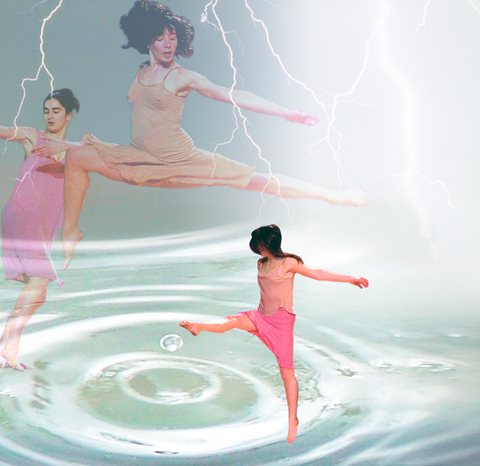
She founded the Brussels-based Rosas with just four dancers, including herself, and quickly gained a reputation for tightly structured, minimalist choreography centered on combinations and variations on a theme.
Over the years she has developed a unique dance vocabulary based on her own body and those of her dancers.
While her choreography is very precise, it is often playful, and over the years she has frequently added live music, theater and video to her productions, something that now appears to be mandatory for Belgian modern dance companies -- think of Ultima Vez for example.
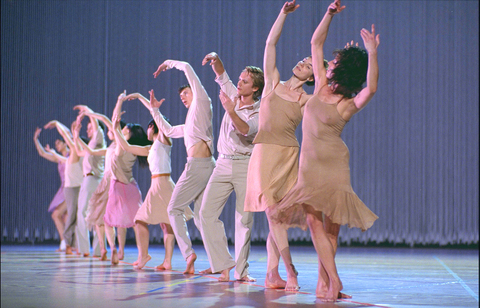
In 1995 De Keersmaeker helped set up the Performing Arts Research and Training Studios (P.A.R.T.S.), which offers dance students a three-year program of all the major techniques along with music and theater training, and she continues to serve as director of the program.
Her 2001 dance Rain is set to Steve Reich's Music for 18 Musicians, which combines percussion instruments and a piano with rhythm of breathing in voices and wind instruments. Reich appears to be a favorite source or inspiration for De Keersmaeker; she has used his music for six of her pieces.
Rosas' three male and seven female dancers are on stage for almost the entire 70-minute piece, disappearing only occasionally to change costumes (which were done by a fellow Belgian, fashion designer Dries van Noten), and they almost never stop moving.
In the beginning they appear to be dancing through a wall of rain, thanks to an impressive piece of stagecraft sculpture by set designer Jan Versweyveld -- a cylinder formed by shiny ropes that fall to the floor from a giant hoop suspended above the stage.
At times De Keersmaeker's choreography makes one think of children playing in the rain, or along the seashore, swinging their arms out to the side as they run and jump through pools of water or crashing waves.
The nine sections of Rain offer a mix of solos, duets and ensemble movements, sometimes in synch with Reich's music and sometimes out of phase.
Rosas began their Taipei run last night and will perform tonight and tomorrow afternoon before following in the footsteps of their National Theater predecessor, the Compagnie Marie Chouinard, and heading off for Singapore and Arts Festival 2006 -- proof again that Taipei has become an important stop on the international dance circuit.
For your information:
What: Rosas
Where: National Theater, Taipei
When: Tonight at 7:30pm and tomorrow at 2:30pm
Tickets: NT$500,NT$700, NT$900, NT$1,200, NT$1,600 and NT$2,000. Available through NTCH ticketing

For many people, Bilingual Nation 2030 begins and ends in the classroom. Since the policy was launched in 2018, the debate has centered on students, teachers and the pressure placed on schools. Yet the policy was never solely about English education. The government’s official plan also calls for bilingualization in Taiwan’s government services, laws and regulations, and living environment. The goal is to make Taiwan more inclusive and accessible to international enterprises and talent and better prepared for global economic and trade conditions. After eight years, that grand vision is due for a pulse check. RULES THAT CAN BE READ For Harper Chen (陳虹宇), an adviser

Traditionally, indigenous people in Taiwan’s mountains practice swidden cultivation, or “slash and burn” agriculture, a practice common in human history. According to a 2016 research article in the International Journal of Environmental Sustainability, among the Atayal people, this began with a search for suitable forested slopeland. The trees are burnt for fertilizer and the land cleared of stones. The stones and wood are then piled up to make fences, while both dead and standing trees are retained on the plot. The fences are used to grow climbing crops like squash and beans. The plot itself supports farming for three years.

President William Lai (賴清德) on Nov. 25 last year announced in a Washington Post op-ed that “my government will introduce a historic US$40 billion supplementary defense budget, an investment that underscores our commitment to defending Taiwan’s democracy.” Lai promised “significant new arms acquisitions from the United States” and to “invest in cutting-edge technologies and expand Taiwan’s defense industrial base,” to “bolster deterrence by inserting greater costs and uncertainties into Beijing’s decision-making on the use of force.” Announcing it in the Washington Post was a strategic gamble, both geopolitically and domestically, with Taiwan’s international credibility at stake. But Lai’s message was exactly

May 4 to May 10 It was once said that if you hadn’t performed at the Sapphire Grand Cabaret (藍寶石大歌廳), you couldn’t truly be considered a star. Taking the stage at the legendary Kaohsiung club was more than just a concert. Performers were expected to entertain in every sense, wearing outlandish or revealing costumes and staying quick on their feet as sharp-tongued, over-the-top hosts asked questions and delivered jokes that would be seen as vulgar, even offensive, by today’s standards. Opening in May 1967 during a period of strict political and social control, Sapphire offered a rare outlet for audiences in


 RSS
RSS