


What's on tap at Taipei bars is no longer limited to Taiwan beer, Heineken and a few Belgian imports. A number of bars serving home-grown microbrews have sprung up, and the latest of these is Biermeister.
Like similar establishments, Biermeister does not brew its own beer on the premises -- that's illegal inside city limits. It gets its three varieties -- a pale ale, a wheat beer and a stout -- from breweries in Southern Taiwan, all of which use German brewing techniques and imported equipment.
"Our brews are different than draft beers or canned beers because they are the most premium beers containing fresh yeast, which is killed during the brewing process for draft and canned beers," said Hiro Cheng (
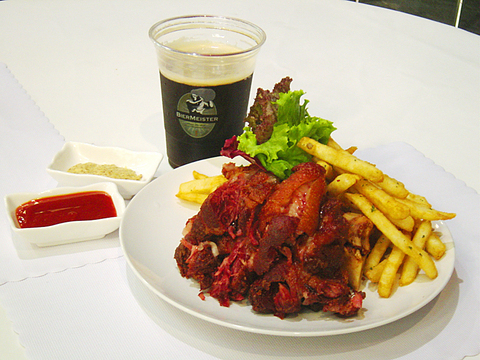
PHOTO: HO YI, TAIPEI TIMES
Cheng launched the Biermeister beer brand in spring, and quickly made a name on the local dance-party scene with his business partners by offering their distinct brews at parties and musical events such as this year's Spring Scream.
The idea behind Biermeister was to create an outdoor lounge, Cheng said, explaining that he and his partners all spent time in Canada or the US and enjoyed sitting outside a bar on a nice day with friends.
The bar-cum-restaurant, which is located near Taipei 101 on Songshou Road, also serves a decent array of American and Mexican-style appetizers and entrees to go with its rich-tasting, aromatic brews.
The menu lists the usual snacks, including onion rings, chicken nuggets, cheese sticks and buffalo wings. Another popular Biermeister specialty is its Mexican chili, which tastes great on its hotdogs, french fries and nachos.
The German sausage plate (NT$300) and crispy pork knuckle (NT$350) are two European dishes altered to suit local palettes. The sausages are not as salty and heavy as the authentic kind, while the pork knuckle makes for a filling dinner on its own with a huge pile of fries on the side.
Another must-try is the chili sausage rice (NT$220), which brings out the tangy aroma of chili with fried rice.
Although Biermeister's trademark is its beers, the restaurant takes its food seriously and each dish is prepared fresh.
Like many patrons, the staff tend to be of the hipster persuasion. But they're friendly, attentive and speak fluent English, as one-third of the clientele are foreigners.

Taiwan’s English education system is being pulled apart by three opposing forces. Bilingual Nation 2030 pulls students toward English and global communication. Artificial Intelligence (AI) readiness pulls them toward digital judgment, verification and AI-mediated work. But Taiwan’s old exam culture pulls them back toward memorization, grammar drills, timed reading and correct answers. If the education system keeps using old exams to define success, it risks producing graduates who are neither genuinely bilingual nor genuinely AI-ready, but trained for tasks machines can already perform. The first force is Bilingual Nation 2030. Launched in 2018, the policy aimed to “help Taiwan’s workforce connect
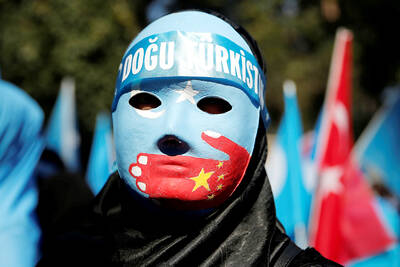
It seems every few days one bumps into one of those “real man” comments in which Taiwan is urged to “face reality” or similar, and “make a deal,” with the speaker implying that soon it will be too late. “Deal” advocates always present themselves as having a superior grip on reality, and the manly ability to make the “hard choice.” Their testosterone-laden language often echoes that of Taiwan sellout advocates. Note that such commentary always specifies a process (“make a deal, work with, make progress”), never the end state of what occupation by a violent authoritarian colonialist state will entail. In
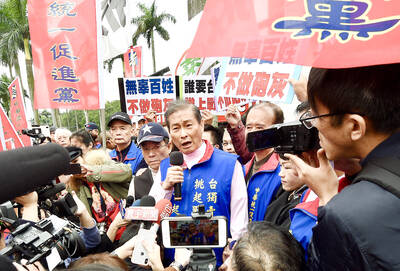
There are shadowy cabals plotting to sell out Taiwan to be annexed by China, by invasion if necessary. Fortunately, they are buffoons. In 2019, former Bamboo Union gangster and founder of the China Unification Promotion Party (CUPP), Chang An-le (張安樂, colorfully known as “White Wolf”), led a protest at the Legislative Yuan against comments made by then-premier Su Tseng-chang (蘇貞昌) that in the event of an attack by China, he would never surrender, but would protect the nation by fighting to the end, even if he only had a broom. Chang had party members bring a wooden casket that they
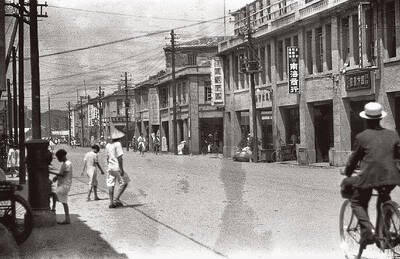
June 1 to June 7 "If all Taiwanese were as afraid of dying as you, then what would happen?” Physician Shih Chiang-nan (施江南) reportedly said this to his wife Chen Chiao-tung (陳焦桐) after she urged him to stop intervening on behalf of Taiwanese soldiers stranded overseas after serving in the Japanese Army during World War II. Shih had clashed with high-ranking officials over the issue, engaged in several heated arguments with Taiwan governor-general Chen Yi (陳儀) and allegedly shouted at general Ko Yuan-fen (柯遠芬), chief of staff of the Taiwan Garrison Command, over


 RSS
RSS