


The Beijing People's Art Theater (北京人民藝術劇院) is following up its huge success of 2004 when it brought Teahouse to Taipei with its long-running production of Thunderstorm, an iconic work of modern Chinese drama. The production will complete its booking at the National Theater in Taipei this weekend, presenting a great opportunity to observe solid, old-fashioned stage melodrama.
There is not a lot that is new about the play Thunderstorm. After all, it was written in 1934, and if we draw a comparison with the Western theater, there is certainly not very much from that period that has survived the test of time and changing mores and social concerns. The plays of Terrance Rattigan or J.B. Priestley, major figures in their time, are now rarely revived. More often than not they seem hopelessly dated and can, at best, be appreciated in the spirit of nostalgia for a time of stricter and more comprehensible dramatic conventions. So the question inevitably arises: Why should anyone want to see such an old chestnut?
Thunderstorm, and Cao Yu (
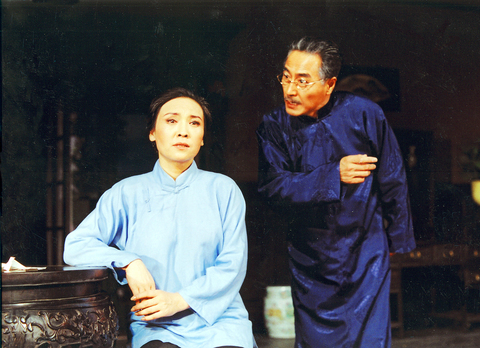
PHOTO COURTESY OF NEW ASPECT
The group has been producing the play on a regular basis since the early 1950s, and is closely associated with the works of Cao Yu. On this occasion, the playwright's daughter Wan Fang (萬方), who adapted another of her father's plays The Wilderness (原野) for performance as a Beijing opera (which was performed at the National Theater last week), has accompanied the group over to Taiwan. At a press conference last week, director Xia Chun (夏淳) lauded the many virtues of the play, which is regarded by many critics as being superbly constructed. Seen now, the adherence to the Aristotelian unities and the contrasts of pacing and mood, lend the play a faintly nostalgic quality, but the fine craftsmanship can still be appreciated.
It is in those elements that the author tries to shock the audience, such as in the revelation of incest within the family, that the play can seem to fall a bit flat.It is in its more banal aspects that the production finds its voice. Its exploration of familial dynamics within an oppressive patriarchal family, a beloved theme of Chinese drama and cinema (think Raise the Red Lantern among many, many others), that the play truly shines, and Gong Lichun's (
Xia said Thunderstorm is a play that evolves, giving each era what it requires. In its original incarnation, Thunderstorm focused on the conflict between an authoritarian capitalist father and a son who wanted to be one with the people (and who was in love with a maid working for the family). The second incarnation, which took shape in the 1980s focused on the question of guilt, and the apportioning of blame for past wrongs. The third incar-nation, which is currently being performed in Taipei, focuses on the struggle of human beings in the face of an implacable fate. In 2004, the Beijing People's Art Theater gave a fine performance of Tea House, and is in fine form with Thunderstorm. In the former, it was the depth of the ensemble's acting that raised the play to a level seldom achieved by local groups, which often lack sufficient depth of talent; however, with this current show, in which the focus will be on bravura performances by star performers, audiences will be able to make direct comparisons with local performers.
What: Cao Yu's Thunderstorm by the Beijing People's Art Theater
When and Where: Today, tomorrow and Sunday at the National Theater; Tuesday and Wednesday at the Jhongli Arts Center (中壢藝術館)
Tickets: NT$500 to NT$3,000 for the National Theater; NT$400 to NT$2,200 for Jhongli Arts Center
Taiwan’s English education system is being pulled apart by three opposing forces. Bilingual Nation 2030 pulls students toward English and global communication. Artificial Intelligence (AI) readiness pulls them toward digital judgment, verification and AI-mediated work. But Taiwan’s old exam culture pulls them back toward memorization, grammar drills, timed reading and correct answers. If the education system keeps using old exams to define success, it risks producing graduates who are neither genuinely bilingual nor genuinely AI-ready, but trained for tasks machines can already perform. The first force is Bilingual Nation 2030. Launched in 2018, the policy aimed to “help Taiwan’s workforce connect
It seems every few days one bumps into one of those “real man” comments in which Taiwan is urged to “face reality” or similar, and “make a deal,” with the speaker implying that soon it will be too late. “Deal” advocates always present themselves as having a superior grip on reality, and the manly ability to make the “hard choice.” Their testosterone-laden language often echoes that of Taiwan sellout advocates. Note that such commentary always specifies a process (“make a deal, work with, make progress”), never the end state of what occupation by a violent authoritarian colonialist state will entail. In
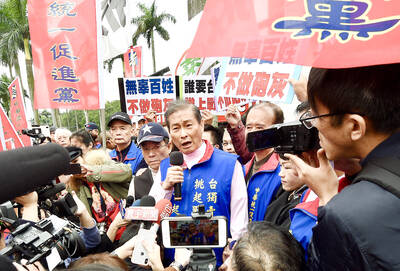
There are shadowy cabals plotting to sell out Taiwan to be annexed by China, by invasion if necessary. Fortunately, they are buffoons. In 2019, former Bamboo Union gangster and founder of the China Unification Promotion Party (CUPP), Chang An-le (張安樂, colorfully known as “White Wolf”), led a protest at the Legislative Yuan against comments made by then-premier Su Tseng-chang (蘇貞昌) that in the event of an attack by China, he would never surrender, but would protect the nation by fighting to the end, even if he only had a broom. Chang had party members bring a wooden casket that they
June 1 to June 7 "If all Taiwanese were as afraid of dying as you, then what would happen?” Physician Shih Chiang-nan (施江南) reportedly said this to his wife Chen Chiao-tung (陳焦桐) after she urged him to stop intervening on behalf of Taiwanese soldiers stranded overseas after serving in the Japanese Army during World War II. Shih had clashed with high-ranking officials over the issue, engaged in several heated arguments with Taiwan governor-general Chen Yi (陳儀) and allegedly shouted at general Ko Yuan-fen (柯遠芬), chief of staff of the Taiwan Garrison Command, over


 RSS
RSS