


Histories get lost. That's how life is. Then, when the time is right, they get found. Energy/Experimentation: Black Artists and Abstraction 1964-1980 at the Studio Museum in Harlem, New York, is about such a history, which went something like this.
During one of the most radical periods in 20th-century American politics, the black power era, a group of African-American artists was working with what was, and still is, one of the most radical forms of 20th-century art, abstraction. Radicalism is relative, though, and in this case politics and culture were on different tracks.
At a time of impassioned gestures and hot visions -- raised fists, "the fire next time" -- abstract art appeared cool and noncommittal. It had been conceived as a revolutionary language of color, line, shape. But the 1960s revolution was about bodies and beliefs. Also, abstraction raised authenticity issues. It was widely seen as white art, academic art. Whites viewed black practitioners as copycats; blacks dismissed them as sellouts.
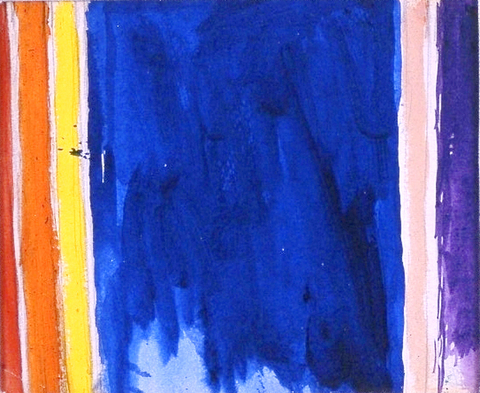
PHOTO: NY TIMES NEWS SERVICE
So, while a few figures like Melvin Edwards, Sam Gilliam and Al Loving (1935-2005) gained visibility, abstraction by African-Americans as a phenomenon faded from view, and its invisibility has persisted. The Guggen-heim Museum's 1996 survey, Abstraction in the 20th Century: Total Risk, Freedom, Discipline, included no artists of color.
But now the relationship between aesthetics and politics is changing. Many young artists see racially defined art as limiting: a problem, not a solution. A return to the story of earlier artists who struggled with that same view is in order, and that's what the Studio Museum exhibition does.
It is not alone. Two years ago, at Franklin and Marshall College in Pennsylvania, the painter Bill Hutson organized Something to Look Forward To, a survey of African-American abstract painters whose careers began in the 1960s. He included nearly two dozen artists, but much of the work was recent, so the show was really about a past continuing in the present. A full-scale historical survey was still needed.
Energy/Experimentation is not that survey. It has only 15 artists. Much of the art is large, and the Studio Museum galleries are fairly small. A multi-venue show, done in partnership with, say, the Bronx Museum of the Arts, or one of the City University of New York campus galleries, might have been a solution.
Although it is by no means complete, the present show, organized by Kellie Jones, an art and cultural historian at Yale University, does many things right. All but one piece dates from the 1960s and 1970s, when a number of black artists -- too few to be a movement, too many to be a circle -- were turning contemporary styles (Pop, Minimalism, Conceptualism), new materials (acrylic paint, plastics, light) and varying degrees of multicultural content to abstract ends.
The artists spanned generations. When Alma Thomas (1891-1978) first started painting her abstract images of gardens in Washington in the 1960s, she was almost 70. When Gilliam had his first career retrospective in that city in 1967, he was in his 30s.
Cosmopolitanism ruled. Frank Bowling was born in Guyana, trained in London and settled in New York. The Americans Ed Clark and Barbara Chase-Riboud emigrated from New York to Paris. Chase-Riboud, who has a splendid 1972 aluminum floor piece in the show -- it's like a Carl Andre spouting green silk creepers -- lives in France still.
The show traces spheres of influence. Haywood Bill Rivers (1922-2002), represented by a florette-pattern picture inspired by quilts and Islamic arabesques, was a mentor to artists like Jack Whitten. In the late 1960s, the superb painter William Williams was instrumental in establishing the artists in residence program at the Studio Museum, which has nurtured major talent.
What's instantly apparent when you enter the galleries is the absence of any binding "look." These artists were a determinedly individualistic bunch. Loving and Williams both did high-color, hard-edge painting early on, but the results are unalike: One favored self-contained forms, the other fragmented compositions pitched at a tilt.
Fragmentation, in fact, was a shared interest: Pindell made ethereal relief paintings from sewn strips of cloth; Tom Lloyd (1921-96) assembled sculptures from colored lights. So was an interplay of weightlessness and gravity. Steel sculptures by Edwards, like Lifted X (1965), were heavy but free-hanging. Joe Overstreet's Saint Expedite A (1971) is a shaped painting that seems to levitate in midair.
Daniel LaRue Johnson's smashing, spacey Homage to Rene d'Harnoncourt floats between categories. It is at once a reclining polychrome sculpture and a painting that hovers horizontally over the floor. Metaphors of floating in space are everywhere in the show. Whitten's paintings look like lunar landscapes. Fred Eversley's plastic-resin sculptures have an otherworldly sheen. A 1972 painting by Thomas of a cloud of red strokes against deep blue ground is titled Mars Dust.
Images of suspension made sense in an age obsessed with aeronautics and mobility. They also had pertinence to the lives of forward-looking artists who found themselves on uncertain ground in relation to the mainstream art world and to the intensifying identity politics of the day.
These politics found their way, however obliquely, into abstraction. Loving, Pindell and Williams were all inspired by traditions of African-American quilt-making and African weaving. Overstreet's piece refers to Native American shelters but is painted in an Africanesque palette of black, red and green.
Bowling, who argued adamantly against the association of art with racial politics, made paintings in the colors of the Guyanese flag. Lloyd's flashing light sculptures have links to the work of Dan Flavin and Bruce Nauman, but also to police cars. The title of Edwards' sculptural series Lynch Fragments speaks for itself.
In short, politics is here if you want it, but it is just one aspect of an art that focuses on extracting something fresh from formal convention and new materials. Only one piece, Pindell's video Free, White and 21, is a direct-address indictment of racism. Made in 1980, it points to a type of confron-tational, non-abstract, activist art that dominated the following decades.
Actually, that dominance was never as monolithic as it is often made out to be. And Pindell herself has consistently blended abstraction, figuration and political content into a single expressive language. Younger contemporaries, like Ellen Gallagher, have done the same in nuanced bodies of work, some more abstract than others. So have still younger figures like Louis Cameron, Arnold Kemp and Annette Lawrence, who are in a show at the museum titled Collection in Context: Gesture that complements Jones' exhibition.
If we were seeing their art someplace other than the Studio Museum in Harlem, would we necessarily read it as African-American at all? And because we know it is by African-American artists, must we automatically mine it for racial and political content? The answer to both questions is no.
Art is about possibility. As Jones' fine show demonstrates, it is capacious; its history is ever-changing; and what is lost is only lost until you see it again.

Yesterday, the Democratic Progressive Party (DPP) nominated legislator Puma Shen (沈伯洋) as their Taipei mayoral candidate, the Chinese Nationalist Party (KMT) put their stamp of approval on Wei Ping-cheng (魏平政) as their candidate for Changhua County commissioner and former legislator Tsai Pi-ru (蔡壁如) of the Taiwan People’s Party (TPP) has begun the process to also run in Changhua, though she has not yet been formally nominated. All three news items are bizarre. The DPP has struggled with settling on a Taipei nominee. The only candidate who declared interest was Enoch Wu (吳怡農), but the party seemed determined to nominate anyone
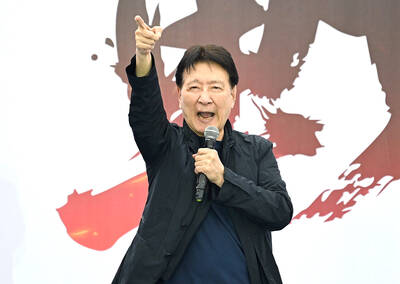
In a sudden move last week, opposition lawmakers of the Chinese Nationalist Party (KMT) and Taiwan People’s Party (TPP) passed a NT$780 billion special defense budget as a preemptive measure to stop either Chinese leader Xi Jinping (習近平) or US President Donald Trump from blocking US arms sales to Taiwan at their summit in Beijing, said KMT heavyweight Jaw Shaw-kong (趙少康), speaking to the Taipei Foreign Correspondents Club on Wednesday night in Taipei. The 76-year-old Jaw, a political talk show host who ran as the KMT’s vice presidential candidate in 2024, says that he personally brokered the deal to resolve
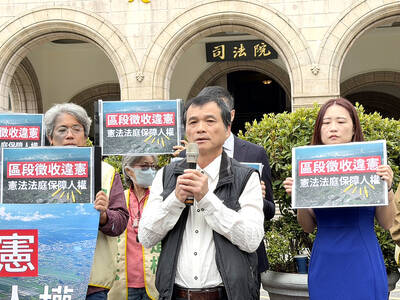
What government project has expropriated the most land in Taiwan? According to local media reports, it is the Taoyuan Aerotropolis, eating 2,500 hectares of land in its first phase, with more to come. Forty thousand people are expected to be displaced by the project. Naturally that enormous land grab is generating powerful pushback. Last week Chen Chien-ho (陳健和), a local resident of Jhuwei Borough (竹圍) in Taoyuan City’s Dayuan District (大園) filed a petition for constitutional review of the project after losing his case at the Taipei Administrative Court. The Administrative Court found in favor of nine other local landowners, but

The Chinese Nationalist Party (KMT) and its sock puppet, the Taiwan People’s Party (TPP), passed their version of the government’s proposed supplementary defense spending bill last week, engendering much commentary. While all eyes were on the defense budget, the PRC’s assault on Taiwan was advancing on other fronts. The removal of domestic drone production and other technologies critical to the nation’s asymmetrical defenses from the list of items purchased in the “compromise” bill shows how the KMT-TPP alliance appears to be serving the People’s Republic of China (PRC). Ironically, the cuts will impact industries heavily represented by tech firms in areas run


 RSS
RSS