


Expats Wade Davis and Jimi Moe started Spring Scream music festival in 1995 with a handful of musicians and artists near the entrance to Kenting National Park. A few years later, local ravers got in on the act.
Now, Spring Scream is often confused with the dance music parties that take place in the area during the "Spring Scream Weekend." What makes Spring Scream stand out from the dance scene is the organizers' focus on bands.
"There has been no change in our philosophy. When ravers come to our festival, they will immediately know the difference. We have more than 200 bands playing on stage, featuring all kinds of music like rock, funk, rap, pop, punk, experimental and under-ground," Spring Scream's co-founder and organizer Davis said.

To be exact, this year's lineup is comprised of 250 bands that were chosen from 350 applicants. Seventy percent of the scheduled bands are local acts, 15 percent are composed of foreigners living in Taiwan, and another 15 percent come from Japan, Hong Kong, Singapore, the US, Europe and the UK.
The festival site is situated at Liufu Ranch (
There are also plenty of new faces in town. "It's just incredible to see how many great bands are coming out of Taiwan. If you ask me to choose my favorites, I just have to name them all," Davis said.
Highlights from the foreign act lineup include MTV Asia Awards winner Saw Loser from Singapore, Japan's guitar playing DJ and singer Poplar and rap band Shanbhala from the US.
A major change to the festival format is the addition of a stage for DJs. "There are so many styles of dance music apart from the rave beats. We have DJs playing along with bands, with lap-tops or LPs. They feature an amazing variety of music such as hip hop, bossa nova, R&B, reggae and world music. We are here to offer variety," Davis said.
Apart from the music, Spring Scream is also an arts and film festival. The outdoor film festival will feature 10 films and numerous shorts on the theme of music.
Local police have kept a close eye on the dance parties held on previous Spring Scream weekends and arrested dozens of partygoers for the possession of drugs. Spring Scream concert-goers, Davis said, can rest easy as "The festival has never been raided. We have good relations with the police."
Since thousands of people will be surging into the town over the weekend, transportation and accommodation can pose serious problems. Most hotels and bed-and-breakfasts in the vicinity hiked their prices and are fully booked. Camping seems to be the cheapest option.
Apart from the fields at the Liufu Ranch, Kenting South Ocean camping ground (
Charter buses to Kenting will leave daily from The Wall (這牆), Taipei, at midnight starting tonight. From Sunday until April 10, Taipei-bound buses will depart from Kenting at 2pm daily. One-way tickets cost NT$1,000, round-trip tickets cost NT$1,800. Call (02) 2704 0792 or (02) 2704 8951 for more details.
Information on bus and accommodation packages costing between NT$2,900 and NT$4,400 per person can also be found on the event's Web site.
A new entrance to the festival site has been opened. The route, between South Bay (南灣) and Kenting, is open to scooters, bikes and walkers. So when you go down there this year, remember to look for guideposts and flyers for further instructions.
Advance tickets paid for via ATMs are no longer available. A limited number of advance paper tickets can still be purchased at locations including The Wall (這牆), Witch House (女巫店), The Riverside (河岸留言) and Apa's Studio in Taipei, 89K in Taichung, Rise Music Store (又升樂器音響) in Tainan, Dog Pig Cafe (豆皮文藝咖啡館) in Kaoh-siung and HotKT.com (哈墾丁) in Kenting, Pingtung. Tickets are also available at Hi Life convenience stores nationwide. For a complete festival schedule and ticket information, visit www.springscream.com.
Festival notes:
What: 2006 Spring Scream Where: Liufu Ranch
When: Tonight through April 9
Tickets: Advance discounted paper tickets cost NT$1,999 and include a 10-day event pass, camping pass and souvenir pack. At the gate, tickets cost NT$3,000 for a 10-day pass and NT$1,500 for a single-day pass (noon to midnight)

It seems every few days one bumps into one of those “real man” comments in which Taiwan is urged to “face reality” or similar, and “make a deal,” with the speaker implying that soon it will be too late. “Deal” advocates always present themselves as having a superior grip on reality, and the manly ability to make the “hard choice.” Their testosterone-laden language often echoes that of Taiwan sellout advocates. Note that such commentary always specifies a process (“make a deal, work with, make progress”), never the end state of what occupation by a violent authoritarian colonialist state will entail. In

There are shadowy cabals plotting to sell out Taiwan to be annexed by China, by invasion if necessary. Fortunately, they are buffoons. In 2019, former Bamboo Union gangster and founder of the China Unification Promotion Party (CUPP), Chang An-le (張安樂, colorfully known as “White Wolf”), led a protest at the Legislative Yuan against comments made by then-premier Su Tseng-chang (蘇貞昌) that in the event of an attack by China, he would never surrender, but would protect the nation by fighting to the end, even if he only had a broom. Chang had party members bring a wooden casket that they
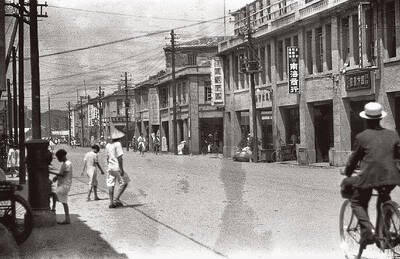
June 1 to June 7 "If all Taiwanese were as afraid of dying as you, then what would happen?” Physician Shih Chiang-nan (施江南) reportedly said this to his wife Chen Chiao-tung (陳焦桐) after she urged him to stop intervening on behalf of Taiwanese soldiers stranded overseas after serving in the Japanese Army during World War II. Shih had clashed with high-ranking officials over the issue, engaged in several heated arguments with Taiwan governor-general Chen Yi (陳儀) and allegedly shouted at general Ko Yuan-fen (柯遠芬), chief of staff of the Taiwan Garrison Command, over

Food prices have often played a major role in Taiwan’s history. The first major wave of migration from China occurred in 1628. A moderate drought, the Ming Dynasty maritime ban that prohibited fishing and trading (intended to reduce piracy) and a temporary tax, conspired to exhaust local resources, leading to famine in Fujian Province. The famed pirate and trader Zheng Zhilong (鄭芝龍), scooped up starving people from Fujian and transported them across the Taiwan Strait, where they settled under the Dutch. Two factors enabled Zheng. First, by 1624 he had settlements around today’s Beigang (北港) in Yunlin County with a small


 RSS
RSS