


■ Mizrahi keeps his hands to himself
Isaac Mizrahi kept his hands to himself on the red-carpet celebrity stroll for the Academy Awards. The flamboyant fashion designer created a stir at January's Golden Globes when he groped Scarlett Johansson's breast, asked Eva Longoria about her pubic hair and peeked down Teri Hatcher's dress as he conducted interviews for the E! cable channel. Mizrahi said last month to expect more of the same at the Oscars, but on Sunday night he had changed his tune. He quickly put a nervous looking Sandra Bullock at ease with a series of innocuous questions. He ignored Dolly Parton's ample cleavage as he asked about her hair and earrings.
■ Smooth George Clooney takes it easy
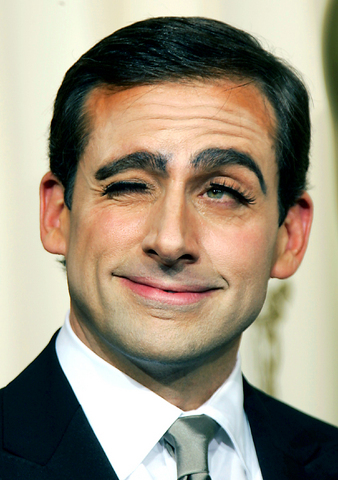
PHOTO: AP
George Clooney, on his first trip to the Academy Awards, was a winner with the Oscar for best supporting actor for the film Syriana. But he didn't sound hopeful about his chances later in the evening for his nominations as best director and best original screenplay for Good Night, and Good Luck. ``All right, so I'm not winning director,'' he quipped as he accepted his acting award. Surprisingly, Clooney said he wasn't nervous when he arrived on the red carpet. ``That worries me more than anything,'' he said of his lack of butterflies. Someone who has been there plenty of times, and who was nervous, was two-time Oscar-winning director Steven Spielberg, nominated this year for Munich. ``Every time I come to one of these things, I feel like a first-timer,'' he said with a smile.
■ What a drag for Steve Carrell
He'd already been through a body wax for his role in The 40 Year-Old Virgin, so donning false eyelashes and pancake makeup to present the Oscar for makeup probably wasn't a big deal for Steve Carell. ``What are you wearing?'' asked Carell's co-presenter, Will Ferrell, also plastered in orange makeup. ``It's called pineapple bliss,'' the actor joked. Coming in a close second in the unusual attire category were co-directors Nick Park and Steve Box, who were wearing big striped bow ties when they walked on stage to accept their animated-feature Oscars for Wallace and Gromit: The Curse of the Were-Rabbit. They must have been counting on winning because they brought along smaller bow ties, which they quickly dressed their Oscar statuettes with. Not to be outdone, the makers of the Antarctic nature tale March of the Penguins, came on stage carrying stuffed penguins -- matching their tuxedos -- when they accepted their Oscars for best documentary. ``I sleep with him,'' said director Luc Jacquet as he arrived on the red carpet with his stuffed penguin.
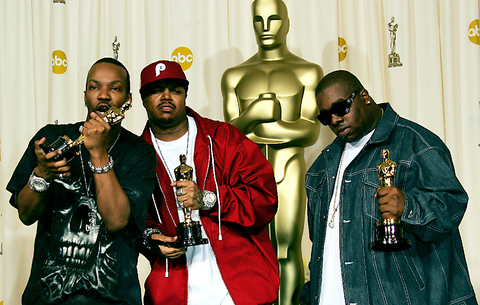
PHOTO: AP
■ Rachel Weisz blames it on the baby
Rachel Weisz is eating for two these days. And both of them were celebrating her best supporting actress award at the Oscars. ``The baby was going crazy. Poor baby. I think it was from the adrenaline,'' said the actress, who is seven months pregnant. If her acceptance speech wasn't coherent, Weisz, who won for her role in The Constant Gardener, said to blame it on the baby. ``I couldn't hardly have told you my name,'' she said backstage.
■ What a loser!
Veteran sound mixer Kevin O'Connell lost his bid for an Oscar, but he can still lay claim to another Academy Award landmark -- having the most nominations without a win. O'Connell's work on Memoirs of a Geisha earned him his 18th Oscar nomination in 24 years. But he lost to the team behind King Kong. The sound mixer was philosophical about his Oscar streak when he was nominated earlier this year. ``There's 300 to 400 films every year. Five of them get that phone call, and I've gotten it 18 times,'' he said.
■ Jennifer Tilly ups the stakes
Jennifer Tilly knows when to hold 'em and when to fold 'em and on Sunday night the one-time Oscar nominee was shunning Hollywood's Academy Awards for a high-stakes poker game in Las Vegas. ``This is the first time in 15 years I haven't attended the Oscar parties or gotten swept up in Oscar fever,'' Tilly said. ``I haven't even seen Brokeback Mountain. I don't even know who's nominated.'' The actress, who was nominated for an Oscar for the 1994 film Bullets Over Broadway, skipped the Oscars this year to compete in the National Heads Up Poker Championship on the Las Vegas Strip. She was eliminated in Saturday's first round, but said Sunday she had no regrets. After all, she won last year's World Series of Poker ladies event.
■ Richard Neely is the ultimate extra
Superstar violinist Itzhak Perlman owned the Oscar stage for a few minutes with a moving medley of the year's nominated film scores. But it was air violist extraordinaire Richard Neely who had a rehearsal audience buzzing at the Kodak Theatre on Saturday. Neely is an old hand at playing the stand-in, having accepted hundreds of fake Oscars at rehearsal ceremonies over the years. So has actor Ron Waldron, who sat in this year for George Clooney, Tom Hanks and composer John Williams. He's also played Steve Martin, Billy Crystal, Jon Voight and Michael Caine in a 22-year career. Unlike so many real people, Waldron had no trouble keeping his acceptance speech brief. ``I'd like to thank Steven Spielberg,'' he said. ``And I'd like to thank the Academy.'' Uh-oh, he forgot to mention his mother.
■ Three 6 Mafia nab award for pimpin'
The Oscar people showed they were ready to embrace a song called It's Hard Out Here for a Pimp, and the hip-hop group Three 6 Mafia couldn't have been happier -- or more surprised. When Three 6 Mafia's name was called as the winner of the Oscar for best original song, its members bounded joyfully onto the stage, where they offered shout-outs to friends. ``I just couldn't believe it. I couldn't stand still,'' Jordan ``Juicy J'' Houston said backstage. ``I had to run somewhere. I started to run somewhere. People thought the police was probably chasing me somewhere.''
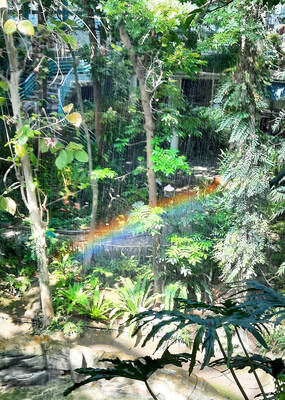
It’s only half the size of its more famous counterpart in Taipei, but the Botanical Garden of the National Museum of Nature Science (NMNS, 國立自然科學博物館植物園) is surely one of urban Taiwan’s most inviting green spaces. Covering 4.5 hectares immediately northeast of the government-run museum in Taichung’s North District (北區), the garden features more than 700 plant species, many of which are labeled in Chinese but not in English. Since its establishment in 1999, the site’s managers have done their best to replicate a number of native ecosystems, dividing the site into eight areas. The name of the Coral Atoll Zone might

On Monday morning, in quick succession, the Chinese Communist Party (CCP) and the Chinese Nationalist Party (KMT) released statements announcing “that the Central Committee of the Communist Party of China and General Secretary Xi Jinping (習近平) have invited KMT Chairwoman Cheng Li-wun (鄭麗文) to lead a delegation on a visit to the mainland” as the KMT’s press release worded it. The KMT’s press release added “Chairwoman Cheng expressed her gratitude for the invitation and has gladly accepted it.” Beijing’s official Xinhua news release described Song Tao (宋濤), head of the Taiwan Work Office of the CCP Central Committee, as
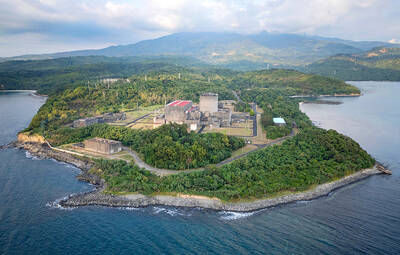
Nuclear power is getting a second look in Southeast Asia as countries prepare to meet surging energy demand as they vie for artificial intelligence-focused data centers. Several Southeast Asian nations are reviving mothballed nuclear plans and setting ambitious targets and nearly half of the region could, if they pursue those goals, have nuclear energy in the 2030s. Even countries without current plans have signaled their interest. Southeast Asia has never produced a single watt of nuclear energy, despite long-held atomic ambitions. But that may soon change as pressure mounts to reduce emissions that contribute to climate change, while meeting growing power needs. The

Last week saw Ko Wen-je (柯文哲), former Taipei mayor and founder of the Taiwan People’s Party (TPP), receive a 17-year sentence for crimes involving political corruption. This was only the opening round: the case is likely to drag on for several more years in appeals. Both the TPP and the Chinese Nationalist Party (KMT) are claiming that the prosecutors are engaging in a political witch hunt, green terror, fascism and so forth. It is easy to see this as a kind of compensation. After all, otherwise they would have to admit that the rather impressive collection of evidence against Ko actually


 RSS
RSS