


Formerly, only a fine Bordeaux was good enough to grace the dining table in Vietnam. Now, after years of rough counterfeits, French wines have little-by-little lost out to competition from New World producers.
From T-shirts to luggage to perfume, nothing escapes the counterfeiters in a country which is open to the market economy but rarely of respects trademarks and royalties.
It comes as no surprise that wine, which conveys luxury and prestige, should receive the same treatment.
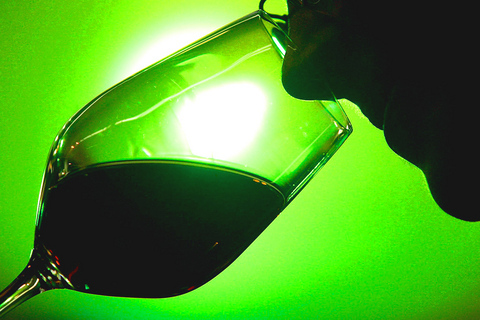
PHOTO: EPA
Bottles which have been used several times, wines mixed from doubtful origins, labels copied from the Internet, stocks unsold in Asia and re-exported to Vietnam: any way to sell fake wine is used and it becomes increasingly difficult to know what is really in the bottle.
"The wine is of such poor quality that it could come from anywhere and sometimes I suspect it is just fabricated from an alcohol base with coloring and some kind of flavoring. Not even wine at all," said Donald Berger, head of the Vine Group, a catering and wine distribution company.
As consumption of wine climbs each year with the Vietnamese population's increasing spending power, so the counterfeiters step up production.
And Bordeaux, according to experts, is the only wine to have been targeted by this underground activity, even if other wines are likely to suffer the same fate in the future.
Thanks to the country's colonial past, Bordeaux was the first wine to have touched the Vietnamese market and many people still use "Bordeaux" as a generic term for wine in general.
This level of fame and recognition has now, however, proved something of a double-edged sword for the producers of southwest France where the Bordeaux label is only allowed on wine from the strictly delineated region.
"One day I found a table wine sold with a label which hasn't existed for years while this type of wine is drunk within the year it's produced," recalled Youri Korsakoff of Ample Ltd, a wine and spirit import and distribution company based in the southern commercial hub of Ho Chi Minh City.
"I also discovered a parallel shipment of a wine for which we have the distribution monopoly. By checking the batches, I was able to establish that it had been bought in Taiwan and that the importer had resold it in Vietnam after the 1997 Asian financial crisis."
The situation is complicated by the fact that the problem does not solely originate in Vietnam.
"There are also cases which raise more of a European problem than a Vietnamese one," said a French expert who asked not to be named.
Some industry observers even assert that some counterfeited wines actually come from Bordeaux.
"We've never had tangible evidence, commercial documents which prove that there were transits from a French operator to a Vietnamese operator. We didn't succeed in tracing back their networks," the expert said.
All those involved in the Vietnamese market do agree on one thing: the quality of the wines is in any case detrimental to the French producers.
"It is not good for Bordeaux because people associate
Bordeaux with that quality and lots of Vietnamese people now say they don't want French," said Berger.
The situation is similar to that of Singapore in mid-1990s, where many drinkers ended up turning to wines from New World producers: Australia, Chile, South Africa, Italy or the US.
"Now French sales are still growing but only because the market is growing rather quickly. They're losing shares in reality to the new wines because before the French had a virtual exclusivity -- and now many wine-producing regions are eyeing the vast potential of the Vietnamese market," the Vine Group's Berger said.
Anxious to join the WTO, Vietnam is making efforts to thwart the pirates. A law on the protection of intellectual property was adopted by the national assembly last November and will come into effect in July.
The Paris-based National Institute for Designations of Origin (INAO) is currently considering what measures should be taken and is pleased that operations to destroy counterfeit alcohol, in particular Cognacs, were organized in the communist nation and reported by Vietnamese state media.
"It is interesting to know that operations are being conducted even if they are still marginal," explains Veronique Fouks, head of the legal and international department of the National Institute for Designations of Origin in Paris.
"When we identify the nature of the problem for the Bordeaux wines, there will be a possibility of joint action with the Vietnamese authorities," she said.

And so, in the wake of US President Donald Trump’s trip to the People’s Republic of China (PRC), all the experts on the Strait of Hormuz suddenly became experts on US-China-Taiwan relations. The Internet has certainly expanded human knowledge. Lots of these sudden experts made noise this week about Trump’s words after the meeting with PRC dictator Xi Jin-ping (習近平). Trump is going to sell out Taiwan! Longtime Taiwan commentator J. Michael Cole summed the situation up neatly in the Guardian: “We need to keep in mind that he has a tendency to say many things — sometimes contradicting himself within

There is considerable frustration and confusion among many, both in Taiwan and abroad — including in Washington — as to why the Chinese Nationalist Party (KMT) seems so dead set on using their legislative leverage to slash defense spending and disrupt the ability of the ruling Democratic Progressive Party (DPP) administration to function. Are they pawns of the Chinese Communist Party (CCP)? Are they traitors? In reality, there are multiple reasons. In the first column in this series on this subject, “Donovan’s Deep Dives: How and why the TPP and KMT help Beijing” (Sat May 16, page 12), we examined three

It took 12 years and months of standing in the same mountain location for director Liang Chieh-te (梁皆得) to capture a few seconds of footage: Taiwan’s largest resident raptor locking talons with its mate and spinning through the air in a courtship ritual. With only about 1,000 left in the wild and very short flight windows, the mountain hawk-eagle remains among Taiwan’s most elusive birds. The species generally produces only one offspring per year. Using forest cameras, the film crew and research teams document the arduous process the monogamous pairs go through for the chick to hatch and grow up, weathering
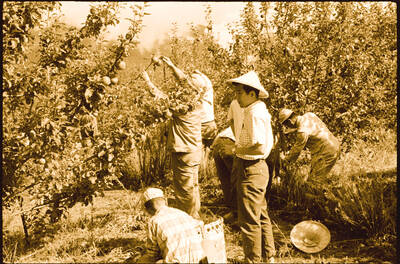
May 25 to May 31 Few believed that apples could be cultivated on a commercial scale in Taiwan’s high mountains. When horticulturalist Cheng Chao-hsiung (程兆熊) first proposed the idea in 1955, both American and Taiwanese colleagues dismissed it as implausible, arguing that temperate fruit could not be reliably grown on a subtropical island, especially on rugged terrain. However, it was this terrain in the Central Mountain Range where many Chinese Civil War veterans were resettled in the late 1950s. With limited job prospects and no family in Taiwan, they were placed on cooperative farms aimed toward self-sufficiency. Some say the conditions


 RSS
RSS