


The Dada movement made its name in the early 20th century by trying to destroy the conventional notion of art. Taking literal inspiration from their exploits this week, a latter-day neo-Dadaist took a small hammer to Marcel Duchamp's Fountain, the factory-made urinal that is considered the cornerstone of conceptual art.
The assailant, a French performance artist named Pierre Pinoncelli, was immediately arrested after his act of vandalism last week, during the final days of the Dada exhibition at the Centre Georges Pompidou. The porcelain urinal was slightly chipped in the attack and was withdrawn to be restored.
Pinoncelli, 77, who urinated into the same urinal and struck it with a hammer in a show in Nimes in 1993, has a long record of organizing bizarre happenings. Police officials said he again called his action a work of art, a tribute to Duchamp and other Dada artists.
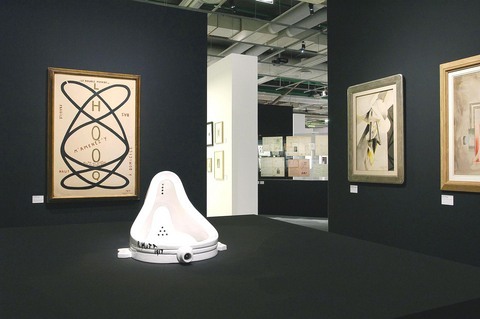
PHOTO: NY TIMES NEWS SERVICE
Indeed, Fountain itself was rejected for being neither original nor art when Duchamp offered it for the first exhibition of the Society of Independent Artists in New York in 1917. That version of the urinal, displayed upside down and signed "R. Mutt," was subsequently lost. The Pompidou's Fountain is one of eight signed replicas made by Duchamp in 1964.
After the attack last Wednesday, Pinoncelli was held by the police overnight. He was released the next day and ordered to appear in court Jan. 24 to answer charges of damaging the property of others. As in 1993, he could face a prison term or a fine. (After the first urinal attack, he was jailed for a month and fined the equivalent of US$37,500.)
The Centre Georges Pompidou said it was too early to know the cost of restoring the work. (Curators said a different Duchamp urinal was already scheduled for inclusion in the version of the show traveling to the National of Gallery of Art in Washington, Feb. 19 through May 14, and to the Museum of Modern Art in New York, June 18 through Sept. 11.)
The vandalism raises the persistent question of how valuable works of art can be protected in museums that log millions of visitors each year.
Many paintings on display today are shielded by glass. At the Louvre, the Mona Lisa, which was stolen in 1911 and struck by a stone in 1956, is now in a sealed enclosure behind thick glass.
Pinoncelli's attack also refocuses attention on the perennial question of what defines art. The question, playfully yet provocatively raised by the Dada movement nearly a century ago, has been refreshed since the 1980s by succeeding waves of conceptual, installation and performance art.
Like this week's case, such protests are often waged by artists themselves.
In 1999, for example, two Chinese artists, Yuan Cai and Jian Junxi Ianjun, jumped on My Bed, a work by the British artist Tracey Emin comprising an unmade bed accompanied by empty bottles, dirty underwear and used condoms, that was on view at the Tate Britain. The next year, the same two artists urinated on the Tate Modern's version of Fountain, noting that Duchamp himself said artists defined art.
A British artist, Michael Landy, held what he called Break Down in an empty department store in London in 2001: in this event, he destroyed all his possessions, including art donated by friends. Two other British artists, the Chapman brothers, were accused of vandalism in 2003 when they added the faces of clowns and puppets to the 80 etchings in an edition of Goya's Disasters of War that they had purchased.
In 1991, an artist generally described as unbalanced, attacked Michelangelo's David statue in Florence, Italy, and damaged a foot.
Among numerous other protests, blue dye was sprayed over Carl Andre's display of bricks at the Tate Gallery in London in 1976, and black ink was squirted into a transparent container displaying Damien Hirst's dead sheep preserved in formaldehyde at the Serpentine Gallery in London.
Still, not all vandalism is intended: another work by Hirst on display in a Mayfair gallery in 2001 -- half-full coffee cups, dirty ashtrays, beer bottles and the like -- was thrown away by cleaners who mistook it for refuse. The same thing happened at Tate Britain in 2004 to a work by Gustav Metzger, a bag of trash titled Recreation of First Public Demonstration of Auto-Destructive Art.
In the case of Pinoncelli, who could not be reached last week, nothing is accidental.
After Pinoncelli urinated in and damaged Fountain in the Carre d'Art in Nimes, he said he wanted to rescue the work from its inflated status and restore it to its original use as a urinal.
Since the early 1960s, Pinoncelli, based in Nice, has been busy with what he calls "les happenings de rue," or "street happenings." In 1969, he used a water pistol to spray red paint on Andre Malraux, who was then the French culture minister. In 1975, he "held up" a bank in Nice with a fake gun to protest Nice's decision to become Cape Town's twin city while South Africa was still under apartheid rule. The same year, he paraded outside Nice's courts, covered in large yellow stars, in what he called a homage to deported Jews.
Perhaps his most striking act unfolded in 2002 at a festival of performance art in the Colombian city of Cali. There, he protested the kidnapping of a Colombian politician, Ingrid Betancourt, by the country's leftist guerrillas by chopping off half of the smallest finger of his left hand. He then used his blood to write "FARC," the acronym of the guerrilla group (the Revolutionary Armed Forces of Colombia), on a white wall.
"The idea was to share in Colombia's violence," he told reporters at the time. But it apparently did not impress the guerrillas: Betancourt is still being held.

Taiwan’s English education system is being pulled apart by three opposing forces. Bilingual Nation 2030 pulls students toward English and global communication. Artificial Intelligence (AI) readiness pulls them toward digital judgment, verification and AI-mediated work. But Taiwan’s old exam culture pulls them back toward memorization, grammar drills, timed reading and correct answers. If the education system keeps using old exams to define success, it risks producing graduates who are neither genuinely bilingual nor genuinely AI-ready, but trained for tasks machines can already perform. The first force is Bilingual Nation 2030. Launched in 2018, the policy aimed to “help Taiwan’s workforce connect
It seems every few days one bumps into one of those “real man” comments in which Taiwan is urged to “face reality” or similar, and “make a deal,” with the speaker implying that soon it will be too late. “Deal” advocates always present themselves as having a superior grip on reality, and the manly ability to make the “hard choice.” Their testosterone-laden language often echoes that of Taiwan sellout advocates. Note that such commentary always specifies a process (“make a deal, work with, make progress”), never the end state of what occupation by a violent authoritarian colonialist state will entail. In

“Taiwan’s Opposition Leader Comes to US With a Message Straight Out of Beijing” read a May 31 headline in the Wall Street Journal. Top US administration officials and members of Congress almost certainly read the WSJ, and if there was a bullet point takeaway that people in Washington should absorb ahead of Chinese Nationalist Party (KMT) Chair Cheng Li-wun’s (鄭麗文) arrival in DC on June 9, that headline is it. The last few columns have discussed this very topic, and the timing is not coincidental. While those top officials likely do not read the Taipei Times, judging by the number
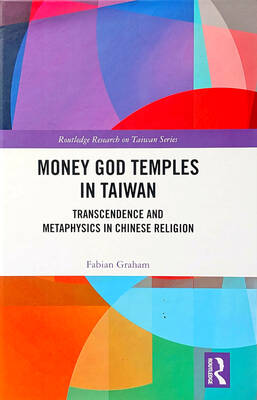
As someone who normally steers clear of books with “transcendence” or “metaphysics” in their subtitles, this reviewer — a casual observer of local belief systems since the 1990s — found Fabian Graham’s Money God Temples in Taiwan a challenging read. Those who’ve only dipped their toes into temple culture will likely need to parse several sections with special care if they’re to keep up with the author, a British ethnographic researcher whose previous books have investigated religious practices among ethnic Chinese in Southeast Asia. This scholarly volume examines a facet of Taiwan’s religious landscape that didn’t exist a century ago, and


 RSS
RSS