


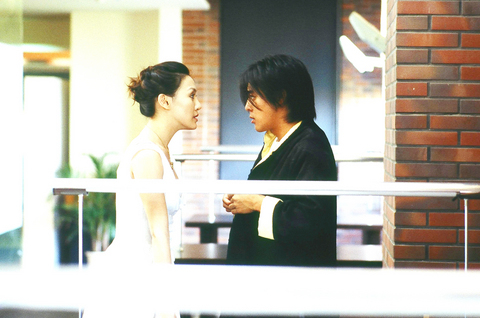
To make a college campus movie, Taiwanese film director Alex Yang (楊順清) went to a college campus. Not just any college campus, but the scenic Chung Cheng University (CCU) in Chiayi. Enlisting the enthusiastic support of CCU president Ren Luo and the student body, Yang and his production team shot My Fair Laddy, with several well-known Taipei television and film stars as the leads, among them Lin Meng-ching (林孟瑾) and Bobby Dou.
Filmed during a 30-day period in June and July, the film crew lived free-of-charge on campus at a CCU guest house, hired a supporting cast of extras from the student population and made My Fair Laddy -- yes, a play on My Fair Lady -- on a shoestring budget. Using nearby locations for background scenes, in addition to many campus locations, the movie has a southern Taiwan feel to it, according to those who have seen it, and it is poised to do well on the international film festival circuit next year. The romantic comedy had its nationwide premiere last month at CCU.
Yang said that word-of-mouth advertising via e-mail, Internet sites and bbs chatrooms will hopefully play an important part in the film's success. The Chinese title translates roughly as "My Happy and Unfettered Study Partner."
PHOTOS COURTESY OF SPOT
Eight more campus screenings are scheduled nationwide over the next few weeks, in Taipei, Kaohsiung, Taichung, Hsinchu and Tainan, an appearance at next year's Berlin Film Festival is planned, and a DVD will be released in early next year. The theatrical release of the film in movie theaters around the country is set for early next month, according to Steve Cheng, a professor of marketing at CCU and one of the associate producers of the film.
In a recent e-mail interview, Yang, 40, spoke about the genesis and background of his new film, which he hopes to take later to audiences in Japan, Hong Kong, North America and Europe. The up-and-coming director, a graduate of the Taipei National University of the Arts, where he studied film with internationally-acclaimed director Edward Yang (no relation), has produced two well-received movies, The Trigger in 2003 and Taipei 21 last year.
When asked what kind of audience he was trying to reach with this campus comedy and how he did his pre-production research, Yang replied: "It's important to know the potential market and your target audience, of course, before you make a film, because a movie is more than just a mere work of art -- it is also a business enterprise, a product. In the last 20 years, almost every Taiwanese film has faced the same problem of how to market your film and find your audience, but in the end, a director has to go on his personal vision and intuition. That's what I've done for all my films."
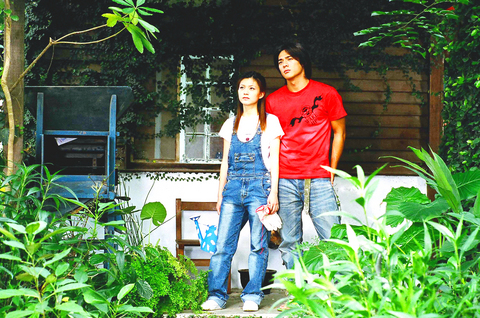
In My Fair Laddy, the lead female character played by Lin, is named Sophia, has 108 study partners as the movie opens. While the theme of the movie is youth and how young people go about trying to make their dreams come true, the film is also about friendship, love and romance, Yang says.
"The movie has its elements of comedy, of course, and also of irony," Yang says. "For example, Sophia wants to find true love but how can she do this when she goes around accumulating 108 study partners? That is part of the theme of the movie: how to be really free and unfettered in life and love."
The main characters in My Fair Laddy are a male university student and two college coeds, according to the shooting script that Yang wrote earlier in the year. The young man, named Tong-tong, writes a play that becomes a big hit on campus. Sophia, one of the most beautiful girls on campus, says she wants to perform in Tong-tong's stage play, and during rehearsals, the two start to fall in love with each other. However, Tong-tong's girlfriend, named Ann, becomes worried that she might lose him.
"When I visited CCU last spring and talked to a lot of students there, I discovered some interesting insights about Taiwan society," Yang said.
"Of course, for young people anywhere, in any country, trying to make their dreams come true is never easy, but it's part of the process of growing up, maturing. We all go through it at that age. So even though the adult society around us may sometimes seem hypocritical or fake, when we are young, as the characters in the movie are, we live lives of innocence and strong emotions."
Yang said later editions of the film will have English subtitles, and a DVD will be released early next year also with English subtitles.
Yang and his producers plan to screen My Fair Laddy at the next Berlin Film Festival in Germany, and they also hope to get invitations later to film festivals in Japan, Canada, New York and Italy.
"Right now, our marketing efforts here in Taiwan are to screen the movie on college campuses nationwide this month and next, kind of like a university roadshow," associate producer Cheng said.
My Fair Laddy was financed in the usual Taiwan way, according to Yang, with a third of the funding coming from local and international investors, and the rest from a bank loan. One of the international investors, Yang said, is a French national, a director of a major multinational clothing company based in Asia who was once Yang's French teacher in Taipei when the director was a college student some 20 years ago.
Yang says he has three big hopes for his new movie. " I hope we can help bring audiences in Taiwan back to the movie theaters; I hope our investors can make some money, of course; and I hope filmgoers in Taiwan and overseas will really enjoy the story and the acting in the film."
Yang says he hopes My Fair Laddy will reach beyond Taiwan's shores and resonate overseas,too.
"I hope that not only Taiwanese students, but also students all around the world will identify with this movie's theme," he says. "If people have dreams, and most college students around the world today do, then they will be able to enjoy this movie. It's for them, after all!"
"Can Youth Save Taiwan Cinema?" asked the International Herald Tribune newspaper last year, in a headline above an article by Taipei-based reporter Caroline Gluck. "A new generation of Taiwanese filmmakers and producers is beginning to make waves," Gluck wrote, noting that Alex Yang was one of them.
My Fair Laddy might just be the film that brings Yang to the attention of a larger international audience and make his name a household word here in Taiwan.

Taiwan’s English education system is being pulled apart by three opposing forces. Bilingual Nation 2030 pulls students toward English and global communication. Artificial Intelligence (AI) readiness pulls them toward digital judgment, verification and AI-mediated work. But Taiwan’s old exam culture pulls them back toward memorization, grammar drills, timed reading and correct answers. If the education system keeps using old exams to define success, it risks producing graduates who are neither genuinely bilingual nor genuinely AI-ready, but trained for tasks machines can already perform. The first force is Bilingual Nation 2030. Launched in 2018, the policy aimed to “help Taiwan’s workforce connect
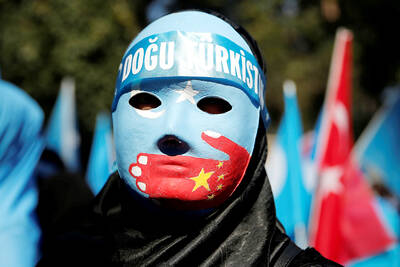
It seems every few days one bumps into one of those “real man” comments in which Taiwan is urged to “face reality” or similar, and “make a deal,” with the speaker implying that soon it will be too late. “Deal” advocates always present themselves as having a superior grip on reality, and the manly ability to make the “hard choice.” Their testosterone-laden language often echoes that of Taiwan sellout advocates. Note that such commentary always specifies a process (“make a deal, work with, make progress”), never the end state of what occupation by a violent authoritarian colonialist state will entail. In

There are shadowy cabals plotting to sell out Taiwan to be annexed by China, by invasion if necessary. Fortunately, they are buffoons. In 2019, former Bamboo Union gangster and founder of the China Unification Promotion Party (CUPP), Chang An-le (張安樂, colorfully known as “White Wolf”), led a protest at the Legislative Yuan against comments made by then-premier Su Tseng-chang (蘇貞昌) that in the event of an attack by China, he would never surrender, but would protect the nation by fighting to the end, even if he only had a broom. Chang had party members bring a wooden casket that they
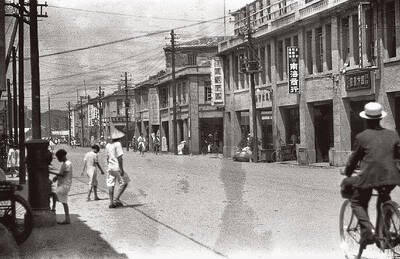
June 1 to June 7 "If all Taiwanese were as afraid of dying as you, then what would happen?” Physician Shih Chiang-nan (施江南) reportedly said this to his wife Chen Chiao-tung (陳焦桐) after she urged him to stop intervening on behalf of Taiwanese soldiers stranded overseas after serving in the Japanese Army during World War II. Shih had clashed with high-ranking officials over the issue, engaged in several heated arguments with Taiwan governor-general Chen Yi (陳儀) and allegedly shouted at general Ko Yuan-fen (柯遠芬), chief of staff of the Taiwan Garrison Command, over


 RSS
RSS