


That Pink Floyd's Roger Waters should write an opera is not all that surprising. In the group's heyday in the 1970s its music was often called "tomorrow's classical music," though I don't suppose many thought that prediction would come to pass in quite this way. Anyway, the two-CD work, Ca Ira ("it will be," or "there's hope") will be given its official launch in Taiwan early next month and Taipei Times has been granted a preview.
It's nothing if not ambitious. It aims to tell the story of the first four years of the French Revolution, an enormous task. The staging is imagined as a circus. Bryn Terfel narrates (as the Ringmaster, while also playing the King), and Ying Huang (the Butterfly in Frederick
Mitterand's wonderful film of Madame Butterfly) is Marie Antoinette, as well as "the voice of Liberty, Reason and the Republic." West African musician Ismael Lo stars in a scene set in the Caribbean.
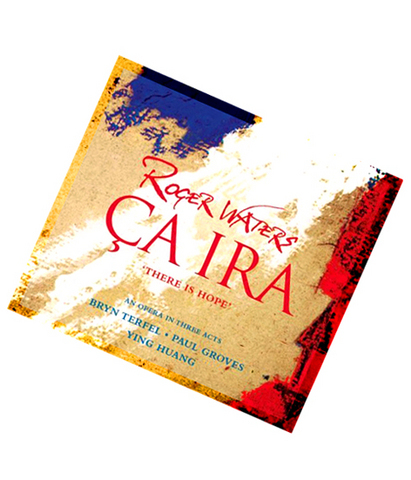
The method is declamatory, rather than the traditional one of telling a story through the interaction of characters. Waters makes full use of an orchestra in the 19th century manner, but there's also a chorus of demanding London children as in The Wall and a lot of sound effects -- guns being fired, pigeons flying away, bells, military drums and wind. This is nevertheless a lot more like Andrew Lloyd Webber than The Dark Side of the Moon.
My feeling is that Ca Ira will be very successful in the way Evita and Les Miserables were. But at the same time it seems much better than either of these, both musically and dramatically. The lyrics (by Waters) are excellent and the music could become memorable on repeated hearing. Needless to say, such an important product has led those responsible to pull out all the stops. The performances are first-rate throughout and the sound quality is cutting-edge. Who said the history of opera was over (even though some will judge that this isn't really opera)?
It's always nice to have a chance to revisit, and to reiterate one's praise for the Pierre Boulez/Patrice Chereau Der Ring des Nibelungen. This famous 1981 set of the anniversary production of Richard Wagner's tetralogy at Bayreuth has now been reissued in boxed form, together with The Making of the Ring, an hour-long film about the production, with interview material from Boulez, Chereau, music critic William Mann, leading video director Brian Large and soprano Gwyneth Jones. Of particular interest is the history of Ring

productions at Bayreuth since Wagner's day and the reminiscences of Friedelind Wagner, the composer's descendant.
This set has always been eminently desirable. Even though the rival and much more traditional James Levine/Metropolitan Opera set has a lot going for it musically, this Boulez/Chereau cycle, now in 5.1 DTS Surround Sound, remains incomparable as a dramatic and imaginative experience. It was one of the 20th century's key productions, in any genre, and anyone with the
remotest interest in such things who doesn't know it should rush out and buy it forthwith. Its splendors are almost unlimited.
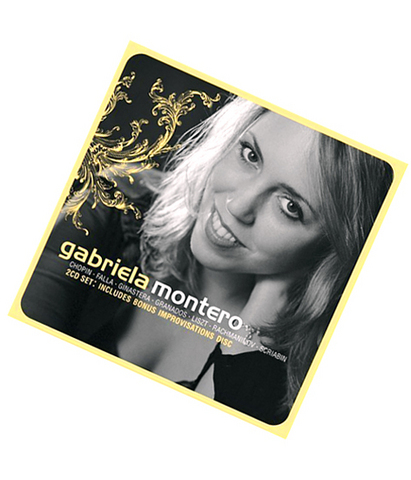
You might sometimes wonder why some classical artists get recording contracts and some don't. In the case of pianists it might depend these days on whether or not they have caught the ear of Martha Argerich, as EMI is running a whole series of debut solo piano albums by people she endorses. By adding Argerich's name to a new release the public are encouraged to trust an unknown. In the case of the Venezuelan Gabriela Montero their trust is unlikely to be misplaced.
A two-CD set is offered. The first is a selection of items from a range of
composers including Rachmaninov, Scriabin, De Falla, Chopin and Liszt, and includes the Argentinean Alberto Ginastera (1916 to 1983). The other, much more unusually in classical circles, contains 12 improvisations. Montero often does these as encores. It's this disc of improvisations that is particularly remarkable, with her style ranging from jazz to what could be described as classically-inspired fantasias.
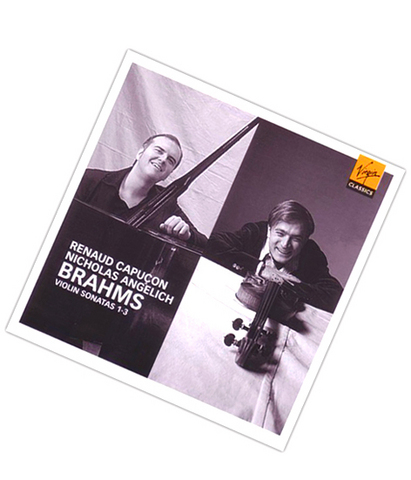
Aimez-vous Brahms?(Do you like Brahms?) asked Francoise Sagan a long time ago in the title of a novel. I don't know what I would have replied at the time, but the older I get the more I enjoy him. There was a time when I took it for granted he was something of a fat cat, purring luxuriously with his sonorous harmonies and full orchestration, the perfect composer for business executives. Now I see him differently, as a somewhat withdrawn, introspective individual who pursued an unfashionable interest in pre-Romantic music and collected original manuscripts of Schubert songs.
A new CD from EMI of his three Violin Sonatas reinforces the view of Brahms as unostentatious and inward-looking. These beautiful works are given sensitive and delicate performances here, and in addition there is the movement Brahms wrote, aged 20, for the Sonata FAE. (frei aber einsam, free but alone), in which each of the three movements was written by a different composer. Altogether fine sounds and flawless interpretations.

Taiwan’s English education system is being pulled apart by three opposing forces. Bilingual Nation 2030 pulls students toward English and global communication. Artificial Intelligence (AI) readiness pulls them toward digital judgment, verification and AI-mediated work. But Taiwan’s old exam culture pulls them back toward memorization, grammar drills, timed reading and correct answers. If the education system keeps using old exams to define success, it risks producing graduates who are neither genuinely bilingual nor genuinely AI-ready, but trained for tasks machines can already perform. The first force is Bilingual Nation 2030. Launched in 2018, the policy aimed to “help Taiwan’s workforce connect

It seems every few days one bumps into one of those “real man” comments in which Taiwan is urged to “face reality” or similar, and “make a deal,” with the speaker implying that soon it will be too late. “Deal” advocates always present themselves as having a superior grip on reality, and the manly ability to make the “hard choice.” Their testosterone-laden language often echoes that of Taiwan sellout advocates. Note that such commentary always specifies a process (“make a deal, work with, make progress”), never the end state of what occupation by a violent authoritarian colonialist state will entail. In

There are shadowy cabals plotting to sell out Taiwan to be annexed by China, by invasion if necessary. Fortunately, they are buffoons. In 2019, former Bamboo Union gangster and founder of the China Unification Promotion Party (CUPP), Chang An-le (張安樂, colorfully known as “White Wolf”), led a protest at the Legislative Yuan against comments made by then-premier Su Tseng-chang (蘇貞昌) that in the event of an attack by China, he would never surrender, but would protect the nation by fighting to the end, even if he only had a broom. Chang had party members bring a wooden casket that they
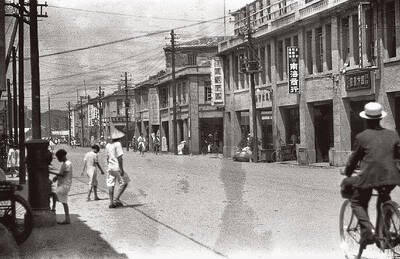
June 1 to June 7 "If all Taiwanese were as afraid of dying as you, then what would happen?” Physician Shih Chiang-nan (施江南) reportedly said this to his wife Chen Chiao-tung (陳焦桐) after she urged him to stop intervening on behalf of Taiwanese soldiers stranded overseas after serving in the Japanese Army during World War II. Shih had clashed with high-ranking officials over the issue, engaged in several heated arguments with Taiwan governor-general Chen Yi (陳儀) and allegedly shouted at general Ko Yuan-fen (柯遠芬), chief of staff of the Taiwan Garrison Command, over


 RSS
RSS