


Ward Marston shut down his turntable, pulled off the record and said, "I'll be singing Night and Day for the rest of the week."
Marston's compliment was for Cole Porter, who wrote the song, and for Fred Astaire, who recorded it in 1932. But not for the recording itself, one track on a remastered CD. "The sound is thin and the surface scratchy," he said.
And Ward Marston should know. By almost any measure, he is considered one of the best in the small but worldwide group of music lovers and sound engineers dedicated to finding new life in old phonograph records.
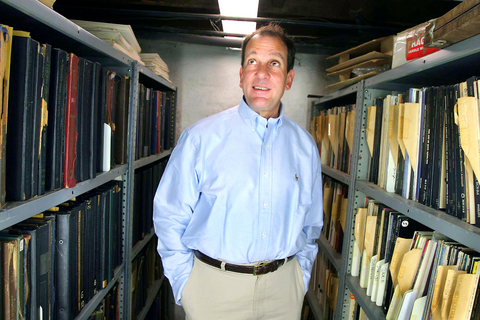
PHOTO: NY TIMES
Marston had not worked on the old Cole Porter disc, which irritated him, he said, because he would have liked to "clean it up." He works mostly with classical recordings, and his output over the years has been prolific. There was the reworking of Arturo Toscanini's entire recording career, ultimately 35 long-playing records, done for the Franklin Mint in conjunction with the Toscanini family. That, he said, earned him his first Grammy Award.
Marston, who has been blind since shortly after birth, first came to prominence in his field in 1979 when he successfully restored the first known stereophonic record, made by the Bell Telephone Laboratories in 1932. He has restored old recordings for labels including EMI, BMG, Biddulph and CBS. He restored all of Rachmaninoff's recordings. "The producer got the Grammy on that one," he said.
Yet another Grammy recognized his work restoring the complete recording of the legendary soprano Lucrezia Bori. For another project, he restored most of the very early records for a 93-record collection of the works of the pianist Arthur Rubinstein.
In 1997, he garnered yet another Grammy for his work on a collection of old Fritz Kreisler recordings for BMG. Separately, he did all of Kreisler's European recordings for a British label. For Naxos, he restored much of the recording done from 1926 to 1937 by Willem Mengelberg and the Concertgebouw Orchestra of Amsterdam. From 1937 through 1943, Mengelberg and the Concertgebouw recorded for Telefunken, and he worked on many of those recordings as well.
Improving the sound of old records -- in fact, discovering sounds no one knew was there -- demands both technical skill and a high degree of musical sensitivity. In the past, Marston said, it was left mostly to recording engineers, some of whom, in his words, "wouldn't know Mussorgsky from Mozart."
"You have to try to know what the composer wanted," he said, "and what the artist tried to achieve."
This does not mean he plays down the technical side of the work. "I come from a musical, not a technical, standpoint," he said, "but I'm not at all spooked by the technical part." Indeed, he quickly leaves a layman behind when he talks about technical achievements in sound reproduction. "We've come far in recent years, but there are going to be incredible strides in the next 10 to 15 years," he said.
Restoring an old record, Marston said, begins very simply -- with a bath. Solutions are used to clean years of dirt and grime that have collected in the record groves. After that, the bulk of the rehabilitation is relegated to a computer. "Once the recording has been digitalized," he said, most of the work can be done from the keyboard, using sophisticated software.
His studio is filled with electronic gear, turntables and speakers. He uses some 15 custom-ground styli -- phonograph needles to most of us. And he invented and built a device that safely plays his old and extremely delicate wax cylinder recordings. "But I'm no one-man band," he said. "I can't do it all. I'm a musician and a historian, and I do have perfect pitch, but I'm always learning from the engineers. For instance, there's a guy out in California who can remove pitch flutter from a recording. He's amazing."
Marston, 53, was born in nearby Bryn Mawr into an old Philadelphia family. He said he taught himself to play the piano when he was 4. At 7, he began lessons in piano and organ.
He seemed destined for a concert career, but it held no appeal. Paraphrasing Yogi Berra, he said, "Life took a fork." Still a teenager, he played in clubs and piano bars, "anything to make a living." His blindness has never affected his career. The few things he can't do, like driving, are handled by his partner and business manager, Scott Kessler. "I wasn't born blind," he said, "but I was born prematurely. Too much oxygen in an incubator did the rest."
At Williams College he majored in history and ran the radio station, mostly so he could play his own records. Even then, his collection was impressive. It still is: His basement in Swarthmore holds 35,000 CDs and records, many of them rare 78s he hopes to restore one day and sell under the Marston label he created two years ago.
But for now Marston must turn elsewhere to earn his living. In fact, he turns to the piano, from which he leads the Ward Marston Trio, which plays nationwide. The group was in the Hamptons recently and has a full calendar for the months ahead.
"I've always tried to keep the sound of live music in my ears," Marston said. "Recordings, even the best of them, are a pale imitation of what real music sounds like."

Taiwan’s English education system is being pulled apart by three opposing forces. Bilingual Nation 2030 pulls students toward English and global communication. Artificial Intelligence (AI) readiness pulls them toward digital judgment, verification and AI-mediated work. But Taiwan’s old exam culture pulls them back toward memorization, grammar drills, timed reading and correct answers. If the education system keeps using old exams to define success, it risks producing graduates who are neither genuinely bilingual nor genuinely AI-ready, but trained for tasks machines can already perform. The first force is Bilingual Nation 2030. Launched in 2018, the policy aimed to “help Taiwan’s workforce connect

It seems every few days one bumps into one of those “real man” comments in which Taiwan is urged to “face reality” or similar, and “make a deal,” with the speaker implying that soon it will be too late. “Deal” advocates always present themselves as having a superior grip on reality, and the manly ability to make the “hard choice.” Their testosterone-laden language often echoes that of Taiwan sellout advocates. Note that such commentary always specifies a process (“make a deal, work with, make progress”), never the end state of what occupation by a violent authoritarian colonialist state will entail. In

There are shadowy cabals plotting to sell out Taiwan to be annexed by China, by invasion if necessary. Fortunately, they are buffoons. In 2019, former Bamboo Union gangster and founder of the China Unification Promotion Party (CUPP), Chang An-le (張安樂, colorfully known as “White Wolf”), led a protest at the Legislative Yuan against comments made by then-premier Su Tseng-chang (蘇貞昌) that in the event of an attack by China, he would never surrender, but would protect the nation by fighting to the end, even if he only had a broom. Chang had party members bring a wooden casket that they

June 1 to June 7 "If all Taiwanese were as afraid of dying as you, then what would happen?” Physician Shih Chiang-nan (施江南) reportedly said this to his wife Chen Chiao-tung (陳焦桐) after she urged him to stop intervening on behalf of Taiwanese soldiers stranded overseas after serving in the Japanese Army during World War II. Shih had clashed with high-ranking officials over the issue, engaged in several heated arguments with Taiwan governor-general Chen Yi (陳儀) and allegedly shouted at general Ko Yuan-fen (柯遠芬), chief of staff of the Taiwan Garrison Command, over


 RSS
RSS