


Madison Avenue advertisers in the US are increasingly interested in using everyday women in advertising instead of waifish supermodels.
The change comes after the Dove line of personal-care products sold by Unilever introduced what it called a "campaign for real beauty," which presents women in advertisements as they are, rather than as some believe they ought to be.
If the fad becomes a trend and shows legs, so to speak, it has the potential to fundamentally change decades of image-making on Madison Avenue. But that is a big if indeed. There have been many previous instances of ads that showed so-called real women in place of professional models, which receded as the allure of glamour again reared its beautiful head. This week, Nike is introducing a humorous print and online campaign for exercise gear, frankly glorifying body parts that until now were almost never seen in ads, much less celebrated. One ad, which begins boldly, "My butt is big," features an oversized photograph of the derriere in question.
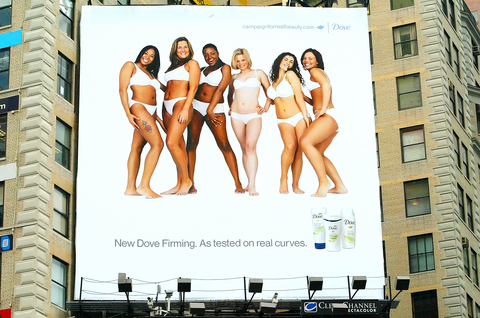
PHOTO: NY TIMES
Another Nike ad declares, "I have thunder thighs," while a third asserts, "My shoulders aren't dainty or proportional to my hips. Some say they are like a man's. I say, leave men out of it."
The Nike ads, by Wieden and Kennedy in Portland, Oregon, are arriving days after the Chicken of the Sea brand of tuna introduced a television commercial showing a gorgeous young woman being ogled by the men in her office. She can escape their wolfish ways only in the elevator, which she enters alone, then breathes a sigh of relief -- revealing she really has a more-than-ample stomach, which she had been holding in.
The Nike campaign was in the works, executives say, well before the much-publicized arrival last month of Dove print and outdoor ads showing six women, none of them models, sizes four to 12, smiling in their underwear. (The first Dove "real beauty" ads, showing older, wrinkled women, started appearing last fall.) And the Chicken of the Sea commercial is adapted from a spot that its parent, Thai Union Frozen Products, began running in Asia in 2001.
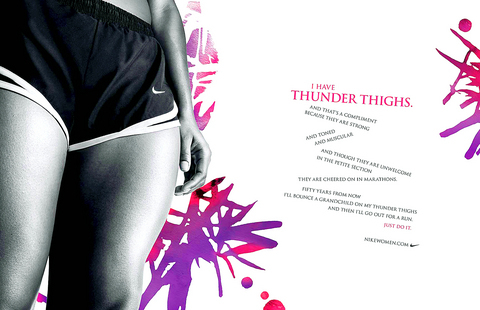
PHOTO: NY TIMES
Even so, the arrival of all the ads at the same time suggests that change may be in the air.
"We've gotten tired of airbrushed pictures none of us can relate to or recognize," said Linda Kaplan Thaler, one of the most prominent women in advertising, whose agency, the Kaplan Thaler Group in New York, was not involved in creating any of the campaigns. Advertisers are "loosening the reins," said Kaplan Thaler, who is chief executive and chief creative officer at her agency, which is owned by the Publicis Groupe, in recognition of the reality that "women are the majority of consumers and are buying most of the products."
But those facts have been evident for years. Why the new style of ads now? One reason, said Nathan Coyle, senior strategist at Brain Reserve in New York, a consulting company, is the advent of reality television.
"Your neighbors, everyday people, are the new celebrities," Coyle said, which feeds the desire for marketers "to shift from depicting women who are unattainable to women who are attainable."
Kelly Simmons, president of a brand-consulting company in Philadelphia named Bubble, offered another reason: the aging of the baby boomers -- the 76 million Americans born from 1946 to 1964 -- who have long set the pace for marketers and advertising agencies. The first boomers will start turning 60 on Jan. 1.
"There's no question baby boomers feel better about their bodies," Simmons said, "and are determined to age beautifully." Simmons said, "It feels there are real voices of women coming through" in the Dove and Nike ads. "I applaud the trend."
Nancy Monsarrat, US director for advertising at Nike in Beaverton, Oregon, said that in addition to the different attitudes about body image among boomer women, "younger women have a diffe-rent perspective" than their counterparts did a decade or two ago.
"They're more personally independent about who they can and should be," Monsarrat said, which is also reflected in the campaign's approach.
"One of the things we've noticed is if you go to an exercise class, if you go to a marathon, active women come in a lot of shapes and sizes," she added. "This can be a great celebration of that."
Fitness and health are also the focus of the Chicken of the Sea commercial, said John Signorino, the company's presi-dent and chief executive, in San Diego. He imported the spot to the US after consumers -- including, he said, his wife -- received overseas versions of it from friends by e-mail.
"It's an effort to show consumers, in an attention-getting way, that tuna, and Chicken of the Sea, fit into a healthy lifestyle," Signorino said.
The commercial is being shown, or soon will be, on networks including ABC, CBS, HGTV and Oxygen, he added, and will be circulated through e-mail. The spot is adapted from the original version created by an agency in Bangkok, Thailand, named Chaiyo. Monsarrat said the Nike campaign, which is also to appear on a Web site (nikewomen.com), is in keeping with her company's efforts, dating back more than a decade, to address issues about women's self-images in a positive way, without stereotypes.
She cited campaigns that carried themes like, "This is not a goddess" and, "If you let me play," all of which were inten-ded, she said, to be "honest in how we communicate with our target consumer."
Nike was not alone in the 1990s in running ads meant to question the conventional wisdom about images of women in advertising. In 1997, the Body Shop gained international attention for a campaign carrying the theme, "Love your body," which featured a Rubenesque plastic doll named Ruby. The print ads and posters showed the voluptuous, even zaftig, Ruby reclining on a sofa under this headline: "There are 3 billion women who don't look like supermodels and only eight who do."
"Advertising sometimes starts trends, and sometimes it follows trends," Kaplan Thaler said.
Even if they do not turn up in ads, "real women have always been here, are here and continue to be here," she added. "I'm always happy to see advertising that does not dictate a norm none of us can achieve."

Taiwan’s English education system is being pulled apart by three opposing forces. Bilingual Nation 2030 pulls students toward English and global communication. Artificial Intelligence (AI) readiness pulls them toward digital judgment, verification and AI-mediated work. But Taiwan’s old exam culture pulls them back toward memorization, grammar drills, timed reading and correct answers. If the education system keeps using old exams to define success, it risks producing graduates who are neither genuinely bilingual nor genuinely AI-ready, but trained for tasks machines can already perform. The first force is Bilingual Nation 2030. Launched in 2018, the policy aimed to “help Taiwan’s workforce connect

It seems every few days one bumps into one of those “real man” comments in which Taiwan is urged to “face reality” or similar, and “make a deal,” with the speaker implying that soon it will be too late. “Deal” advocates always present themselves as having a superior grip on reality, and the manly ability to make the “hard choice.” Their testosterone-laden language often echoes that of Taiwan sellout advocates. Note that such commentary always specifies a process (“make a deal, work with, make progress”), never the end state of what occupation by a violent authoritarian colonialist state will entail. In

There are shadowy cabals plotting to sell out Taiwan to be annexed by China, by invasion if necessary. Fortunately, they are buffoons. In 2019, former Bamboo Union gangster and founder of the China Unification Promotion Party (CUPP), Chang An-le (張安樂, colorfully known as “White Wolf”), led a protest at the Legislative Yuan against comments made by then-premier Su Tseng-chang (蘇貞昌) that in the event of an attack by China, he would never surrender, but would protect the nation by fighting to the end, even if he only had a broom. Chang had party members bring a wooden casket that they
June 1 to June 7 "If all Taiwanese were as afraid of dying as you, then what would happen?” Physician Shih Chiang-nan (施江南) reportedly said this to his wife Chen Chiao-tung (陳焦桐) after she urged him to stop intervening on behalf of Taiwanese soldiers stranded overseas after serving in the Japanese Army during World War II. Shih had clashed with high-ranking officials over the issue, engaged in several heated arguments with Taiwan governor-general Chen Yi (陳儀) and allegedly shouted at general Ko Yuan-fen (柯遠芬), chief of staff of the Taiwan Garrison Command, over


 RSS
RSS