


"Are you really a wealthy man or are you speculating with other people's money?" George Bernard Shaw once asked J Arthur Rank. "I am all right," Britain's only film tycoon gruffly replied.
There was a certain irony in the exchange. At the time, the Rank Organisation was planning a big-budget adaptation of Shaw's play Caesar and Cleopatra, to be produced and directed by the flamboyant Hungarian Gabriel Pascal. Scheduled to shoot for four months, the film (released in 1946) took close to two years to complete at more than double the original budget, and undermined Rank's confidence in British film-making for good.
To mark the 70th anniversary of the golden gong (the iconic Rank symbol that opened all his films), a new boxed set of Rank "classics" is being released on DVD.
Predictably, the ill-fated Caesar and Cleopatra is not among them, but perhaps it ought to be. The story of Pascal's Shaw adaptation captures perfectly that strange mix of vision, extravagance and muddle-headedness that characterized Rank in his pomp. With Rank's money and seemingly endless reserves of goodwill, the autocratic Pascal built his own sphinx, imported camels and covered Denham Studios with sand. He recruited the best cinematographers of the day as well as a small army of leading British actors. The result was a film that bored most critics rigid.
"Pascal sold a bill of goods to Arthur," said another Rank producer, Anthony Havelock-Allan, in the early 1990s. "If we'd been consulted, to a man we would all have said (to Rank) that you are raving mad. Do not let Gabriel Pascal attempt to direct anything. He does not know how. It will be a disaster."
In the years leading up to Caesar and Cleopatra, J Arthur Rank had undergone an unlikely transformation. In 1935, the middle-aged Yorkshire flour tycoon and Methodist Sunday-school teacher backed The Turn of the Tide, a religious-themed yarn about warring families in a fishing community. It won a prize at the Venice festival but sank without trace at the British box office.
Rank then started to back the company General Film Distributors in order to get his own foothold in distribution. At first, he seemed like just another financier dabbling on the edges of British cinema. Soon, though, he was to preside over the biggest film empire in British cinema history. His tentacles began to stretch into every corner of film-making: animation, newsreels, B- movies, children's films, Shakespeare adaptations, Ealing comedies and Gainsborough costume melodramas, as well as movies on the scale of Pascal's folly.
Rank acquired the best studios, the best labs and the cinemas. His company was a fully integrated "major" with every bit as much muscle as its Hollywood rivals.
And yet, Rank didn't tally at all with the stereotype of the Sam Goldwyn or Louis B Mayer-type studio boss. A patrician, slightly aloof figure with a love of British countryside pursuits (golfing, shooting), he was nicknamed "Uncle Arthur" by his employees. Rank freely admitted he knew very little about the medium he had embraced with such fervour.
"He wasn't at all what you would call an artistic man," his daughter Shelagh Cowen said of him. "He was a man of action and great thought, a man of vision, but not aesthetically -- he bought the brains to do that for him."
Those brains -- favorite directors included David Lean, Powell and Pressburger, and Launder and Gilliat, all part of a company called Independent Producers Ltd (IPL) -- were given carte blanche.
"We can make any subject we wish with as much money as we think that subject should have spent on it," Lean boasted in a famous article in the Penguin Film Review.
Time Magazine noted of Rank's benevolent approach, "Perhaps not since the time of the Renaissance popes have a group of artists found a patron so quick with his wallet, so slow with unsolicited directions and advice."
By giving the most talented film-makers their heads, Rank reasoned, he would be rewarded with the prestigious A-pictures that would enable him to break into the all-important US market. The experiment worked, after a fashion. IPL yielded A Matter of Life and Death, The Red Shoes, Great Expectations, Brief Encounter and I See a Dark Stranger, all still acknowledged as among the best British films ever made. Also made during the same period were Laurence Olivier's Hamlet and Henry V.
Jean Simmons, who played Estella in Great Expectations, Ophelia in Olivier's Hamlet and a beautiful siren in Black Narcissus, testifies to the formal ingenuity of Rank's best film-makers of the era. They built stairways to heaven, re-created Dickens' England in extravagant detail, and were even able to make Pinewood Studios seem like the "exotic East." "On Black Narcissus," Simmons says, "I remember going on set one day and seeing lots of white mold. An old man was sitting there with a wind machine. He said, come and look through the camera. I looked through the camera and I was in the Himalayas." (The old man with the wind machine was Alfred Junge, Powell's magician-like production designer.)
The downside to Rank's bold experiment, however, was that the sums didn't add up. The films by Lean and Powell and Pressburger were extraordinarily expensive to make. When the members of IPL had complained to Rank about investing in something as foolhardy as Caesar and Cleopatra, he had responded by telling them that Pascal's epic would sell six other British movies in its wake in the US. This didn't happen.
As the Rank Organisation grew in size, it became less and less efficient. In 1944, Rank had established Production Facilities (Films) Ltd, known as "Piffle" by its detractors. This was an in-house company designed to help all his producers on such matters as casting, props and contracts. Instead, it caused resentment and confusion -- not least because the film-makers could have secured these services far cheaper from outside agencies.
"My remembrance of Piffle is of a bunch of people from various studios who claimed to be experts in this, that and the other, brought together under one banner," Charles Staffell, Pinewood's special-effects expert, said later. "They never really did anything except make themselves a bloody nuisance."
Nor did the Rank Organisation treat its artists with quite as much tact as might have been anticipated. There were hints of mutiny from the Charm School in London, where starlets such as Diana Dors learned about deportment while actors such as Christopher Lee and Anthony Steel were obliged to walk around with books on their heads to improve their posture. Not all the stars appreciated the number of village fetes they were obliged to open. And they didn't enjoy being bartered like cattle. Simmons recalls Pascal (who co-owned her contract with the Rank Organisation) telling her one day that she had been sold to Howard Hughes at RKO. "I needed the money," Pascal confessed when she asked why he hadn't warned her in advance of his plans.
There are many reasons why Rank's bold vision for the British film industry soon began to crumble. The US market wasn't ready to open up to British films, and even in Britain, audiences preferred Hollywood films to home-grown products.
The Rank Organisation's withdrawal from the film business took half a century (and was only definitively completed a few months ago). Many associate the golden gong with the relatively feeble films made in the 1950s -- the Norman Wisdom comedies, Doctor in the House, Genevieve, all those John Mills war movies. In truth, though, Rank's real flowering was comparatively brief. For a few years in the 1940s, Powell and Pressburger, Lean and co were granted a licence that no British film-makers before or since have enjoyed. They responded by making masterpieces.
The Rank 70th anniversary DVD box set, including Brief Encounter, The 39 Steps, The Red Shoes and A Matter of Life and Death, is released on Monday by Granada Ventures.

Yesterday, the Democratic Progressive Party (DPP) nominated legislator Puma Shen (沈伯洋) as their Taipei mayoral candidate, the Chinese Nationalist Party (KMT) put their stamp of approval on Wei Ping-cheng (魏平政) as their candidate for Changhua County commissioner and former legislator Tsai Pi-ru (蔡壁如) of the Taiwan People’s Party (TPP) has begun the process to also run in Changhua, though she has not yet been formally nominated. All three news items are bizarre. The DPP has struggled with settling on a Taipei nominee. The only candidate who declared interest was Enoch Wu (吳怡農), but the party seemed determined to nominate anyone

In a sudden move last week, opposition lawmakers of the Chinese Nationalist Party (KMT) and Taiwan People’s Party (TPP) passed a NT$780 billion special defense budget as a preemptive measure to stop either Chinese leader Xi Jinping (習近平) or US President Donald Trump from blocking US arms sales to Taiwan at their summit in Beijing, said KMT heavyweight Jaw Shaw-kong (趙少康), speaking to the Taipei Foreign Correspondents Club on Wednesday night in Taipei. The 76-year-old Jaw, a political talk show host who ran as the KMT’s vice presidential candidate in 2024, says that he personally brokered the deal to resolve
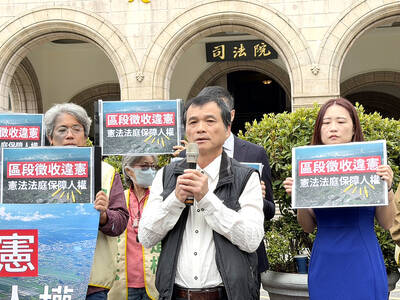
What government project has expropriated the most land in Taiwan? According to local media reports, it is the Taoyuan Aerotropolis, eating 2,500 hectares of land in its first phase, with more to come. Forty thousand people are expected to be displaced by the project. Naturally that enormous land grab is generating powerful pushback. Last week Chen Chien-ho (陳健和), a local resident of Jhuwei Borough (竹圍) in Taoyuan City’s Dayuan District (大園) filed a petition for constitutional review of the project after losing his case at the Taipei Administrative Court. The Administrative Court found in favor of nine other local landowners, but

The Chinese Nationalist Party (KMT) and its sock puppet, the Taiwan People’s Party (TPP), passed their version of the government’s proposed supplementary defense spending bill last week, engendering much commentary. While all eyes were on the defense budget, the PRC’s assault on Taiwan was advancing on other fronts. The removal of domestic drone production and other technologies critical to the nation’s asymmetrical defenses from the list of items purchased in the “compromise” bill shows how the KMT-TPP alliance appears to be serving the People’s Republic of China (PRC). Ironically, the cuts will impact industries heavily represented by tech firms in areas run


 RSS
RSS