


William Empson was one of the UK's leading 20th century literary critics, and he spent much of his early teaching career at universities in Japan and China. If this sounds surprising, the reason today sounds even more so. It was that a conventional academic career in his home country was closed to him after a servant found an unused condom in his room at Magdalene College, Cambridge. His name was removed from the college books, making it impossible for him to proceed to graduate work.
This fine new biography follows Empson -- author of Seven Types of Ambiguity, Some Versions of Pastoral, The Structure of Complex Words and Milton's God -- from his birth in 1906 to his arrival back in London from China in 1939. Myopic, alcoholic and bisexual, he emerges from these pages as an eccentric yet stoical loner, a sometimes frisky but usually owlish figure with glasses held together by sticking tape, who was nevertheless adored by his students, and in many ways laid the foundations of the study of English literature in East Asia.
His four famous books are paradoxical, clever, coat-trailing and in essence deeply subversive. He was anti-militaristic, anti-

Communist, and provocatively anti-Christian. In Milton's God, for instance, he argued that John Milton's portrait of God in Paradise Lost was of a bad-tempered tyrant, and what's more Milton knew it. He thought Buddhism more humane than Christianity (and Buddha's image as ambiguous as the best poetry). In a famous passage in Pastoral he pointed out that the equanimity of Thomas Gray's famous Elegy Written in a Country Churchyard served to hide the fact that the wasted lives it commemorated need not have been wasted if there had been a more equitable educational system.
All the UK's progressive young devoured Empson's early books, and eventually, in 1953, he was given a professorship at Sheffield University. John Haffenden now occupies his subject's former post there, and as a young man worked alongside him prior to Empson's retirement from Sheffield in 1971 (he died in 1984). He describes him as off-handedly agreeing to the biography project. What now appears is the first volume. It's appropriately subtitled Among the Mandarins.
The era Empson was in the Far East was marked by heightened Japanese nationalism and the invasions of Manchuria and, later, much of the rest of China. Empson respected both cultures, nonetheless. Conditions were especially hard in China between 1937 and 1939. Days after his arrival in Bei-jing, the university staff and students decamped by road for the remote southwest, finally setting up at Nan-yueh on the slopes of a sacred mountain in Hunan Province, with Empson teaching English classic poems from memory because there were no books. Former students have claimed he knew the whole of Shakespeare's Othello by heart, but Haffenden has discovered there was a copy of the plays in one of the cockroach-infested huts where living and teaching had to take place. Later everyone moved again, first to near the Vietnam border, then to Kunming.
Extraordinarily, one of Empson's colleagues in Hunan was I.A. Richards, in the 1920s one of the pioneers of the ground-breaking English Department at Cambridge. Why Richards took the job, originally at the National Peking University, isn't clear, but the 1930s was a period when many British litterateurs looked on China as the place to be. Aesthete Harold Acton found a job there, as did Virginia Woolf's nephew Julian Bell, and W.H. Auden and Christopher Isherwood visited. These names alone make an impressive roll call.
Both Richards and Empson were enthusiasts for something called Basic English, an educational tool that limited the language's vocabulary to 850 words and, as far as possible, only its more regular verb forms. Empson believed in this system because he wanted his students to have the dignity that came from being able to speak English fluently as soon as possible. He himself never made much progress with either Chinese or Japanese, so he understood the humiliation that could result from being tongue-tied when attempting a foreign language.
Empson taught at the Peking National University again, from 1947 to 1952, this time under the auspices of the British Council, and there observed the coming to power of the Communists. This crucial period, and Empson's reactions to events, will be covered in the next volume.
Earlier, from 1931 to 1934, Empson taught in Tokyo. Here he had at least one romantic affair with a woman, to add to the string of handsome youths he attempted to befriend at the swimming-pools. He left Japan in mysterious circumstances -- Haffenden judges that a (probably) drunken sexual approach to a taxi-driver, plus an attempt to help a New Zealander suspected of Communism leave the country, don't quite add up to a complete explanation.
Empson continued to be concerned with waste -- the waste of possibilities that characterizes many people's lives. Haffenden is over-kind to Empson's largely forgettable poetry, but his most famous poem, Missing dates, is very striking on just this topic.
But Empson avoided the waste of his own talents that his early setback might have led to. He wrote his books anyway, taught abroad when the way was barred to him at home, and in the end came into his own as a grand old man of English letters. That he was in essence a radical figure was by then almost forgotten. But he believed poets ought to be shocking, and critics too. That he managed this while resisting the pervasive Marxism of the era was very creditable, and John Haffenden serves his subject well with an assured biography that Empson himself would have enjoyed reading, mumbling to himself as he tried to fix his broken spectacles, and taking another gulp of Tiger Bone liquor.

Taiwan’s English education system is being pulled apart by three opposing forces. Bilingual Nation 2030 pulls students toward English and global communication. Artificial Intelligence (AI) readiness pulls them toward digital judgment, verification and AI-mediated work. But Taiwan’s old exam culture pulls them back toward memorization, grammar drills, timed reading and correct answers. If the education system keeps using old exams to define success, it risks producing graduates who are neither genuinely bilingual nor genuinely AI-ready, but trained for tasks machines can already perform. The first force is Bilingual Nation 2030. Launched in 2018, the policy aimed to “help Taiwan’s workforce connect
It seems every few days one bumps into one of those “real man” comments in which Taiwan is urged to “face reality” or similar, and “make a deal,” with the speaker implying that soon it will be too late. “Deal” advocates always present themselves as having a superior grip on reality, and the manly ability to make the “hard choice.” Their testosterone-laden language often echoes that of Taiwan sellout advocates. Note that such commentary always specifies a process (“make a deal, work with, make progress”), never the end state of what occupation by a violent authoritarian colonialist state will entail. In
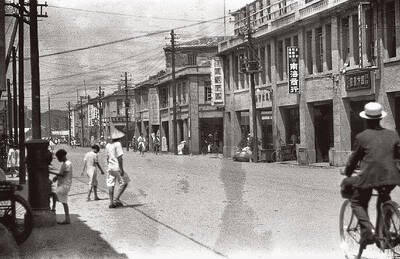
June 1 to June 7 "If all Taiwanese were as afraid of dying as you, then what would happen?” Physician Shih Chiang-nan (施江南) reportedly said this to his wife Chen Chiao-tung (陳焦桐) after she urged him to stop intervening on behalf of Taiwanese soldiers stranded overseas after serving in the Japanese Army during World War II. Shih had clashed with high-ranking officials over the issue, engaged in several heated arguments with Taiwan governor-general Chen Yi (陳儀) and allegedly shouted at general Ko Yuan-fen (柯遠芬), chief of staff of the Taiwan Garrison Command, over

“Taiwan’s Opposition Leader Comes to US With a Message Straight Out of Beijing” read a May 31 headline in the Wall Street Journal. Top US administration officials and members of Congress almost certainly read the WSJ, and if there was a bullet point takeaway that people in Washington should absorb ahead of Chinese Nationalist Party (KMT) Chair Cheng Li-wun’s (鄭麗文) arrival in DC on June 9, that headline is it. The last few columns have discussed this very topic, and the timing is not coincidental. While those top officials likely do not read the Taipei Times, judging by the number


 RSS
RSS