


It's hard to tell if Tongfang Po (
But when you talk to him, it's not hard to tell that Po is the sort of person that invests his whole life into his work.
The Canada-based Taiwanese author spent 12 years researching and writing the 1.5-million-character epic that spans a century and tells the story of three families in Taiwan.
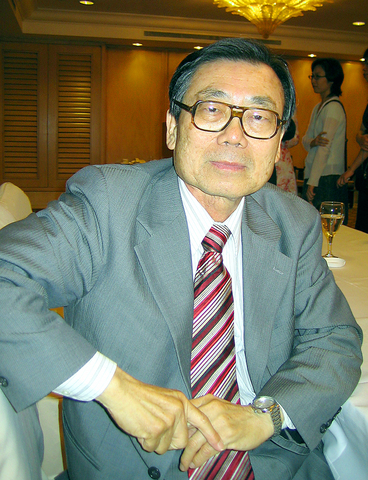
PHOTO: MEREDITH DODGE, TAIPEI TIMES
The central story is based on the life of Dr Cai A-xin (
Po was inspired to write Sand in the Waves when he read Cai's 80-page autobiography in English. A visiting Taiwanese professor at Canada's University of Edmonton, where Po still teaches, first introduced him to Cai's story.
"He wanted to know if anybody would translate [Cai's] biography into Chinese. Many people offered, but in the end they all said they didn't have time," Po said.
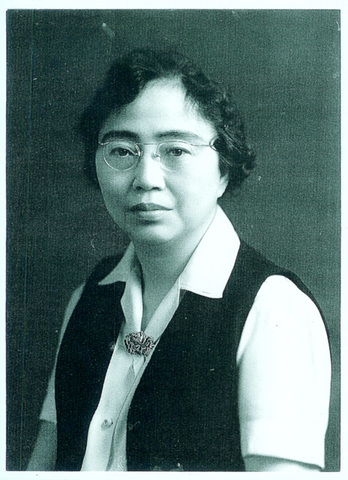
PHOTO COURTESY OF TONGFANG PO
So Po offered to translate the small book into Chinese. (Cai was a Taiwan native, but she received her education in Japanese and English and was not fluent in written Chinese). Little did Po know that this project would take up 12 years of his life.
But he has no regrets.
"The fullest years of my life were the 12 years when I was writing Sand in the Waves. A writer doesn't plan what to write, but rather stumbles upon it."
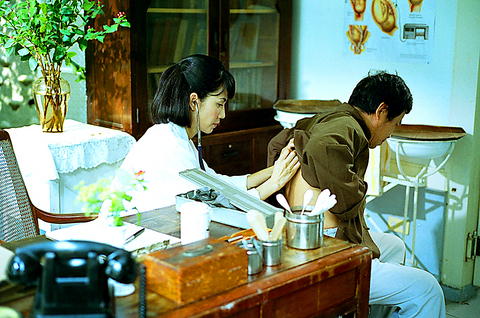
PHOTO COURTESY OF GREEN-APPLE CO
The calling of writer is also something Po stumbled upon. Like the father of modern Chinese literature, Lu Xun (
Despite his PhD in engineering, Po is the first to champion the importance of literature -- especially in the context of Taiwan. Disgusted by a political climate rife with conflict and chaos, Po sees Taiwanese fiction as a means of national salvation.
"Who is president?" he asked. "If you write well, you are
president."
His distaste for politics is a factor in his writing.
Some people make it a point to get involved in politics, but Po feels that those who find politics butting its way uninvited into their lives are the people worth writing about.
"Hers is a very colorful story, and full of irony," Po said of Cai (her name changed to Qiu Ya-xin in his book).
As if being a Taiwanese woman doctor in an era when feminism had scarcely been invented wasn't difficult enough, Cai suffered from the harsh slings and arrows that plagued Taiwan and its people before, during and after World War II.
A Japanese saying about women says, "The nail that sticks up will be hammered down." Cai, who was educated in Japan, completely ignored these words of conventional wisdom.
Born in 1895 in Taipei, Cai's father died when she was five and her mother, unable to support her, sent her to be raised by another family. That family, however, gave up on the homesick youngster after she kept running back to her mother's house.
Cai's mother remarried, and her new husband doted on the child. He paid for Cai to attend elementary school (in Japanese) and then high school (in English) at the Christian Danshui Girls School, founded by Canadian missionary George Leslie Mackay.
Cai excelled in physics, math and English, and after graduation headed for Tokyo Women's Medical University on the recommendation of her Canadian teachers (but against the wishes of her mother, who was afraid people would talk).
Upon returning to Taiwan in 1921 as a doctor, Cai felt that merely practicing medicine was not enough, so she founded Qingxin Hospital and obstetrics school (
When war broke out, Japan started sending Taiwan's doctors and nurses to Southeast Asia to administer to wounded soldiers. As a result, people stopped enrolling in Cai's school.
With the situation in Taiwan as it was, Cai went to the US and then to Canada to further her education in medicine. One day, she visited the Toronto church that had sent Mackay to Taiwan.
"The people [in the church] embraced her as a daughter and were so happy to see her."
Just then, the news of the Japanese attack Pearl Harbor came.
"Cai fainted, and when she came to, nobody was nice to her anymore."
Due to the war in the Pacific, there was no way for Cai to return to either Taiwan or Japan. She found employment as a doctor in an internment camp for ethnic Japanese in Slocan, British Columbia. Then, when it was discovered that she had no Canadian license to practice medicine, she was thrown out of the camp.
When the war ended and Cai could finally go home, she was barely able to get a visa from Taiwan because her work in the internment camp was seen as treason.
Finally, returning to Taiwan in 1946, Cai faced persecution by the KMT as a Taiwanese intellectual. A marriage of convenience to Canadian Raymond Gibson (and the UK citizenship it provided) spared Cai the fate of many intellectuals in 1947's 228 incident, but caused her to be exiled by the ROC government when Britain recognized the PRC in 1950. Cai lived out the rest of her days in Vancouver.
"This story goes to show you how hard it was for women to do business -- three times harder than for a man," said Po, who laments how undervalued women are in traditional Chinese society.
"There's a saying in Chinese that a daughter equals a thief," said Po, "because parents think that a daughter will cost them much and bring them nothing in return."
When asked if things are any better nowadays, Po replied that they are "much better, but it is still very difficult."
Po is doing his part, though. He pointed, grinning, to the picture of him and his wife inside one of newly printed second-edition volumes of Sand in the Waves: "How great is that -- the woman is in front of the man, not behind him."
The TV series of Sand in the Waves airs on Formosa TV (channel 6) every Saturday and Sunday at 10pm.
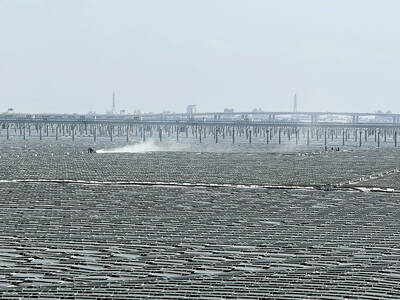
The arithmetic is straightforward and uncomfortable. By the end of 2025, Taiwan had committed itself to a 50-30-20 electricity mix — half natural gas, 30 per cent coal, 20 per cent renewables. The Ministry of Economic Affairs’s (MOEA) own monthly energy reports tell a different story. Natural gas reached 47.8 per cent of generation last year. Coal stood at 35.4 per cent, comfortably above its target ceiling. Renewables came in at 13.1 per cent, well short of the 20 per cent Taipei had pledged a decade earlier. Installed renewable capacity reached roughly half of the 12 gigawatts (GW) the government
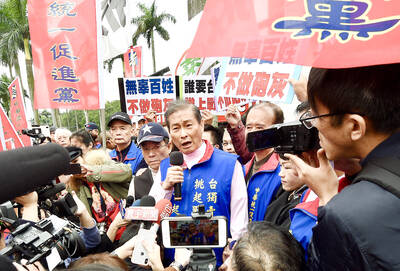
There are shadowy cabals plotting to sell out Taiwan to be annexed by China, by invasion if necessary. Fortunately, they are buffoons. In 2019, former Bamboo Union gangster and founder of the China Unification Promotion Party (CUPP), Chang An-le (張安樂, colorfully known as “White Wolf”), led a protest at the Legislative Yuan against comments made by then-premier Su Tseng-chang (蘇貞昌) that in the event of an attack by China, he would never surrender, but would protect the nation by fighting to the end, even if he only had a broom. Chang had party members bring a wooden casket that they
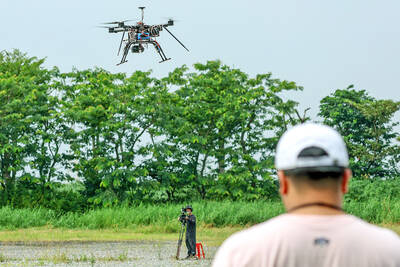
Taiwan’s drone exports are taking off, fuelled by the war in Ukraine, as Taiwanese companies seek a stake in the fast-growing global market for unmanned aerial vehicles (UAV). Low-cost drones used for reconnaissance and strikes are in high demand as governments around the world boost defense spending in the face of intensifying conflicts. A relative new player in the increasingly competitive industry, Taiwan’s pitch is to be an “Asian hub” for the production of UAVs and components free of Chinese materials, or “non-red.” That means its UAVs can be up to three times more expensive than their Chinese competitors, like the world’s biggest
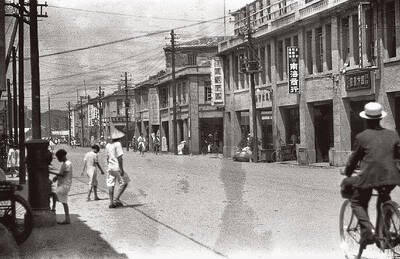
June 1 to June 7 "If all Taiwanese were as afraid of dying as you, then what would happen?” Physician Shih Chiang-nan (施江南) reportedly said this to his wife Chen Chiao-tung (陳焦桐) after she urged him to stop intervening on behalf of Taiwanese soldiers stranded overseas after serving in the Japanese Army during World War II. Shih had clashed with high-ranking officials over the issue, engaged in several heated arguments with Taiwan governor-general Chen Yi (陳儀) and allegedly shouted at general Ko Yuan-fen (柯遠芬), chief of staff of the Taiwan Garrison Command, over


 RSS
RSS