


Stoned Immaculate" is the second collection of Ally Ng, a jewelry designer who has created a buzz by stringing shells, stones, buffed pieces of petrified wood, Thai silver beads and other materials into necklaces, bracelets and earrings.
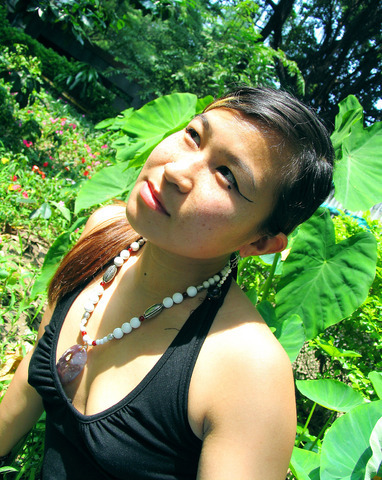
Ng's lively creations steal one's attention and stimulate the imagination. Bright without being gaudy, they draw you in for a longer look. A green stone (above) from South America, about 3cm by 1.5cm, reveals a miniature forest of moss inside and is set off with elliptically shaped jade and engraved silver beads.
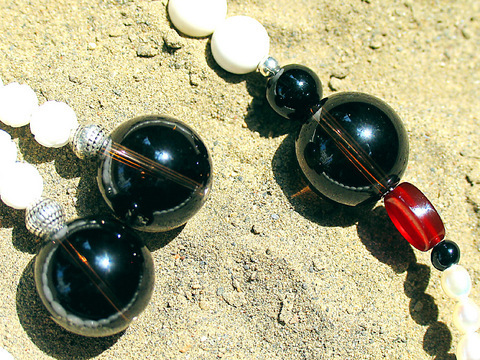
The focus on another necklace is a polished section of petrified wood that has deeply satisfying beige and brown colors, with dark striated veins running through it. Other pieces are made of translucent glass beads, compressed white shells, onyx, garnets, smoky quartzes and freshwater pearls.
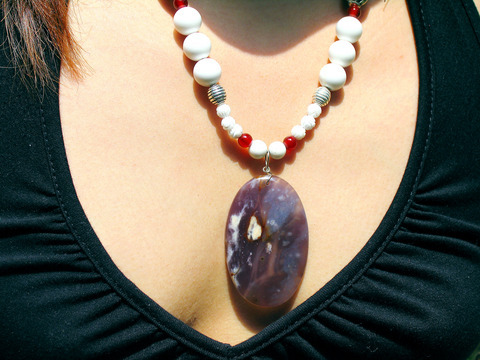
"I have a thing for pearls because they are elegant, natural and beautiful," said the 25-year-old Canadian who has been living in Taiwan for the past two years. "There's a lot of tribal stuff in my work, a bit of an ethnic feel, and it's organic. There's a contemporary impression to some pieces, and others fade to black or are a little bit more antique with a vintage Chinese feel."
Ng's works are recognizable because they bear her imprint, the expressed influences of her life so far. Her mother is from China and her father is from Singapore, so the old Chinese design elements are easy to figure.
But Ng was born and bred in Alberta, and the influences of the Canadian wilderness, its Indian tribes and animals, are also seen in her works. Taiwan's Chinese and Aboriginal influences are also emerging.
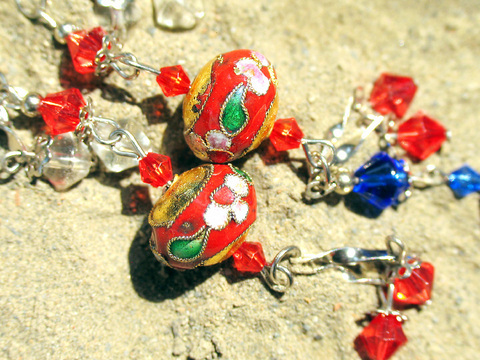
A pair of earrings have a late-Song-early-Ming lacquerware look. There are delicate inlaid flower patterns in green, poppy red and lapis lazuli colors, with metallic gold rims that look almost stitched. A turquoise lacquerware bead is shaped like a miniature, silk pillow. Transparent moonstone beads are threaded with silver clasps. These elements all combine to catch and play with the light. Another pair of earrings are like Chinese red lanterns, with golden tops and ruby red and sapphire blue beads.
It is easy to imagine why someone would want to own something so beautiful, especially when you can wear it and show it off to other people. This is essentially something we have been doing for tens of thousands of years, said Ng, who is considering a course in metalworking to further develop her range of jewelry.
"I came here two years ago on a big adventure; I came here for big bucks. I need money, and I love children! The big bucks are in teaching, and I have an education degree from Canada," she said. "A lot of my friends at home, they've got the car and the mortgage and the payments, and they're just scraping by. I just wanted to do a bit more. I've got more spare time to do things I'm interested in now."
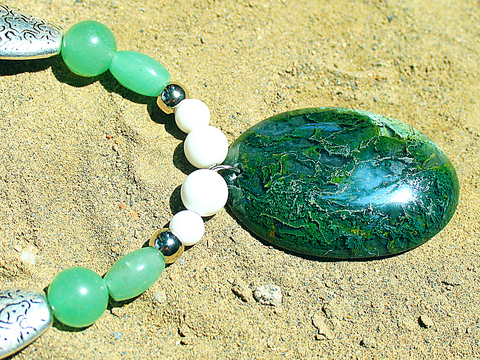
Ng said she was inspired to make her own jewelry by the vendors outside the 24-hour Eslite book store on Dunhua South Road.
"I liked the stuff there so much," she said. "And I just thought I can make this, and that weekend I went to the jade market and just bought all the stuff I thought I would need. I just taught myself through trial and error and eventually got good at it. It came real natural to me. It's just a kind of logic I have. You have to do it step-by-step and know how and when to string on the beads."
On making your own jewelry, she said, "Its lovely and I would encourage everybody to do the same," though she says some people don't have a knack for it or feel more comfortable buying.
PHOTOS: JULES QUARTLY, TAIPEI TIMES
To unveil her collection there will be "big beats, beads and bohemian beauty" at the Living Room on Saturday. The show starts after 10pm with nine models kitted out in Ally Ng jewelry and not much more. There will be a salsa performance from two Polish-born dancers, an acoustic set from Jessie and Tolmer, plus illusionist Issac Hoe and his "amazing" crystal ball. Finally, it's going to get raving with Scotland's Junior Vandenburg spinning Latin American and US house, with DJ 2 from Tainan and the sounds of the black underground until the early hours.
The Living Room is at 3F, 8, Nanjing E Rd, Sec 5,
Taipei (
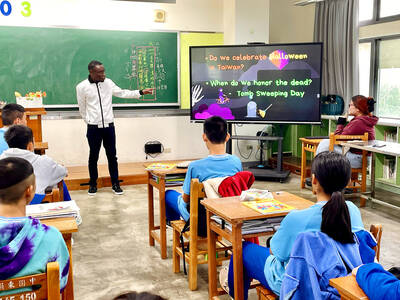
For many people, Bilingual Nation 2030 begins and ends in the classroom. Since the policy was launched in 2018, the debate has centered on students, teachers and the pressure placed on schools. Yet the policy was never solely about English education. The government’s official plan also calls for bilingualization in Taiwan’s government services, laws and regulations, and living environment. The goal is to make Taiwan more inclusive and accessible to international enterprises and talent and better prepared for global economic and trade conditions. After eight years, that grand vision is due for a pulse check. RULES THAT CAN BE READ For Harper Chen (陳虹宇), an adviser
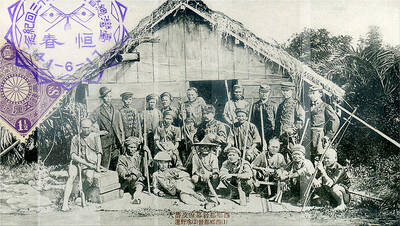
Traditionally, indigenous people in Taiwan’s mountains practice swidden cultivation, or “slash and burn” agriculture, a practice common in human history. According to a 2016 research article in the International Journal of Environmental Sustainability, among the Atayal people, this began with a search for suitable forested slopeland. The trees are burnt for fertilizer and the land cleared of stones. The stones and wood are then piled up to make fences, while both dead and standing trees are retained on the plot. The fences are used to grow climbing crops like squash and beans. The plot itself supports farming for three years.

President William Lai (賴清德) on Nov. 25 last year announced in a Washington Post op-ed that “my government will introduce a historic US$40 billion supplementary defense budget, an investment that underscores our commitment to defending Taiwan’s democracy.” Lai promised “significant new arms acquisitions from the United States” and to “invest in cutting-edge technologies and expand Taiwan’s defense industrial base,” to “bolster deterrence by inserting greater costs and uncertainties into Beijing’s decision-making on the use of force.” Announcing it in the Washington Post was a strategic gamble, both geopolitically and domestically, with Taiwan’s international credibility at stake. But Lai’s message was exactly

May 4 to May 10 It was once said that if you hadn’t performed at the Sapphire Grand Cabaret (藍寶石大歌廳), you couldn’t truly be considered a star. Taking the stage at the legendary Kaohsiung club was more than just a concert. Performers were expected to entertain in every sense, wearing outlandish or revealing costumes and staying quick on their feet as sharp-tongued, over-the-top hosts asked questions and delivered jokes that would be seen as vulgar, even offensive, by today’s standards. Opening in May 1967 during a period of strict political and social control, Sapphire offered a rare outlet for audiences in


 RSS
RSS