


In the 1950s there were three prominent Asian leaders who were also Christians -- Taiwan's Chiang Kai-shek (
But before looking at what it has to say about him, it's important to explain just what is Seth Jacobs' ruling theory.
Jacobs believes that religion played a far greater part in American involvement in Vietnam's affairs than has hitherto been realized. Asia was perceived by the policy-makers on Capitol Hill as an area about to be taken over by atheists, Communists receiving their orders from the godless citadel of Moscow.
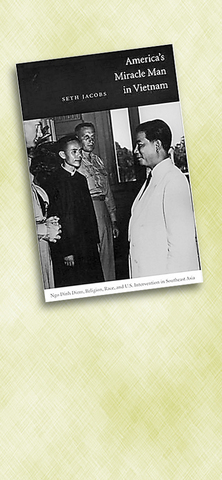
In addition to this, Asians themselves were seen as passive by nature, easily swayed, and for the most part adherents of a religion, Buddhism, that encouraged just such passivity. For them to have Buddhist leaders was therefore not enough.
Christians, stalwarts in their opposition to godlesness in all its forms, were the only individuals capable of leading these mild-mannered people in resisting the monster from the north.
In order to support this analysis, which goes against the Marxist view that the motives for almost everything are economic, Jacobs looks at the diplomatic exchanges between top American statesmen of the 1950s and their representatives in southeast Asia. He also looks at some key books that succeeded in shaping American public opinion about the region in that distant era. All these sources emphasized the religious nature of the struggle.
This might be of merely academic interest were it not for the quite extraordinary parallels with the situation today. In 2005, we see once again a heavy American presence in a distant land with strong religious reasons given for that involvement. Bush, Cheney and Rumsfeld are all reported to hold apocalyptic views about the cosmic battle in which they are involved.
The Axis of Evil, heir to Reagan's Evil Empire, once again puts religion in the front line, and in addition a handful of bizarre books are again credited with lying behind the American administration's thinking.
The similarities don't end here. In the run-up to the war in Vietnam, a coalition, in effect of "the willing," was put together, involving Australia, New Zealand and a handful of other countries, in order to give an international gloss to what was essentially an American commitment.
An anti-atheistic crusade was announced -- a term still thought permissible in those days -- and the entire project was presented under a "slavery versus freedom" flag. The parallels with today, in other words, are terrifyingly exact.
First among the books to rally American opinion in favor of action in Southeast Asia was Tom Dooley's Deliver Us from Evil, described by Jacobs as "a brilliant piece of Cold-War propaganda in which the communist enemy was irredeemably evil and the Americans and their South Vietnamese allies were virtue incarnate."
Dooley was a medic who had witnessed the "Passage to Freedom" exodus of refugees from Communist-held North Vietnam to the south in 1954 and 1955. Atrocity stories were his speciality, notably ones of Catholic priests with nails hammered into their skulls in mocking imitation of Christ's crown of thorns. The suppurating wounds of the Vietnamese refugees themselves, though also graphically described, tended to get second place.
Deliver Us from Evil is described by Jacobs as "racist, lacking in subtlety, and barren of even a sketchy awareness of the complexities of Vietnamese history and politics." Even so, the powerful men in Washington all read it, and so, it seems, did a large proportion of the American people.
The fact that Dooley was gay, and was dishonorably discharged from the US forces, though without the public humiliation usually accompanying such a dismissal, was hushed up. Dooley had become a far too useful propagandist for the publicizing of such facts to be permitted.
Graham Greene's novel The Quiet American was a very different matter. Highly praised in Europe, it was excoriated in the US press. What's more, when it was filmed by Oscar-winning director Joseph Mankiewicz, the book's entire argument was reversed, and the satirized American, Pyle, displayed as a whiter-than-white hero.
The contrast between European and American attitudes is yet another parallel with more recent events.
Another theme of the era in America was fear that the US had become too soft to stand up to the Reds. The book that most compellingly argued that, Lederer and Burdick's The Ugly American, is also subjected to extended analysis in this book.
Vietnamese politics, always complex as they involved differences between north and south, the claims of at least four different religions, as well as the very different attitudes of the French and the Americans (the area's two outside tormentors), are also presented here with unusual clarity. Jacobs' style is notably vivid and forceful, while nowhere evading the convolutions of the actual situation on the ground.
And Vietnam was a famously complicated place. During World War II, for instance, the US had supported Ho Chi Minh, just as it was later in Iraq to support Saddam Hussein. This time it was because Ho was resisting the Japanese, who had been allowed to base troops in Vietnam by the pro-Nazi French government based in Vichy.
Again, Ngo Dinh Diem had to fight off many opponents, the Communists apart, in order to gain full US backing.
He was eventually murdered in November 1963 in Saigon's Chinese "Cholon" district by order of a clutch of conspiring generals. His rule had been characterized by cruelty, despite the hero's monikers bestowed on him by Washington -- the "miracle man of Asia," "Asia's Churchill," and so forth.
As for Chiang Kai-shek, this book has some interesting things to say about why he was so dear to the hearts of Americans, and why, for example, he appeared 10 times on the cover of Time magazine, more than anyone else has ever achieved.
This is a fine book. The author says that studies of how the US became involved in Vietnam have become a virtual academic cottage industry, but he went ahead with this book nonetheless because he believed he had a new angle on those much-discussed and much-disputed events.
Such 1950s figures as President Eisenhower and John Foster Dulles also come in for some new analyses, for the most part pointing out the religious perspective they adopted when viewing foreign affairs.
The inevitable conclusion you reach after reading this fascinating book is that while so much has changed in the world, some things have not changed at all.
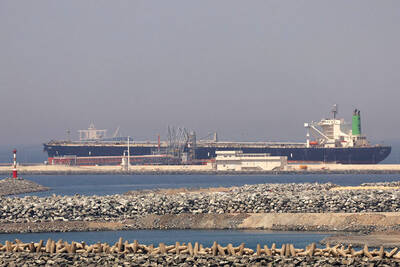
The breakwater stretches out to sea from the sprawling Kaohsiung port in southern Taiwan. Normally, it’s crowded with massive tankers ferrying liquefied natural gas from Qatar to be stored in the bulbous white tanks that dot the shoreline. These are not normal times, though, and not a single shipment from Qatar has docked at the Yongan terminal since early March after the Strait of Hormuz was shuttered. The suspension has provided a realistic preview of a potential Chinese blockade, a move that would throttle an economy anchored by the world’s most advanced and power-hungry semiconductor industry. It is a stark reminder of
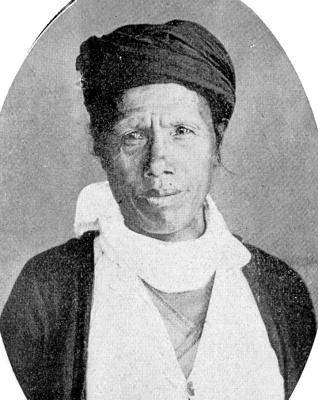
May 11 to May 17 Traversing the southern slopes of the Yushan Range in 1931, Japanese naturalist Tadao Kano knew he was approaching the last swath of Taiwan still beyond colonial control. The “vast, unknown territory,” protected by the “fierce” Bunun headman Dahu Ali, was “filled with an utterly endless jungle that choked the mountains and valleys,” Kano wrote. He noted how the group had “refused to submit to the measures of our authorities and entrenched themselves deep in these mountains … living a free existence spent chasing deer in the morning and seeking serow in the evening,” even describing them as
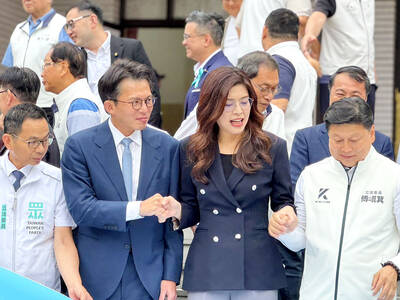
As a different column was being written, the big news dropped that Chinese Nationalist Party (KMT) caucus whip Fu Kun-chi (傅?萁) announced that negotiations within his caucus, with legislative speaker Han Kuo-yu (韓國瑜) of the KMT, party Chair Cheng Li-wun (鄭麗文), Taichung Mayor Lu Shiow-yen (盧秀燕) and Taiwan People’s Party (TPP) Chair Huang Kuo-chang (黃國昌) had produced a compromise special military budget proposal. On Thursday morning, prior to meeting with Cheng over a lunch of beef noodles, Lu reiterated her support for a budget of NT$800 or NT$900 billion — but refused to comment after the meeting. Right after Fu’s

Yesterday, the Democratic Progressive Party (DPP) nominated legislator Puma Shen (沈伯洋) as their Taipei mayoral candidate, the Chinese Nationalist Party (KMT) put their stamp of approval on Wei Ping-cheng (魏平政) as their candidate for Changhua County commissioner and former legislator Tsai Pi-ru (蔡壁如) of the Taiwan People’s Party (TPP) has begun the process to also run in Changhua, though she has not yet been formally nominated. All three news items are bizarre. The DPP has struggled with settling on a Taipei nominee. The only candidate who declared interest was Enoch Wu (吳怡農), but the party seemed determined to nominate anyone


 RSS
RSS