


Taiwan's Directorate General of Budget, Accounting and Statistics released an interesting figure in the middle of this month claiming that, of 12 countries, Taiwan led the world with the most cellular phone subscribers -- 111 per 100 people.
While the report didn't elaborate on the reasons for this seemingly implausible statistic, an informal survey of carriers suggests it has to do with the fact that many small businesses have a cellphone number as their main line to the outside world.
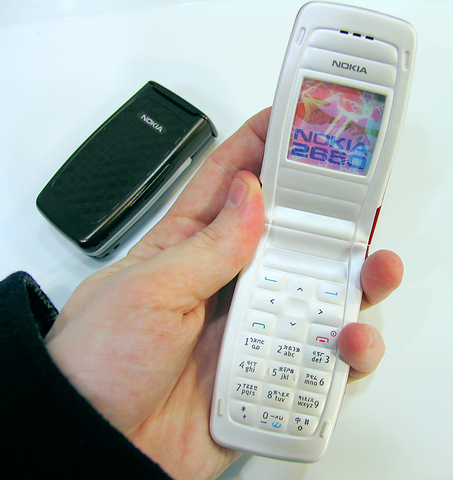
PHOTO: DAVID MOMPHARD, TAIPEI TIMES
"A lot of people have one number that services their business and another number for their personal cellphone," said a representative with the carrier FarEastTone.
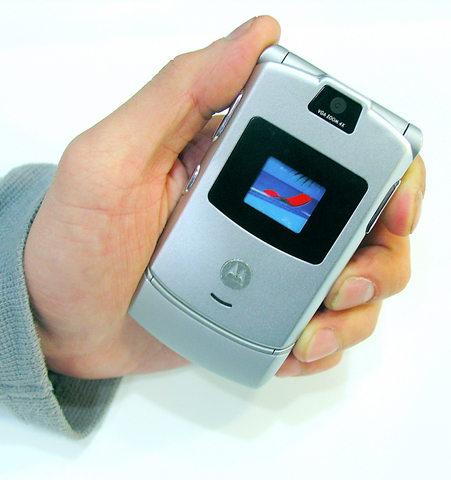
PHOTO: DAVID MOMPHARD, TAIPEI TIMES
And though many cellphones can accommodate two lines, users are just as likely to carry two phones.
Given this, Taiwan might also lead the world in the highest number of phones per capita. Time then to take a look at some of the models clipped to local belts and tucked inside local pants' pockets. Another informal survey, this time of cellphone salespeople, suggests that the models most popular among the populace are Motorola phones.
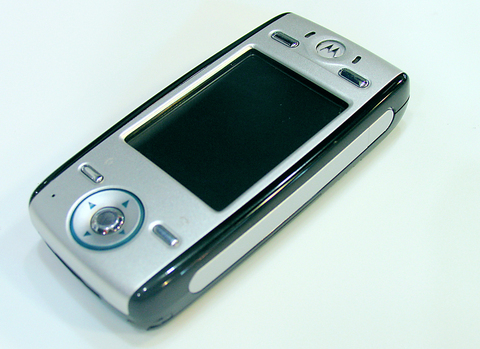
PHOTO: DAVID MOMPHARD, TAIPEI TIMES
This is casual confirmation of the company's own claim to have nearly one half of the cellphone market in Taiwan, and it's not surprising, given the number of Motorola V505s and V600s you see people fidgeting with on buses or at bars.
The phones have been among the best-selling in Taiwan for packing in a lot of functions for business-centric users and a lot of style options for the fashion conscious.
It has to be said the "domino-effect" plays a great part in the success of these and other models. Good word of mouth moves more quickly than any other kind of review. Word of mouth is also helping to sell Motorola's latest model, the V3.
The V3 owes its design aesthetic to laptop computers, specifically Apple' s Macintosh PowerBooks. Encased in anodized aluminum, it looks much like a Mac in miniature, save that it has a screen on the front that displays a photo of whoever is calling as well as other programmable information.
Open it up to reveal its chemically-etched touchpad, which resembles nothing so much as a computer interface found on the starship Enterprise -- Next Generation, of course. Of all the models currently on the market, it probably induces the most envy.
The V3 is also getting lots of good press, not the least of which was a runner-up award from Wallpaper magazine for gadget of the year (It lost out to Apple's iPod Mini).
Design aside, the V3 has a lot of functionality as well and packs in many features you won't find in other cellphones. But at more than NT$20,000, it better. That price tag has likely kept a lot of the model's good word of mouth to a minimum.
Less expensive, albeit less enviable, is Motorola's E680. It's not a "clamshell" phone and lacks the design savvy of the V3, but it packs features on the same footing with the V3. And, as one of the better-selling smart phones in Taiwan, it presents those features more stunningly than any phone in its class.
The first thing you notice about the E680 is its large screen and lack of a type pad, leading you to think, at a glance, that it's some sort of hand-held video game. In fact, it is a hand-held video game and much more; capable of downloading Quicktime movies, carrying a virtual office, and playing MP3s.
In fact, the sound quality of the E680 is comparable to an iPod -- better considering it ships with earphones far superior to Apple's little white ear buds.
The E680 uses a stylus in lieu of a keypad, making it a two-handed phone. It' s also fairly heavy, but at NT$13,000 its price is much lighter than the V3's.
There is another model rapidly networking its way into Taiwan's cool set, according to cellphone sales clerks -- Nokia's 2650. The reason for this are simple. Clamshell-style phones have long been the preferred model among Taiwanese; Nokia has held the number two spot in Taiwan's cellphone market, and the 2650 is among the company's first clamshell offerings.
"I used to sell Motorola exclusively," said Fu Jia-wei (傅家瑋), who owns a west-side cellphone dealership, "but I began selling Nokia shortly after they began offering a line of clamshell phones. The 2650 is probably my best-seller right now."
But the reasons for the phone's popularity are also a matter of simple math: It costs just NT$4,200. At that price, and given Nokia's famed easy-to-use interface, it's destined to be the company's next workhorse model.
One last note about upgrading phones -- or buying a second model to accommodate your business phone line: If you're unhappy with your current phone because of poor reception, remember that this usually has more to do with your carrier than with the phone itself, particularly if your phone is a newer model.
In Taiwan, Chunghwa Telecom has more transmission towers than any other carrier and is often the only service that will give you a signal in remote spots of the island's interior. Climb to the top of Jade Mountain with your Chunghwa Telecom-serviced phone and you'll be popular among fellow travelers who have no reception.
For this reason, picking a good cellular service is actually the first step to picking a good cellphone. A NT$20,000 Motorola V3 with all its fancy functions becomes an anodized aluminum paperweight outside your coverage area.
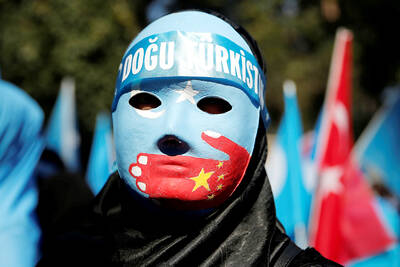
It seems every few days one bumps into one of those “real man” comments in which Taiwan is urged to “face reality” or similar, and “make a deal,” with the speaker implying that soon it will be too late. “Deal” advocates always present themselves as having a superior grip on reality, and the manly ability to make the “hard choice.” Their testosterone-laden language often echoes that of Taiwan sellout advocates. Note that such commentary always specifies a process (“make a deal, work with, make progress”), never the end state of what occupation by a violent authoritarian colonialist state will entail. In
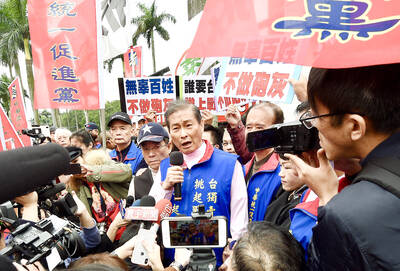
There are shadowy cabals plotting to sell out Taiwan to be annexed by China, by invasion if necessary. Fortunately, they are buffoons. In 2019, former Bamboo Union gangster and founder of the China Unification Promotion Party (CUPP), Chang An-le (張安樂, colorfully known as “White Wolf”), led a protest at the Legislative Yuan against comments made by then-premier Su Tseng-chang (蘇貞昌) that in the event of an attack by China, he would never surrender, but would protect the nation by fighting to the end, even if he only had a broom. Chang had party members bring a wooden casket that they
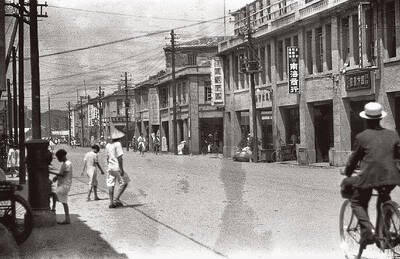
June 1 to June 7 "If all Taiwanese were as afraid of dying as you, then what would happen?” Physician Shih Chiang-nan (施江南) reportedly said this to his wife Chen Chiao-tung (陳焦桐) after she urged him to stop intervening on behalf of Taiwanese soldiers stranded overseas after serving in the Japanese Army during World War II. Shih had clashed with high-ranking officials over the issue, engaged in several heated arguments with Taiwan governor-general Chen Yi (陳儀) and allegedly shouted at general Ko Yuan-fen (柯遠芬), chief of staff of the Taiwan Garrison Command, over
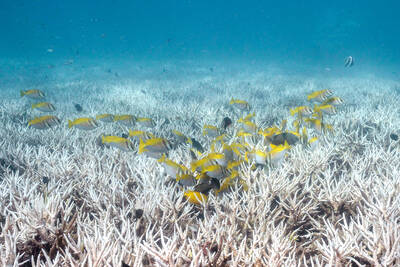
Food prices have often played a major role in Taiwan’s history. The first major wave of migration from China occurred in 1628. A moderate drought, the Ming Dynasty maritime ban that prohibited fishing and trading (intended to reduce piracy) and a temporary tax, conspired to exhaust local resources, leading to famine in Fujian Province. The famed pirate and trader Zheng Zhilong (鄭芝龍), scooped up starving people from Fujian and transported them across the Taiwan Strait, where they settled under the Dutch. Two factors enabled Zheng. First, by 1624 he had settlements around today’s Beigang (北港) in Yunlin County with a small


 RSS
RSS