

Neihu's Miramar Shopping Complex boasts the world's second largest Ferris wheel. At 110m at its highest point and 70m in diameter, the wheel takes about 17 minutes to do a single circuit. With a capacity of 288 passengers -- six people to each of its 48 cars -- it has already proven to be a crowd puller despite being open for just over two months. If you fancy a ride, avoid the weekends unless you have the patience of a saint. You'll have to wait at least an hour in line then and on public holidays. Still, it's an experience not to be missed, and in fact the amusement park rivaled Taipei 101 as the best place to see in the new year.
From the Ferris wheel during the day, it's possible to see the National Palace Museum, all the way out in Waishuangxi and the Taipei 101 building to the south. Probably the best time of day to enjoy the view, however, is dusk, when the sky turns into a deep blue backdrop to the scenery spread out before you.
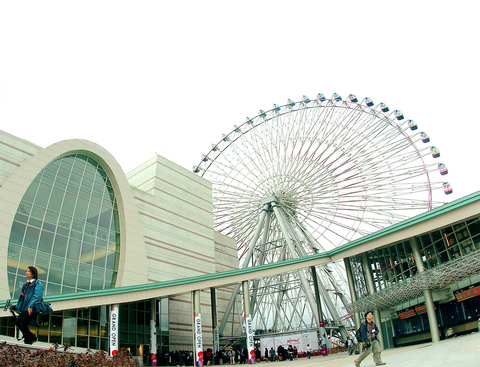
PHOTO: TAIPEI TIMES
That's not to say, of course, that the night view is without its charms. In fact, you'll be kicking yourself if you forget to take your camera along to capture the city lights from on high.
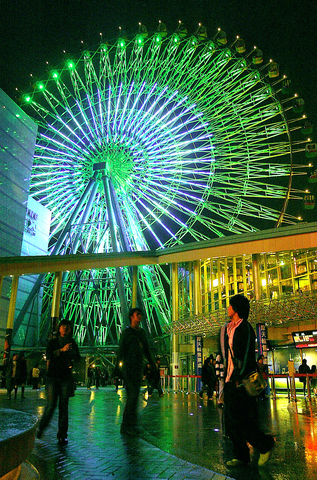
The wheel itself is lit up with the help of 624 sets of neon lights. There is also a spectacular light show, orchestrated by a Japanese designer, in three parts: the "Melody from Heaven," the "Colors on the Ground" and the "Dances of the Winds."
If you want a ride in the world's biggest Ferris wheel, you'll have have to fork out money for a trip to London, home of the 135m-tall London Eye on the South Bank of the Thames. The Eye, one of the public projects built to commemorate the turn of the millennium four years ago, is still one of the city's biggest tourist draws.
The London Eye takes around 30 minutes to make one circuit, and has 60 passenger cars, each the size of a small bus, holding 20 people. The rides need to be booked in advance, and each car comes with a guide to make sure you don't miss anything. From the top you can see the whole of London, with a view of up to 40km away. In the distance you will even be able to see Windsor Castle.
Sunset is a great time to go, if you want to see London's architecture at its best, lit up against the darkening sky.
A trip to Japan will also get you to a Ferris wheel of note. Tokyo's Odaiba district, known as Palette Town, has what is perhaps the most romantic Ferris wheel to be found anywhere on the globe. It has provided the backdrop to many movie scenes, including scenes in Bayside Shakedown with Yuji Oda. It's also become one of the top choices for Romeos who plan to pop the big question.
Odaiba is Tokyo's newest commercial area, sitting on the side of Tokyo Bay with Rainbow Bridge and the Ferris wheel as landmarks. At 115m tall, the wheel takes 15 minutes to go around once. The scene from the top at nightfall, looking over Tokyo Bay and Shinjuku, with the Rainbow Bridge lit up in seven colors, is simply unforgettable.
Back in Taiwan, there are still a number of choices open to you if you want that Ferris wheel experience nearer to home. In Taichung there is the 28m-high wheel in Yamay Resort's Discovery World which, despite its modest dimensions, offers a comprehensive view of the entire park, as well as the Houli district beyond. It takes a quarter of an hour to make the journey round once, so you can have a while to relax.
On the east coast there is the Hualien Ocean Park, with a Ferris wheel standing 33m high, 68m above sea level. On one side you can get a glimpse of the lush green hills that are the foothills of the central mountain, and on the other you can see the deep blue of the Pacific Ocean.
Janfusun Fancy World in Yunlin used to lay claim to owning the largest Ferris wheel in Taiwan before the one in the Miramar Complex came along. It's still nothing to sniff at: at 30 storeys high, its highest point is 88m. Fifty passenger cars each fit eight people, making its total capacity 400 people, and it takes 15 minutes to go around once.
-- Translated by Paul Cooper
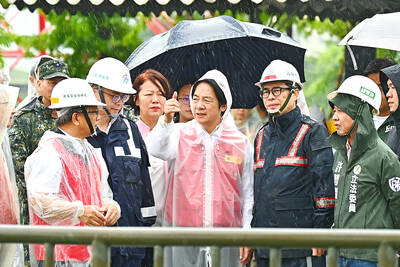
The flooding in Kaohsiung after the recent torrential rains has become an issue for mayoral candidates of both major parties. Chinese Nationalist Party (KMT) Kaohsiung mayoral candidate Ko Chih-en (柯志恩) brought in hydraulic-engineering professor Lee Hong-yuan (李鴻源), who called for comprehensive flood control measures on the Dianbao Creek (典寶溪), according to local media. Ko attacked the Democratic Progressive Party (DPP) for being behind on flood control measures, but as the city administration observed, there are many weaknesses in how the government can mitigate extreme rainfall. Nor is the river entirely under the management of the city. The low-lying Dianbao River
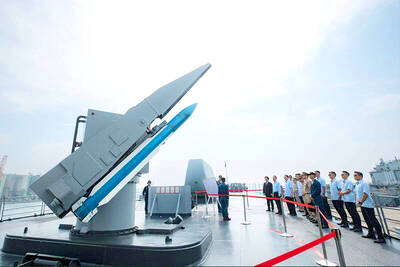
Bloomberg reported earlier this week that the People’s Republic of China (PRC) “has developed hypersonic glide vehicles that can launch air-to-air weapons, an advancement meant to threaten high-value targets such as command-and-control aircraft thousands of miles away.” Military Watch magazine reported in 2024 on one of the designs: “the vehicle is designed with payload options that include electronic warfare and reconnaissance suites, as well as bombs and both supersonic and subsonic drones that detach from the vehicle during flight,” while noting that the PRC is a world leader in such technologies. The threat from the PRC is not only increasing,
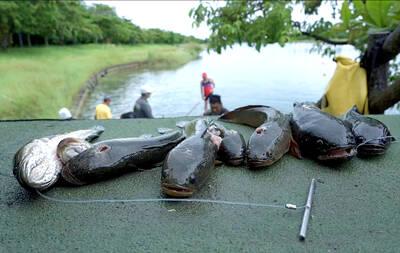
Taiwan’s rivers are significantly cleaner today than they were a few decades ago. The country’s rapid industrialization left many waterways polluted by untreated factory discharge, domestic sewage and runoff from livestock operations. Since the 1990s, expansion of municipal sewerage infrastructure and stricter enforcement of environmental standards have turned the situation around. However, freshwater ecosystems now face a very different threat — one that’s far less obvious to people living nearby. “Southern Taiwan — Tainan, Kaohsiung and Pingtung — is facing a particularly critical crisis regarding freshwater biological invasions,” says Lin Yen-ting (林晏廷), an assistant professor in the Master’s Program in Biodiversity

Wait. President Volodymyr Zelenskyy, Ukraine’s war chief, holding a puppy? Yes, and it’s no accident. In a collision of dog lovers, sports and ongoing war with Russia, the Ukrainian president was seen on video Tuesday as never before — cuddling and cooing over a floppy, 3-month-old American pit bull terrier, handed to him by US former boxer Terence Crawford. The cute and fluffy scene in Zelenskyy’s office in Kyiv was the latest volley in a deadly serious battle of visuals that runs in parallel to Ukraine’s fight against Russia’s brutal four-year invasion. Crawford, a longtime supporter of Ukraine and a devotee of the


 RSS
RSS