


When National Symphony Orchestra director Chien Wen-pin (簡文彬) planned his current series aimed at introducing Taiwanese audiences to a range of operatic masterpieces, he chose Amadeus Mozart's three mature Italian operas, Richard Wagner's Tristan, Guiseppe Verdi's Falstaff (due in April), Hector Berlioz's Damnation of Faust, Giacomo Puccini's Tosca and Giovanni Bellini's Norma. The first five of these are unquestionably supreme masterpieces. Tosca, the opening production, was presumably selected to attract audiences to the project as a whole, and Damnation (less than a master work) to represent French opera. Why, then, Norma? Surely because it is the greatest of all operas written in the early 19th century bel canto style.
The opera is set 2,000 years ago in Gaul (France) under Roman occupation. Opposition to the Romans is led by the Druids, and Norma is the chief Druid priestess. But she has compromised her position by falling in love with the Roman commander, Pollione, and together they have had two children. She consequently instructs the Druids, led by her father Oroveso, to hold back from active resistance until such time as the Romans' power declines naturally, as inevitably it will. This is what she urges in her prayer to the moon, Casta Diva ("chaste goddess"), the opera's most famous aria.
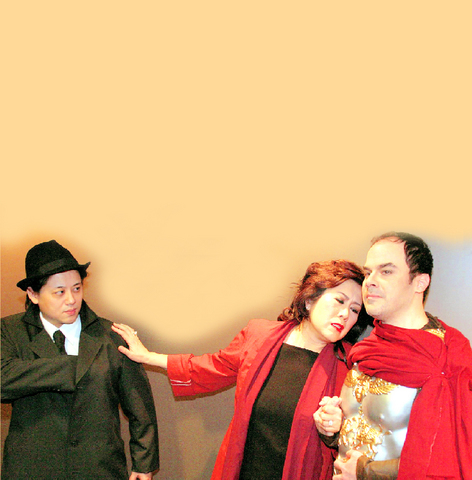
Unfortunately for Norma, Pollione has recently turned his attentions to a younger Druid priestess, Adalgisa. When she comes to confess her profane love to Norma, and the identity of her lover is revealed, the two women are launched into a series of duets (together with Pollione, who inappropriately shows up at the same moment). Feminine solidarity prevails, however, and Norma repairs to the temple to see to her duties, possibly including tending the sacred mistletoe.
But when she hears that Pollione is planning to return to Rome with Adalgisa in tow, she strikes the temple gong and calls for all-out war against the Romans. Pollione, meanwhile, is caught red-handed among the priestesses in the sacred precinct and is brought on stage as a prisoner. Here is the human sacrifice Druid ritual requires, and it's Norma herself who has to see to the arrangements. But who was his female accomplice? All is set for Norma to denounce Adalgisa and get her double revenge. Instead, however, she names herself. She arranges for her father to look after her children, Pollione rediscovers her essential nobility and selflessness, and together the two reunited lovers walk away to be burnt alive on the sacrificial pyre.
Norma is a notoriously difficult soprano role, but also a glorious one. Often, productions have been mounted simply to display the talents of a supremely gifted diva. Adalgisa, a mezzo-soprano part, also contains wonderful music. Pollione too, though placed low for the traditional tenor voice, is a rewarding role for a strong singer. And all bel canto opera is singer-oriented. Both story and orchestral accompaniment are essentially subservient to the display singing that is both beautiful and technically demanding.
So what can we expect from tonight's Taipei line-up? Chu Tai-li (
We can be sure, too, of a strong Pollione in Steven Harrison, one of the finest young American tenors. He was last heard in Taipei as Pinkerton in Chien Chiu-sen's evocative and never-to-be-forgotten Madame Butterfly of 2001, and in La Boheme the previous year.
Adalgisa is Hsu Yi-lin (
In opting to use directors with non-operatic backgrounds, Chien is on less secure ground. The results to date have been on the whole successes, but every director represents a new start. It wasn't possible to assess Li Huan-Hsiung's staging of Norma in rehearsals earlier this week, and we'll have to wait until tonight to judge how far it succeeds. What can be said is that it's relatively minimalist, with the orchestra at the back (as is now becoming customary in this series), with a sloping central area into which is set a revolving wooden oval. Costumes will be in a mixture of ancient European and modern 1950s styles.
"Norma is a great work and it's the chance of a lifetime to be directing it," Li said. "I see its themes as essentially timeless, hence my costume choices. And the revolving area, echoing the moon symbol, implies that the characters lying or standing on it don't really know what's happening to them, or even in which era they're living.
Musically, this Norma is likely to prove strong. Orchestral musicians sometimes dislike playing the work because their role can be viewed as nominal, in
contrast to the oceanic orchestration later required by Wagner and Richard Strauss. But in rehearsal the NSO's playing was notably powerful and assured, and testimony to Bellini's dramatic understanding, whatever his detractors might assert to the contrary.
Chien Wen-pin's conducting, too, will be relatively forthright, with few concessions to the self-styled Bellini purists who insist on a porcelain-like femininity in the playing. This is surely right -- Bellini's style generally is much more varied and dramatic than the silk-smooth, elegiac melodies for which he is most famous might suggest.
Norma, though it remained in the repertory in Italy since its 1831 opening, fell into disuse elsewhere until Maria Callas insisted on singing it for her debuts in London, Chicago and New York in the early 1950s. Since then, along with the other bel canto masterpieces, it has often been revived.
Some highlights of the work are Norma's extraordinarily demanding aria "Ah! bello a me ritorna," following immediately after "Casta diva" and calling on her faithless lover to return to her; Norma, Pollione and Adalgisa's superb trio in 9-8 time "Oh! Di qual sei tu vittima" (dismissed by the ignorant as "lilting"); the duet between Adalgisa and Norma beginning "Deh! Con te, li prendi," with its extraordinary coda "Si, fino all ore estreme" marking the restoration of their friendship; and Norma's appeal to her reluctant father to care for her sons after her death, "Deh! non volerli vittime," with its mournful string accompaniment. There's much else, and the more you listen to Norma the more there is to enjoy. Indeed, its closing section of has been called one of the finest half hours in all opera.
"They think me an ogre in all that concerns the musical school of Italy," wrote Wagner in 1837, "and they set me in especial opposition to Bellini. No, no, a thousand times no! Bellini is one of my favorites, because his music is all heart, deeply felt, closely and intimately bound up with the words."
Verdi, too, loved Bellini, and said that the melody we hear just before, and again during and after, the opera's first aria (by Oroveso) was "more beautiful and heavenly" than anything he had ever written himself. Bellini himself repeats it as if reluctant to say goodbye to it. But Norma is awash with fine melodies, including those of several of the choruses, wrongly dismissed by the opera's detractors as mere accompaniments to lines of Druids processing on and off stage and cursing the Romans.
One final point needs to be made -- the plot has clear parallels with the current situation in Iraq. An occupying force facing a religious opposition working from sacred territories into which the occupying armies are denied access -- this again familiar situation is central Norma. It may not be a parallel utilized in this production, but it's one many in the audience will be unable to overlook nonetheless.
Event Information:
What: Bellini's Norma by the National
Symphony Orchestra
Where: Taipei's National Concert Hall
When: Tonight at 7.30pm, Sunday, Jan. 2 at 2.30pm, and Tuesday, Jan. 4 at 7.30pm.
Tickets: NT$400 to NT$2,000. For further information call (02) 3393 9888.

By global standards, the traffic congestion that afflicts Taiwan’s urban areas isn’t horrific. But nor is it something the country can be proud of. According to TomTom, a Dutch developer of location and navigation technologies, last year Taiwan was the sixth most congested country in Asia. Of the 492 towns and cities included in its rankings last year, Taipei was the 74th most congested. Taoyuan ranked 105th, while Hsinchu County (121st), Taichung (142nd), Tainan (173rd), New Taipei City (227th), Kaohsiung (241st) and Keelung (302nd) also featured on the list. Four Japanese cities have slower traffic than Taipei. (Seoul, which has some

In our discussions of tourism in Taiwan we often criticize the government’s addiction to promoting food and shopping, while ignoring Taiwan’s underdeveloped trekking and adventure travel opportunities. This discussion, however, is decidedly land-focused. When was the last time a port entered into it? Last week I encountered journalist and travel writer Cameron Dueck, who had sailed to Taiwan in 2023-24, and was full of tales. Like everyone who visits, he and his partner Fiona Ching loved our island nation and had nothing but wonderful experiences on land. But he had little positive to say about the way Taiwan has organized its

Michael slides a sequin glove over the pop star’s tarnished legacy, shrouding Michael Jackson’s complications with a conventional biopic that, if you cover your ears, sounds great. Antoine Fuqua’s movie is sanctioned by Jackson’s estate and its producers include the estate’s executors. So it is, by its nature, a narrow, authorized perspective on Jackson. The film ends before the flood of allegations of sexual abuse of children, or Jackson’s own acknowledgment of sleeping alongside kids. Jackson and his estate have long maintained his innocence. In his only criminal trial, in 2005, Jackson was acquitted. Michael doesn’t even subtly nod to these facts.
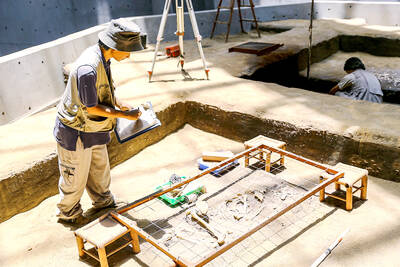
Writing of the finds at the ancient iron-working site of Shihsanhang (十 三行) in New Taipei City’s Bali District (八里), archaeologist Tsang Cheng-hwa (臧振華) of the Academia Sinica’s Institute of History and Philology observes: “One bronze bowl gilded with gold, together with copper coins and fragments of Tang and Song ceramics, were also found. These provide evidence for early contact between Taiwan aborigines and Chinese.” The Shihsanhang Web site from the Ministry of Culture says of the finds: “They were evidence that the residents of the area had a close trading relation with Chinese civilians, as the coins can be


 RSS
RSS