


The Taiwan International Documentary Festival came to a close yesterday, awarding Maria Ramos of the Netherlands the prize for best film in the international competition for her film Justice.
Ramos won the top honors and NT$300,000 at the ceremony in Taipei for her film that looks at the lives of people moving through Brazil's court system.
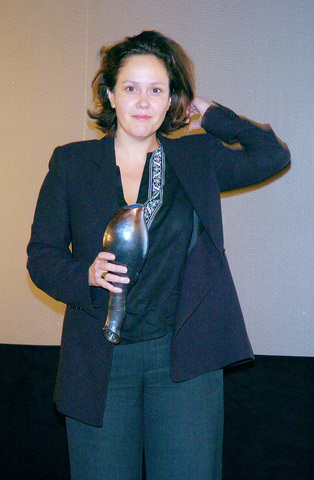
PHOTO: TAIPEI TIMES
The Jury Award in the international competition went to Eyal Sivan and Audrey Maurion of Germany and France, respectively, for their film I Love You All, a piece about a high-ranking officer in East Germany's secret police force who reflects on two decades of service to the state just as the regime is collapsing.
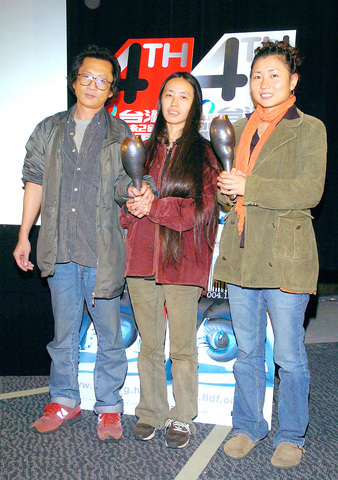
PHOTO: TAIPEI TIMES
Sharing the festival's Exceptional Film Prize in the international competition were Jerusalem My Love by Jeppe Rode and Flashback by Latvian director Herz Frank.
Winning NT$200,000 and the top prize in the Asian film competition category was Tunska Pansittivorakul for his humorous film titled Happy Berry, which follows a group of young people in Bangkok who open a fashion store and struggle to achieve their unlikely dreams of stardom.
In the Taiwan documentary competition, Farewell, 1999 (再會吧 1999) by Wu Ching-yi (吳靜怡) shared top honors with Let it Be (無米樂) by Cres Yen (顏蘭權). The Jury Award in the category was given to Lee Jong-wang (李中旺) for Radio Mihu (部落之音), a film about an Aboriginal village's slow reconstruction following the 921 earthquake in 1999.
The Exceptional Film Prize in the category was awarded to Michelle Chu (
This year's biennial received over 1,000 submissions, a two-fold increase over the number of submissions to the last festival. Over 120 films were selected for screening, with 70 films taking part in the festival's three compeitition categories.
The festival opened and closed with works by documentary and film luminaries Naomi Kawase, Werner Herzog and Agnes Varda.
The winners of the Fourth Taiwan
International Documentary Festival :
International Competition:
First Prize: Justice, by Maria Ramos
Jury Award: I Love You All by Eyal Sivan and Audrey Maurion
Exceptional Film Prize: Jerusalem My Love by Jeppe Rode and Flashback by Herz Frank
Asian Vision Competition:
First Prize: Happy Berry by Tunska Pansittivorakul
Image-Taiwan Award:
First Prize: Farewell, 1999 (
Jury Award: Radio Mihu (
Exceptional Film Prize: Someone Else's Shinjuku East (

Taiwan’s English education system is being pulled apart by three opposing forces. Bilingual Nation 2030 pulls students toward English and global communication. Artificial Intelligence (AI) readiness pulls them toward digital judgment, verification and AI-mediated work. But Taiwan’s old exam culture pulls them back toward memorization, grammar drills, timed reading and correct answers. If the education system keeps using old exams to define success, it risks producing graduates who are neither genuinely bilingual nor genuinely AI-ready, but trained for tasks machines can already perform. The first force is Bilingual Nation 2030. Launched in 2018, the policy aimed to “help Taiwan’s workforce connect
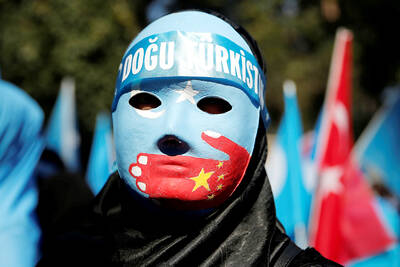
It seems every few days one bumps into one of those “real man” comments in which Taiwan is urged to “face reality” or similar, and “make a deal,” with the speaker implying that soon it will be too late. “Deal” advocates always present themselves as having a superior grip on reality, and the manly ability to make the “hard choice.” Their testosterone-laden language often echoes that of Taiwan sellout advocates. Note that such commentary always specifies a process (“make a deal, work with, make progress”), never the end state of what occupation by a violent authoritarian colonialist state will entail. In

There are shadowy cabals plotting to sell out Taiwan to be annexed by China, by invasion if necessary. Fortunately, they are buffoons. In 2019, former Bamboo Union gangster and founder of the China Unification Promotion Party (CUPP), Chang An-le (張安樂, colorfully known as “White Wolf”), led a protest at the Legislative Yuan against comments made by then-premier Su Tseng-chang (蘇貞昌) that in the event of an attack by China, he would never surrender, but would protect the nation by fighting to the end, even if he only had a broom. Chang had party members bring a wooden casket that they
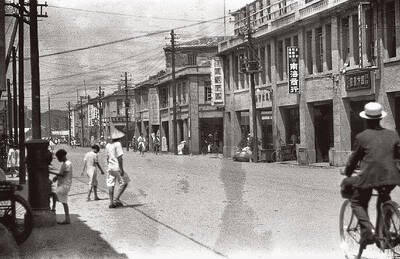
June 1 to June 7 "If all Taiwanese were as afraid of dying as you, then what would happen?” Physician Shih Chiang-nan (施江南) reportedly said this to his wife Chen Chiao-tung (陳焦桐) after she urged him to stop intervening on behalf of Taiwanese soldiers stranded overseas after serving in the Japanese Army during World War II. Shih had clashed with high-ranking officials over the issue, engaged in several heated arguments with Taiwan governor-general Chen Yi (陳儀) and allegedly shouted at general Ko Yuan-fen (柯遠芬), chief of staff of the Taiwan Garrison Command, over


 RSS
RSS