


There was a rare winter typhoon blowing across the island, but it did not stop the 41st Golden Horse Awards from running in Taichung yesterday on what turned out to be a sunny day.
Kekexili (
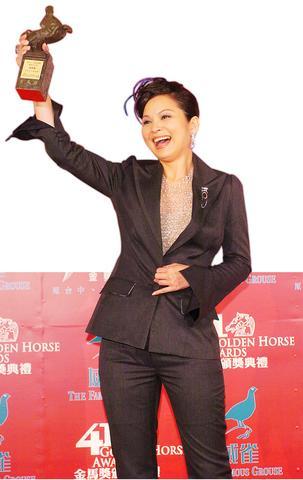
PHOTO: AGENCIES
The Best Actress award went to Yang Kuei-mei (
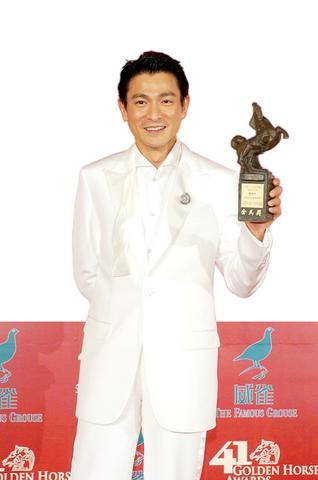
PHOTO: AGENCIES
The outcome of the tight battle between Andy Lau (
The Best Supporting Actor was awarded to Daniel Wu (
Bai Ling (
There was also keen competition in the Best Director award category but Johnnie To (
The joint-winner of Best New Performer was Tony Yang Yu-Nin (
The Lifetime Achievement award this year went to 87-year-old A Pi Po (
Earlier in the day some 2,000 Taichung residents gathered on the sides of the red carpet -- the so-called "Star Boulevard" -- to star gaze. Hundreds of others crammed by the window of the nearby McDonald's, trying to spot the stars.
Celebrities included John Woo (
Despite the low attendance by actual nominees, the number of films competing for the Golden Horse Awards reached a new high this year. A total of 110 films (including shorts) were nominated.
"Lack of innovation in styles and stories is Hong Kong's weakness this year," one jury member said, but agreed that it was the movie powerhouse in the region.
In Taiwan, where humanism is still the leading filmmaking trend among directors, there are new talents and new spirits among the younger generation, said the jury member, who did not want to be named.
Her opinion was backed up by the number of prizes that went to Hong Kong films and actors, as well as local award-winning Taiwanese films such as Formula 17 (十七歲的天空) and Splendid Float (艷光四射歌舞團).
The latter picked up the Best Make Up and Costume Design award for Jean Chen (
Winners at the 41st Golden Horse Awards
*Best Picture
Kekexili (可可西里)
*Best Short Film
The Magical Washing Machine (神奇洗衣機)
*Best Documentary
Chronicle of Sea Nan-Fan-Ao (南方澳海洋紀事)
*Best Animation
McDull, Prince de la Bun (麥兜, 菠蘿油王子)
*Best Director
Johnnie To (杜琪鋒) for Breaking News (大事件)
*Best Leading Actor
Andy Lau (劉德華)
*Best Leading Actress
Yang Kuei-mei (楊貴媚)
*Best Supporting Actor
Daniel Wu (吳彥祖)
*Best Supporting Actress
Bai Ling (白靈)
*Best New Performer
Hong Hao-Xuan (洪顥瑄) and Tony Yang Yu-Nin (楊佑寧)
*Best Original Screenplay
Yau Nai Hoi (游乃海), Yip Tin Shing (葉天成), Au Kin Yee (歐健兒) for Throw Down (柔道龍虎榜)
*Best Screenplay Adaptation
Lin Cheng Sheng (林正盛) for The Moon Also Rises (月光下我記得)
*Best Cinematography
Cao Yu (曹郁) for Kekexili (可可西里)
*Best Visual Effects
Victor Wong (黃宏達), Brian Ho (何志輝) for New Police Story (新警察故事)
*Best Art Direction
William Chang (張叔平) and Yau Wai Ming (邱偉明) for 2046
*Best Make Up and Costume Design
Jean Chen (陳淑津), Lai Wei-Joung (賴蔚炅) for Splendid Float (艷光四射歌舞團)
*Best Action Choreography
Lee Chung Chi (李志忠), Jo Stunt Team (成家班) for New Police Story (新警察故事)
*Best Original Film Score
Shigeru Umebayashi, Peer Raben for 2046
*Best Original Film Song
Splendid Float (艷光四射歌舞團)
*Best Editing
David Richardson for Breaking News (大事件)
*Best Sound Effects
Cao Yuan-Fong (曹源峰) for The Passage (經過)

Taiwan’s English education system is being pulled apart by three opposing forces. Bilingual Nation 2030 pulls students toward English and global communication. Artificial Intelligence (AI) readiness pulls them toward digital judgment, verification and AI-mediated work. But Taiwan’s old exam culture pulls them back toward memorization, grammar drills, timed reading and correct answers. If the education system keeps using old exams to define success, it risks producing graduates who are neither genuinely bilingual nor genuinely AI-ready, but trained for tasks machines can already perform. The first force is Bilingual Nation 2030. Launched in 2018, the policy aimed to “help Taiwan’s workforce connect

It seems every few days one bumps into one of those “real man” comments in which Taiwan is urged to “face reality” or similar, and “make a deal,” with the speaker implying that soon it will be too late. “Deal” advocates always present themselves as having a superior grip on reality, and the manly ability to make the “hard choice.” Their testosterone-laden language often echoes that of Taiwan sellout advocates. Note that such commentary always specifies a process (“make a deal, work with, make progress”), never the end state of what occupation by a violent authoritarian colonialist state will entail. In
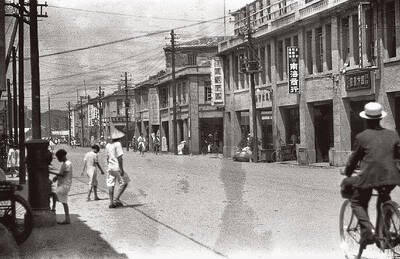
June 1 to June 7 "If all Taiwanese were as afraid of dying as you, then what would happen?” Physician Shih Chiang-nan (施江南) reportedly said this to his wife Chen Chiao-tung (陳焦桐) after she urged him to stop intervening on behalf of Taiwanese soldiers stranded overseas after serving in the Japanese Army during World War II. Shih had clashed with high-ranking officials over the issue, engaged in several heated arguments with Taiwan governor-general Chen Yi (陳儀) and allegedly shouted at general Ko Yuan-fen (柯遠芬), chief of staff of the Taiwan Garrison Command, over

“Taiwan’s Opposition Leader Comes to US With a Message Straight Out of Beijing” read a May 31 headline in the Wall Street Journal. Top US administration officials and members of Congress almost certainly read the WSJ, and if there was a bullet point takeaway that people in Washington should absorb ahead of Chinese Nationalist Party (KMT) Chair Cheng Li-wun’s (鄭麗文) arrival in DC on June 9, that headline is it. The last few columns have discussed this very topic, and the timing is not coincidental. While those top officials likely do not read the Taipei Times, judging by the number


 RSS
RSS